Archive for the ‘Uncategorized’ category

Seduced by Term Limits

June 13, 2010

The primary election last week in California didn’t excite me much. Jerry Brown was nominated by the Democrats for governor. (Him again. Can’t that guy just retire?) Super-rich businesswoman Meg Whitman got the Republican nomination for governor, and a good thing too! She’d be right to be annoyed if she had not even won the primary after spending $71 million on her campaign. I wonder how much that election cost her per vote. Surely someone’s done the math.

There was one question on the ballot that forced me to look deep inside myself for guidance. It was a local proposition that asked if San Diego County Supervisors should be subject to term limits. Somehow, the local supervisors had evaded those political statutes of limitations… quite a feat in Southern California. I think they dodged term limits for so long because few people knew who they were and nobody was quite sure what a county supervisor did.

But last week, reality caught up with the county supes. Labor unions, who dislike the all-GOP county board, had managed to qualify a ballot question on term limits and voters overwhelmingly passed it. Two terms will now be the maximum for a county supervisor. I too voted for Proposition B.

This is curious because I had always considered myself an opponent of term limits. It didn’t make sense to me to kick people out of their jobs just when they’d gotten good at them. It’s also ironic that voters, who seem to love voting for incumbents, love term limits as well. “Please stop me before I vote for that guy again!!”

Let’s look at the example of the San Diego County Supervisors. Today, they are they same five old duffers who’ve been in office ever since I moved to San Diego in 1998. We must like them if they keep getting elected. Even so, we just don’t trust our lazy, uninspired selves to decide whether they should stay in office. 

So if term limits make me mock and sneer like this, why did I vote for Prop B?  

It’s partly because I’ve been stained by the local political culture. Term limits are how we do things here, so why fight it? But I have also come to believe that incumbency is a force that’s too powerful when political apathy is such a problem. Yes, voters should have the attention span and civic spirit to know who their county supervisor is and whether he/she deserves to be fired. But that’s just not the case. Apathy allows politicians who work below the radar to remain in office by cultivating the right contacts and getting all their buddies to make it to the polls on election day.

The result, in San Diego, is a board of supervisors whose members are all old, white and Republican in a county that’s becoming more and more diverse, racially and politically. That has caused me to buy into the arguments for term limits. Yes, we need fresh blood. Yes, we need to give challengers a better chance to hold office.

I have not entirely transformed my views on the subject. I’ll still vote for any proposition that would extend term limits for local and state offices. Why limit politicians to two four-year terms? Three or four terms make more sense to me. But all things considered, I decided Prop B deserved a yes vote.

Mind you, this proposition will have no real effect on the current stable of San Diego County Supervisors. Prop B is not retroactive, so our county supes won’t be termed out for another 8 years, by which time they’ll be  more concerned about using their Medicare benefits than running for office.

Death of a Short Sale

June 13, 2010

I didn’t used to believe that the short sale was the bane of the housing market. But that was before I tried to buy a house from a guy who was underwater on his mortgage. In February, I made an offer on a house in Kensington (that’s a neighborhood in San Diego). I offered less than the owner paid for the house but I figured something would be better than nothing for him and/or his lender.

But last week, after four months of watching the seller and his money lenders fight over small change, my wife and I gave up. We withdrew our offer to buy the house and moved on.

In the case of this short sale, the homeowner had seen his business go south and he defaulted on two mortgages. The primary lender was trying to get the second one to accept less than 20 percent on a loan that lender #2  foolishly gave the homeowner at the height of the housing boom. Lender #2 was determined to get as much as possible and eventually hired a collection agency to go after the homeowner. Going after him meant going after as much money as they could get out of me as I sought to buy the house.

Eventually, the short sale negotiator (the only person we were dealing with who actually had a name) was fired and there was nobody left to talk to. I assume the next step will be foreclosure. I just wish it had happened before I wasted four months trying to buy the house.

The housing market has had its gyrations and I guess we all hope we can hold onto our homes long enough to see the ups and downs come and go. We also hope there will be more ups than downs. The California housing market has been kind to me. I was lucky enough to move to San Diego and buy in the late 90’s when housing prices were still reasonable and were headed upwards. That’s why I’ve got enough equity to try to buy something bigger.

Had I moved here eight years later I would have been one of those unlucky folks who went underwater.

Home ownership is a peculiarly American thing. I was speaking to a friend about a family she knows in Germany. The family has lived in the same rental apartment for two generations. Why does that seem strange to us? In the U.S., ownership is the thing that gives us a proper relationship with an inanimate object like as a house. Without ownership, your house will belong to somebody else and will therefore be alienated from you and not be a real home… or so we think.

I believe in the American dream because home ownership is a great way of saving money. If you are forced to invest in a house every month eventually you’ll have something to show for it. Someday the house may actually be paid for. But prices don’t go up forever, even in California. If you do become submerged, mortgage-wise, hopefully your house will still be your home and still be a good place to live.

An Irresistible Force

June 2, 2010

I get up out of bed after a sleepless hour because I forgot to take a pill. I reach into the top drawer of my dresser in the dark. I can’t tell by touch which bottle contains the Vicodin but I know it by the sound. The oblong tablets make a heavy, hollow sound when they rattle inside the bottle. I take one and slip back under the covers.

My daily use of painkillers is one of the ways my life has changed since I suffered a serious accident, riding my bike to work more than three years ago.  I thought the effects of my traumatic brain injury would be temporary. It would just be a matter of months before everything would be back to normal. But that day never came and the chronic pain, which came with the nerve damage, may be with me for the rest of my life.

The pain is a reminder of what can happen when you live in idealistic disharmony with the world around you. My ideal was to not be dependent upon a car, even though I was living in southern California.  I would prove to others, or at least myself, that I didn’t have to fully embrace a lifestyle that was physically unhealthy and bad for the environment. My feelings have changed since then.

I remember being at a meeting of transportation planners. A guy from Brazil said that the only people in his city who didn’t drive cars were poor people, who couldn’t afford cars, and “nerds like me.” It makes sense to ride a bike to work if that’s all you’ve got. But I’ve decided it doesn’t make sense if you’ve got the option of being surrounded by a car’s steel envelope. I’ve got that option, and now it’s the one I use.

Today we see pictures of an oil rig in the Gulf of Mexico endlessly pouring its deadly muck into waters that had been full of life. Yet the awesome power of fossil fuels has brought us comfort and convenience we simply will not give up until we’re forced to. The lives we lead, in our energy-rich environment, seem like an irresistible force.

It’s a force that’s given us too much faith in technology. We believe the masters of invention will find a way to turn sunlight or wind into engines that are every bit as powerful, dependable and efficient as coal and petroleum. Maybe we should hope for that, but I wouldn’t bet on it. There’s more than one way to stick your head in the sand, when it comes to the subject of global warming. One is to deny it exists. The other is to deny that our lives must change to stop it from happening.

Someday we will be forced to change our lives but I’ll be driving my car to work in the meantime because, I’ve decided, I can’t change the world by myself. I miss the superior feeling of a having a small carbon footprint, but the pain in my legs makes me think there are more important things.

The Changing American Race

May 18, 2010

Last Friday I was on the deck of the decommissioned USS Midway in San Diego bay to see about 90 sailors and marines take the oath of citizenship. The Navy Band Southwest performed and four sailors paraded the colors. The ceremony was rich in military tradition but it was also a picture of a changing America that lots of people find unsettling.

Yes, there were one or two immigrants from Europe who became Americans that day. One from Italy and one from Poland, as I recall. But the vast majority were Asian, African, Latin American or Caribbean. It was hard to find a white person among them.

There are still an awful lot of white people in this country and they still dominate positions of power and status. But that’s a reality that may not last long. So I wonder, what does it mean to be white and what will become of me and my fellow Caucasians?

If you watch Fox News you see white people acting pissed off as they spend great energy blasting the Obama administration. Barack Obama is a bit like those sailors on the Midway. He’s scary because he is a powerful symbol of our country’s future, which is non-white and culturally complex.

But the feelings of the angry conservative white man don’t tell the whole story. For instance, post-election polls show that if white people had been the only ones voting in California in 2008 we would have approved gay marriage. A Canadian comic and blogger named Christian Lander wrote a book called “Stuff White People Like.” His list of stuff includes Barack Obama, coffee, The New Yorker Magazine, bike shops and recycling. Clearly, he’s talking about highly educated white people living in blue states or large urban areas.

The American notion of being “white” is a strange one, though it’s not unheard of outside our borders. I assume our national whiteness was created to define who was a free person back in the days of American slavery. There were white and black people and not much in between.

The burgeoning ethnic variations now living together inside the U.S. have made it harder and harder to determine who or what is really white. Speaking of the old world, if white people begin in Europe where do they end? An Iranian acquaintance once told me that the Persian people where white but everyone to the south or east were not. He imagined a kind of Persian line of demarcation. Compare that worldview to the small town in the Midwest, where I grew up, which was so ethnically northern European that Italians were people of color.

The great white race will become something quite different, worldwide, as birth rates in Europe decline and the developing world industrializes. We’ll become fewer and less powerful. Ultimately, this could mean Fox News gets fewer viewers or it could mean countries like the Netherlands become more religious and more conservative.

Race is one in a long list of things humans have used to decide who are members of their tribe. Once it was family, then it was language, then religion, then nation, then skin color. Sadly, in the U.S. today, social class may be the most powerful determinant of our caste. It largely determines where you live, what car you drive and how you vote.

As long as I live, I’m sure skin color will continue to determine a part of what we are. That will change with time. But tribal instincts are too strongly ingrained in us to ever let us look at every human being and conclude that person is just “one of us.”

Loving a child who’s not quite normal

May 10, 2010

Parents want to have normal children. It’s not because they won’t love them if they’re not normal. It’s not because they don’t understand that the world needs people who aren’t normal. It’s because they want their kids to be happy, and children who behave like their peers seem so happy.

I didn’t realize this before I became a dad. But now I have two kids, and my son is not quite normal. Did I imagine he’d want to play sports? Did I imagine he’d enjoy rough-housing with his friends? I guess so.

My son has Asperger’s Syndrome. He has an attention deficit and he has something called a coding problem, which means it takes him a long time to do any school work that involves writing.

But he does his homework because he’s conscientious. He’s gentle and he’s more polite than he needs to be. He’s very smart. When he takes standardized tests he blows them away. I just wish he were normal.

When I attend his school’s outdoor assembly I see him standing in line with his eyes cast down while his classmates are joking around. During recess he wanders around by himself holding a stick. Sometimes he gazes at the ground to study the movement of ants. There was a time when he collected junk all over the school yard and brought it home. Bottle caps. Pieces of paper. Lots of hair bands that girls had left behind.

His little sister is five years old. She likes pink. She likes Barbie. She is also my son’s very best friend. They’ve played together joyfully ever since she was an infant. It frightens me to think how lonely my son would be if we hadn’t had his sister.

Kids with Asperger’s Syndrome are mildly autistic and they have a hard time relating to other people. They’re awkward and nerdy. My son’s deficit in social skills has made him an outsider since he was in preschool. He now attends a Catholic school which is a den of rules, and I love that. Rules protect vulnerable kids like my son. They give him a structure he can relate to and they shield him from bullies.

Yet there are rules my son finds very difficult. They are the rules of human interaction that say you have to read subtle expressions and gradations of attitude and emotion. At the age of ten he understands jokes and sarcasm. But he doesn’t look people in the eye when he talks and he doesn’t understand that you’ve got to stop talking when people aren’t listening to you anymore.

We all see the world from inside a human skin so none of us see it perfectly. My son may be more normal than I think he is and I may not be what my parents expected. All of us rely on some mercy and indulgence and maybe those things will bring my son friends aside from his little sister. I know he’s happy at home and he may be perfectly happy wandering the playground with his stick as other kids swirl around him in pairs and foursomes.

I can’t make my son normal and I will confess I don’t want to because he’s what I want. As for his happiness… I can wish for it, but it is something he’ll eventually have to find on his own.

Justice Delayed

April 29, 2010

The San Diego County District Attorney is not verbally gifted. But Bonnie Dumanis was on the mark when she called the death penalty in California a “hollow promise.” She said this after accepting a plea agreement with a man named John Gardner who raped and murdered two teenage girls. The killer traded his plea for a sentence of life in prison without parole.

California has, by far, the largest number of people on death row of any state. We have 702 condemned prisoners. And since the state’s death penalty was reinstated in 1976, only thirteen people have been executed. A story in the San Diego Union Tribune pointed out that during that time a total of 86 death-row inmates have died, most from natural causes, a few by suicide and even fewer by execution.

If justice delayed is justice denied, then hundreds of families of murder victims in California are being denied justice. In fact, the families who saw the killers of their sons, daughters, spouses and parents die of natural causes in San Quentin will be denied justice forever. This was clearly one of the reasons why the parents of those teenage girls agreed that the DA should settle for life in prison without parole. The death penalty in California is a cruel joke, and victims’ families are the butt of it.

I don’t know why death penalty proceedings for California convicts take decades. All condemned prisoners are guaranteed appeals to the State Supreme Court and federal district court. The California Commission on the Fair Administration of Justice wrote in a report that there’s a serious shortage of state public defenders to handle death penalty appeals.

But I suspect the real problem is that the people who run things in this state are not comfortable with the death penalty. Their reticence has led to endless delays in the process. The death penalty is a broken apparatus they don’t want to fix.

There are a lot of good reasons  to be uncomfortable with the death penalty. Allowing the state to kill, on behalf of its residents, is morally questionable. Also, our justice system is not perfect. That means the death penalty will inevitably lead to innocent people being put to death.

If we agree on nothing else we must agree that California’s death penalty is a costly farce and it has to change. I see two ways. The first option, and certainly the most practical, is to simply get rid of it. Make life in prison without parole the ultimate punishment, reserved for the most horrible crimes.

The second possibility is to keep the death penalty, but require a higher burden of proof to sentence a person to death. Proof beyond a reasonable doubt isn’t enough. The state should have to prove its case beyond a shadow of doubt before it can kill a convict. That would dramatically reduce the number of people we put on death row, and it would make the appellate system less cumbersome and less necessary.

Dropping crimes rates and the passing of time have caused public opinion in California to turn against the death penalty, even though a majority still support it. I hope we will evolve into a society that no longer needs or wants the death penalty. But if society demands it, society should also demand a death penalty that protects the rights of the condemned and the rights of victims’ families, who deserve a prompt exercise of justice.

Stolen Skateboard, Still Under Investigation

April 26, 2010

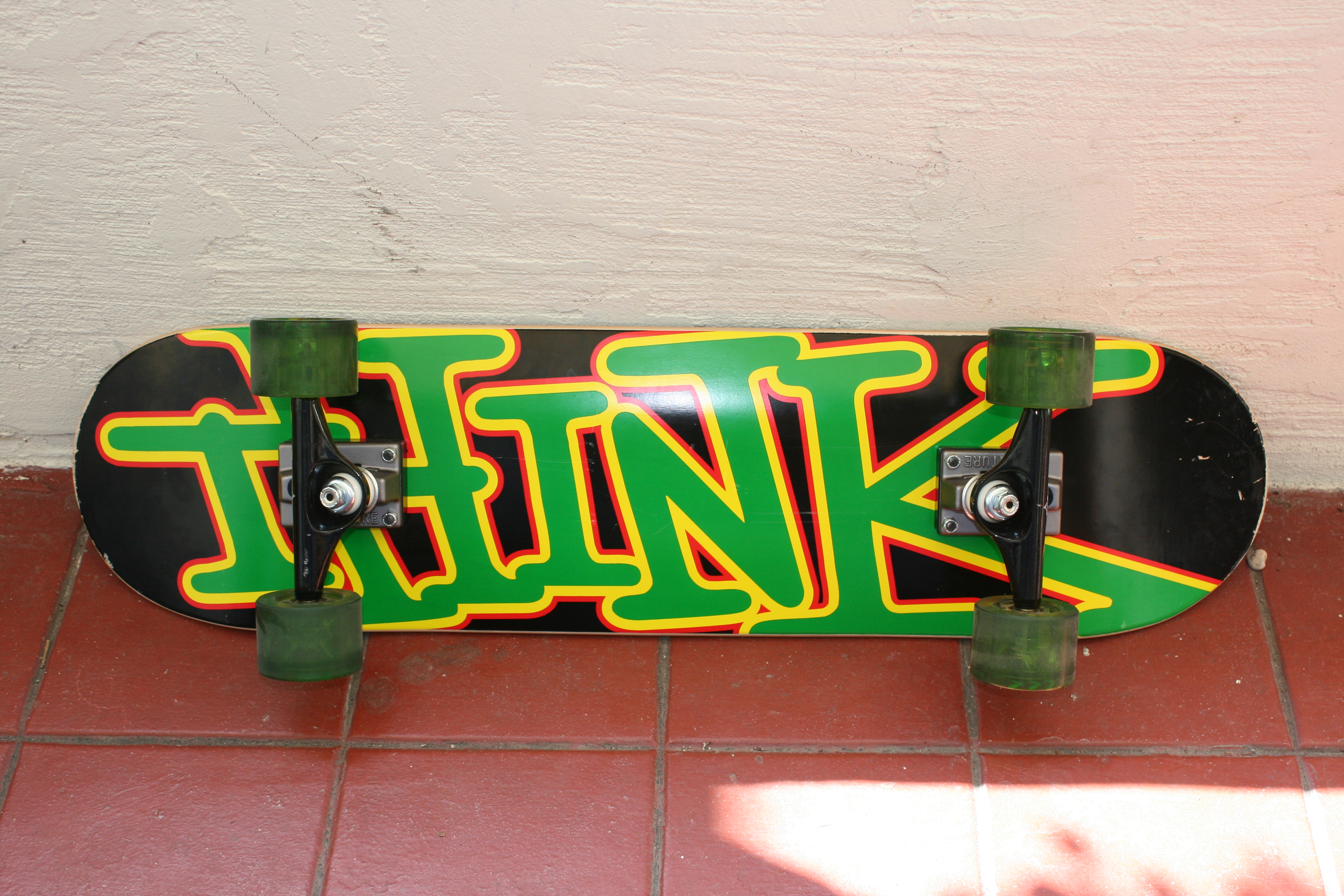
A couple of weeks ago I wrote about crime in my neighborhood, illustrated by the theft of a skateboard from my front yard. My effort to mobilize the community and find the offender has, so far, failed.

But this photograph could make a difference. This is not the stolen skateboard. But it’s a duplicate they made for me at Sk8box. So if you see this skateboard anywhere near Normal Heights, and it’s not being used by my family, let me know. Remember the green wheels.

Covering FLOTUS

April 19, 2010

Last Thursday afternoon I was at work, writing a story about the San Diego appearance of FLOTUS (First Lady Of The United States). More than one female co-worker approached me wearing a large grin and asking me what it was like to get close to Michelle Obama.

Unfortunately press availability is not something you can expect from FLOTUS, to say nothing of POTUS. Mrs. Obama visited an urban garden in City Heights, a low-income part of San Diego, as part of her campaign against childhood obesity. Beforehand the news media were told 1)The First Lady would take no questions 2)We would need to be there at least an hour and a half before her scheduled speech 3)Our recording or photographic equipment would need to arrive four hours before her scheduled speech.

After I got there, I also learned that reporters and photographers would be confined to what you might call a press corral. This was a roped-off section of the viewing area where we had to remain until FLOTUS stepped into a black SUV and made her escape. It was a day of following Secret Service instructions and standing for a long time in the sun, waiting to hear a speech that was okay but not memorable.

Still, lots of people (Democrats probably) assumed I’d be stoked about seeing Michelle Obama.

I’m not old enough to remember John and Jackie Kennedy, though my parents claim I attended a Kennedy speech wearing diapers. The Kennedy family celebrity must have been similar to the Obama aura. Like the Kennedys, the Obamas are young, charismatic and — most importantly — attractive. The man who introduced Michelle Obama Thursday hit it on the head when he called her a rock star.

The Obamas live in a different country, or course. The Kennedys worked for a public that was more forgiving, more trusting of its leaders and more united, having yet to experience the cultural rifts that would arrive in the late sixties.  Besides, the Kennedys were white and therefore insulated from the strong, complex emotions that race engenders in the USA.

So it was ironic that Jack Kennedy was murdered in Dallas. After showering him with a love that allowed us to ignore his faults and his many extramarital affairs, America took the form of Lee Harvey Oswald and shot him dead. And that is why I was confined to a press corral last Thursday covering FLOTUS.

I did actually get fairly close to Michelle Obama. She walked past our corral as she waved to supporters and headed toward her black SUV. She was accompanied by a white Secret Service agent who wore sun glasses, had a shaven head and looked like he was 6 feet 10 inches tall. Michelle Obama looked pretty and warm-hearted, just like she does on TV.

That’s what I’ll tell people who ask me what it was like to be in the presence of FLOTUS. She looks like she does on television. So if you love Michelle Obama, just keep loving her. And we can still hope the Obamas will become a first family like the Kennedys in the sense that most people seem to like them.

Cloistered nuns. Cloistered workers.

April 13, 2010

There’s a Carmelite Monastery on the edge of a cliff above Mission Valley just a quarter-mile from my house. I’ve walked there many times with family and friends to see their coveted gardens. You used to be able to ring a doorbell to summon one of the sisters, who would remain unseen while she gave you a key by putting it on a shelf in a rotating chamber. The key would circle to your side of the wall and you could let yourself into the church

Shutting yourself off from the view of the world may seem strange to the spiritually undeveloped. But it’s not so different from what we’re all doing in our tech-based, motorized world.

The car, the phone, the TV and their many high-tech cousins have made us very much like cloistered ascetics who forswear life in society. We meet each other less and less as the car has replaced the trolley and the wide-screen TV has begun to replace the movie theater. An Internet connection may be our only social link to the outside world. Being a blogger, I guess I shouldn’t talk.

Consider telecommuters.  They may be a good thing since they don’t waste space and they don’t waste gas. Look a little closer and you realize telecommuting depends on two modern trends: The large house and the small family. It’s hard to imagine how you could concentrate on a work project if you don’t have a room of your own and are constantly interrupted by the noisy demands of children.

We’ve got all these home PCs and I supposed they should be put to constructive use. But heading off to work is one of the few remaining activities that gets us out of the house. What happens when even that goes away?

Will we devolve into some other creature as our social skills atrophy? Will we develop over-sized butts and long fingers and learn to reproduce without any sexual contact? At least the nuns don’t have to be concerned about that. My advice is we need to get out more. Sunny San Diego is an absurd place to develop Vitamin D deficiency.

Pulitzer Prize next door

April 13, 2010

I saw my neighbor Chuck outside his house yesterday and I asked him how much you get for winning the Pulitzer Prize. It was a good question because his wife, Rae, just won the prize for her book of poetry called Versed. He said it was only ten thousand dollars and it seemed to me you should get more than that. But I told him to pass along congratulations anyway.

Rae lives there. I just didn’t happen to see her out in the yard that day.

Poetry is something most of us don’t read, and I’m embarrassed to say I haven’t read any of Rae’s poetry. Now, I’m sure I will. I did know that Rae fought a battle with cancer. But she dug herself out of that hole and wrote about it in Versed.

Chuck told me Rae heard about the Pulitzer one day before her birthday. It was quite a birthday present though there’s no better present than life and she got that one too. Here’s to Rae and her good fortune.