Archive for the ‘Uncategorized’ category

A Call from Mike

October 3, 2011

I was enclosed in my dark work chamber, where the glow from a computer screen illuminates your face, when I spotted the email from Mike Aguirre.

Mike had been the San Diego City Attorney who used to make  life miserable for more staid and practical city politicians. Accusations of misconduct and corruption flowed from his office nonstop for a four-year term that ended when a judge, with a bad toupee, challenged him in the election and sent Mike packing.

Mike Aguirre

People in city hall regularly quoted the Werner Herzog film, calling him “Aguirre, the Wrath of God.” I don’t think Mike would differ with that.

Anyway, the email that came out of nowhere referred to a three-year-old interview I did with Jan Goldsmith (of the bad toupee) during the election that lead to Aguirre’s ouster. The note came attached to a soundfile of the interview, which Mike said displayed a brazen contradiction to Goldsmith’s actions as City Attorney.

I responded by writing that I didn’t know what he was talking about, but he could feel free to give me a call to explain. My phone rang five minutes later.

It was a typical phone discussion with Aguirre, who spoke at blazing speed, going off on ten different tangents. As in the past, he managed to say at least a couple of things that rang true, and which gave me the journalistic notion there may be a good story to tell.

Much of our talk revolved around reform of the heavily indebted San Diego pension system. As City Attorney, Aguirre filed a lawsuit that argued the level of benefits approved for city workers were illegal… a lawsuit Goldsmith would eventually drop.

Mike told me he never wanted to kill the municipal pension and turn it into a 401K, as appears to the way local politics are taking us. He just wanted to make the pension legal and affordable: A strong point, but one that depends on believing that he was right about the law, which he may not have been.

I finally put down the phone, half an hour after it rang. I thought about Aguirre’s manic personality, the disorder it brought to city hall and the belief some people had that he wasn’t right in the head. I remember a reporter friend telling me a story of chatting with Aguirre at a press event, when he told her and another reporter that he had to take some time off for an MRI.

“Of your head?” asked one of them. Aguirre laughed as he said no, it was for his knee. But at least one member of the press assumed Mike needed to have his head examined.

To this I would say that while some people are mentally ill, some people are just plain crazy. Mike Aguirre is a member of the second group. His behavior in office showed a person who was motorized by an outsized ego and a strong faith in his beliefs. His success as a private attorney shows he’s a person who is very mentally on the ball, despite his problems getting along with people.

But his failure as a politician shows he just wasn’t cut out for that game. Mike was an elected official who managed to antagonize every powerful group. That left him with nobody to dance with, aside from a handful of crabby anti-establishment types who didn’t really like anyone.

Once Aguirre earned the dislike of both the unions AND the Republican party, it was clear he did not have a career in politics.

I remember being at a dinner party with Mike Aguirre when I didn’t know he was also going to be invited. This was a night when the host told us he once had sex with Marilyn Monroe. A real conversation stopper, that.

I was crabby that night as I had to share a table with Aguirre, who then had a very confrontational relationship with my station (imagine that). But I wish I had lightened up a bit. Aguirre is back where he should be, practicing law. I’ll keep taking his calls if he’ll take mine.

PS: The SD Union Tribune DID do an Aguirre story today. Here it is.

Eggplant Interlude

October 2, 2011


Curse IKEA

September 26, 2011

German black bread gave me a profound horizon-broadening experience when I was a high-school kid who traveled to Hamburg, Germany as an exchange student more than 30 years ago.

A native of the land of Wonder Bread, I was astounded by the rich flavor and texture of black bread. I could actually see the whole grains and feel them on my tongue.

On weekends my host family, the Bestgens, would eat dinner as the noon meal, while evening meals would be “Abend Brot.”  That meant the offerings were slices of black bread, condiments and toppings you’d use to make open-face sandwiches, which you ate with a knife and fork.

I ate black bread with mayo and sausage or tomatoes. Or we’d cover the bread with schmaltz, which was basically pork fat.

And this is why I’m pissed off at IKEA.

For several  years, I’ve shopped at the international warehouse of home-improvement and hit their grocery section on the way out to buy Finax Swedish Rye Bread. Whole-grain rye bread is black bread. It’s the same stuff.

In fact, the Finax product is black bread in a box! Just add water, put it in a baking pan and do an hour in the oven. Then you have fresh bread like the kind I used to eat in Hamburg.

But this is now. IKEA has discontinued the product. Why? Because they didn’t sell enough. It got too expensive. It got unfashionable. Whatever.

A week ago my wife went to the San Diego IKEA and spoke to an actual Swede with blond braids who was working in the grocery nook, and she said a customer had just arrived and had bought out the remaining stock of Finax rye.

Anyway… black bread was a treasured part of my upbringing and it was great when I could bake it fresh, myself, after buying the batter at IKEA. But no longer.

I’m sure the Swedish retailing giant is not so sentimental about selling their rye bread dough. But they may regret their decision to discontinue it when I write an angry letter to complain.


UPDATE!!!

Since writing this screed more than a year ago IKEA has replaced its black bread product with a new brand. I describe this development in a new blog post. I feel it’s necessary to mention it here, since so many people who read Cul-De-Sac read this post. Maybe the headline is so riveting it draws people. I don’t know. But do know that this is old news. -TF


My New Bike

September 23, 2011

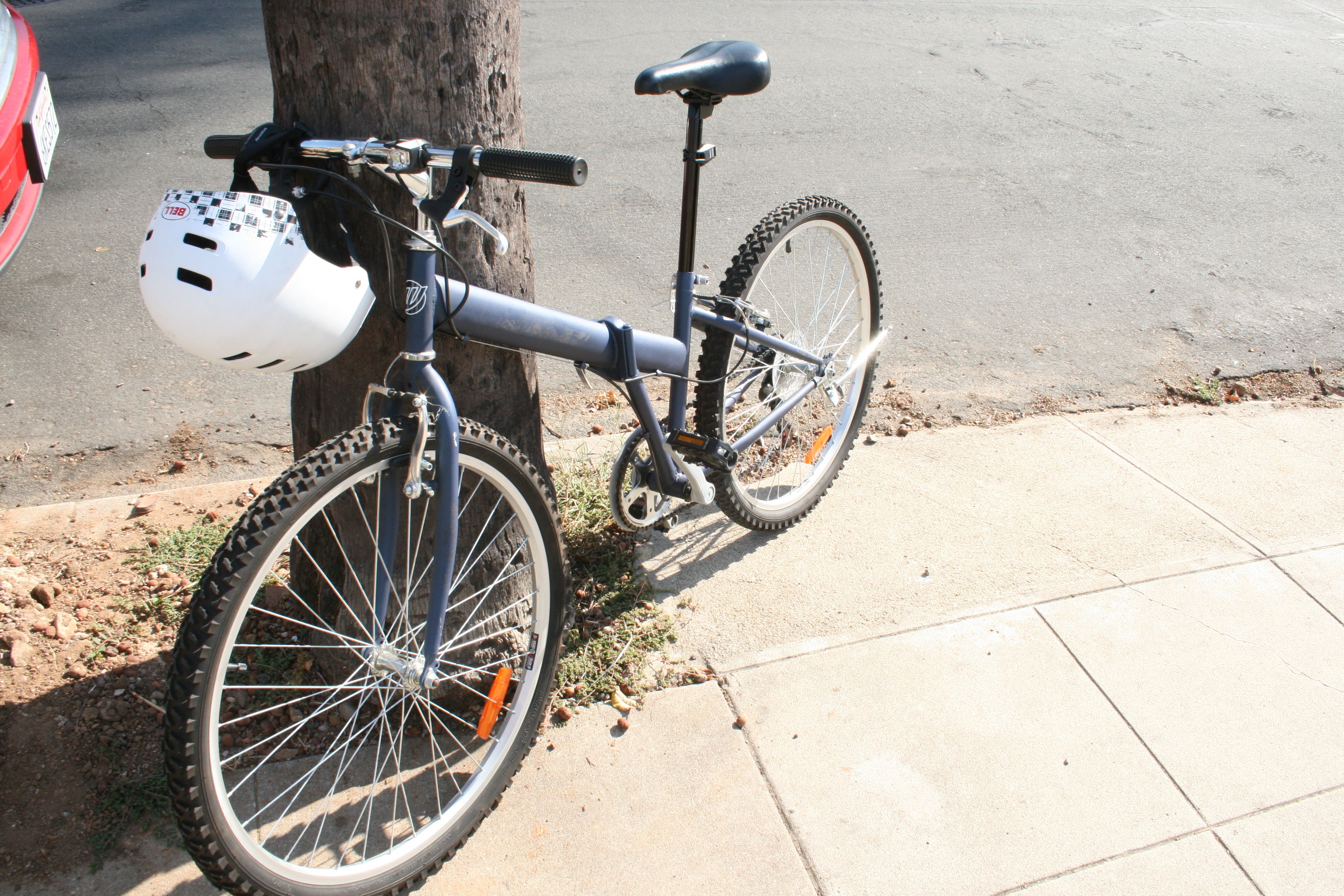
I did something this week I haven’t done for 4 and-a-half years. I rode a bike.

It was a bike I bought from my neighbor, Robert. It’s a folding bike that he tried to stow in a train-car luggage compartment on Amtrak, which he rides to his job in Irvine. But the wheels were too big and it didn’t fit.

My new bike

So he sold it to me for 80 bucks. Same price he paid for it, used.

If you know me, you know that I haven’t ridden a bike in four years because on April 14, 2007 I was hit by a car while riding my bike to work and I suffered traumatic brain injury.

A lot of people thought I stayed off a bike this long because I was skittish after a serious accident. Actually, I’ve stayed off a bike because the TBI made me suffer chronic nerve pain in places that make you not want to pedal a bicycle.

But I have ridden this bike to the grocery store and I rode it to work today. Both destinations are about a mile away from home. I also have ridden around the neighborhood with my son, a couple times at night, after he finished the homework he finds so difficult. That, alone, has been worth $80.

I don’t know what role bike riding will play in my life. I like getting around on my own power. But I no longer consider biking to be safe. It’s only safe if you assume all car drivers are both responsible and competent.

I remember speaking with a trauma-ward nurse I knew while waiting for a plane at the Buffalo airport (long story). She told me that one doctor is killed each year in San Diego while riding his/her bike.

“You mean one doctor is killed each year?” I asked. “One person in one profession?”

“Yes,” she said.

But biking is faster than walking, and I’m hoping if I stay on the grid of streets that crisscross my quiet neighborhood I’ll be fine. Wish me luck.

When it Doesn’t Pay to have Kids

September 18, 2011

This week I’ll be meeting with a financial planner to figure out how my wife and I will pay for retirement and for college education of our two kids. The first item won’t be too much trouble, provided we start planning now. But the cost of giving our children a decent college education, especially if it’s a private college education, is frightening.

I don’t know how college got so goddamned expensive, but sending two kids to a private college at the same time — even a college that’s well below the top of the cost scale — would cost nearly two-thirds of our annual family income. Why didn’t we just use birth control!

That leads me to the question of why people choose to have kids. One of the most profound and consequential trends today is the drop in the birth rates in developed and developing countries. An article last month in National Geographic examined the dramatic drop in the birth rate in Brazil, where couples, on average, are having fewer than two kids.

Birth rates that are too low to replace the population are a reality that’s well established in Europe and East Asia. But now it’s happening pretty much everywhere except Africa.

The question “Why?” has been answered by lots of so-called experts, to the point where we’ve developed a conventional wisdom that says, “Birth rates drop dramatically when you reduce infant mortality and educate women.” That’s probably true, but experts seem to ignore a glaringly obvious point: The financial incentive to have children has gone with the wind.

A hundred years ago, when most of us lived on farms, having more kids meant having more farm hands. Kids were an integral part of the economic engine that provided for families. Your kids were also your social security. Who would otherwise take care of you when you got old and feeble?

Today we don’t live on farms anymore, and in developed countries (at least we hope) we have a financial safety net, through pensions and the Social Security system, which will provide for us when we’re old. So what’s the point of having kids, who only show up on the expense side of the ledger?

I decided to have kids because I longed for them. Something inside me said I simply wouldn’t be complete without children. Having children was an emotional awakening. I never knew I could love anything so much.

Philosophically, I’ve come to believe having kids is my raison d’etre . The drive to reproduce is something humans share with all of God’s biological creation. There may have been a time when I thought my mission was to be a great journalist or great performer or the author of the next great American novel. But I never achieved any of that and I no longer think it would have been so meaningful if I had.

If my reasons for having kids make no financial sense, all I can say is that economists don’t know everything.

But let me pose a couple of questions. Can I really be sure the state and my savings accounts will take care of me when I get old? Am I sure I won’t need a close relation, of working age, to look after me when poor health and senility take their toll on me and my wife?

In twenty years, we may get a better picture of what life is like for people, growing old, who have chosen not to have children. We’ll really get a good look at that in countries like Italy and Germany, where the birth rates are so low they’re well on their way to becoming big old folks’ homes.

Overpopulation is certainly a problem in this world of ours. The optimist in me hopes this reduction in birth rates is a positive adjustment, which will eventually lead to a world with a sustainable number or people who maintain a sustainable birth rate. But human behavior may not that logical.

The drive to reproduce has been a product of our sexual drive and our economic realities, not to mention the need to counteract disease, death and war. The sex drive is the same today, but everything else is in a dramatic state of flux. Maybe the best we can do is follow our yen to have children, or not, and hope for the best.

Church and Football on 9/11

September 14, 2011

The tenth anniversary of the last military attack on American soil happened on a Sunday. It could have been any other Sunday. I went to church and I watched the Chargers-Vikings game.

The Vikings: The team I used to love that played on 9/11.

The game was a challenge in loyalties for me. I now live in San Diego, but throughout my childhood and young adulthood I was a Vikings fan. I remember the four times the team went to the Super Bowl and lost. I think my allegiance to the Vikings taught me that loyalty is important, even when it isn’t easy.

What does it have to do with 9/11? The terrorist attack of ten years ago showed America what it was like to not be winners and to be vulnerable. It showed us what it was like to be humiliated and fearful. Not everything goes our way and the consequences can be tragic.

Is that what it’s been like to be a Vikings fan? Maybe I’m milking this for more than it deserves. But a feeling of invulnerability can come with being a citizen of the world’s most rich and powerful country, and it’s a lot like being a Yankees fan.

I’m in the middle of reading a book about Franklin and Eleanor Roosevelt called No Ordinary Time. It’s the story of Roosevelt administration during World War II. It’s very long and ponderous but somehow I keep reading it. I think of this book because of the comparisons people have made between the attack of 9/11 and the bombing of Pearl Harbor.

It’s a comparison I can understand, but one that’s ultimately ridiculous. The attack on us by the Japanese Empire, and the subsequent declaration of war on us by Nazi Germany, cannot in anyone’s imagination be similar to a terrorist attack by a motley bunch of Arab religious fanatics, who just happened to get lucky by hijacking four airplanes while nobody was paying attention.

In World War II, our enemies were large industrialized counties with the capacity to conquer other developed countries and murder millions of people. By comparison, Al Qaeda is a bad joke.

Al Qaeda managed to murder a few thousand Americans. But their greatest achievement was the inspiration of fear and hatred among Americans. Did I tell you I went to church on 9/11?

I felt like I needed to pray for the people who were killed ten years ago, and I did. The message of the homily at St. Didacus Church in Normal Heights: Forgiveness.

You might be wondering who won that game between the Vikings and the Chargers. San Diego did. I thought I might cheer for the Vikings, in light of my history. But my life has changed and my allegiances have shifted. Still, I’m comforted by the fact that San Diego Chargers have also never won a Super Bowl. I’ve cheered for losers all my life, and it feeds the soul. Yankees fans, and Americans, should keep that in mind.

The Day of No Power

September 10, 2011

I was meeting with my son’s school teacher when the power went out. It was a blazing hot September day, just two days ago, in the 6th-grade classroom of St. Didacus Catholic School where the windows were wide open and two ceiling fans were turned to their highest setting. I heard a click, then the fans slowed down and stopped. I didn’t know this meant 4 million other people in Southern California had also seen their power go out.

As I left the school I pulled my car into a grid of streets with no working traffic lights. The streets were filled with traffic jams. Cars lined up at uncontrolled intersections and waited their turn to proceed. It was actually pretty civilized, though you would never know when some jerk would just blow through.

The stacks of traffic slowed things down so much that people afoot would simply cross busy streets in the middle of the block and pass between that cars that were creeping along. Cops directed traffic on Montezuma Road.

Darkness fell and the streetlight right outside my house was blessedly dead. But sharp shadows still crossed Collier Avenue, and I realized their were cast by a near-full moon. The moonlight was beautiful, though I would have preferred to see the stars a little better. I guess you’re grateful for whatever you can get when a power outage obliterates the ugly light pollution.

Mitch, who lives three doors down, was having a blackout barbecue that all the neighbors were invited to. People sat in chairs in his front yard and talked as they passed around hamburgers. My kids came home with one but didn’t eat it. One of our cats pushed it off the dining room table and onto the floor.

At one point, I stood in my backyard and looked back at my house and saw, through the windows, a dim interior that was lit by four candles. This, I thought, was how people lived — in this kind of darkness — before electric lights. I tried to resist the thought that it was somehow a better, simpler life.

The blackout lasted 12 hours, and reality returned at 3 a.m. with a burst of lamp light. I was lying awake in the family room of my house when I saw the lights come back on. I walked around the room, turning off the lights and resetting flashing digital clocks on my Bose CD player, my microwave oven and my electric oven with its induction range top. The comforts of modern life… those I definitely have not been able to resist.

The romance of the blackout was over. At 5 a.m. I would go to work to talk on the radio and tell listeners about what they had just been through, as if they didn’t know already.

Addicted to Comfort

September 9, 2011

The past couple of days have been hot. They’ve been the kind of days that make me wish I had central air conditioning even though I’ve lived my entire adult life without it, and coastal California is pretty darn temperate.

When it does get hot I imagine that my puritanical forebears will admire me for accepting God’s world as it is. I also think about an accusation made against modern Americans that they are “addicted to comfort.”

A little background.

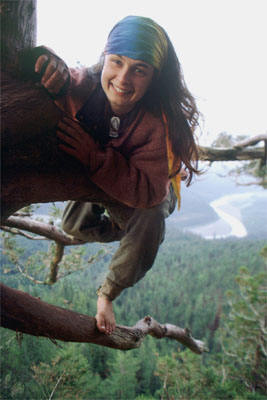
Julia Butterfly Hill in a tree.

I was once asked by San Diego State to host a panel discussion at an environmental conference where my guests would be Daryl Hannah (the movie star) and a celebrated environmentalist named Julia Butterfly Hill.

Hill got to be a famous activist when she climbed a redwood tree in Northern California that was in danger of being harvested for wood and she refused to leave. She actually lived in the tree for two years or some other outrageous length of time.

Being a strict environmentalist, she naturally avoided things that required lots of fossil fuels; things like car use and air conditioning. I asked her if environmentalists had to spread the message that people have to do without some of the creature comforts and conveniences we’ve come accustomed to, she basically said “yes.

That was when she accused Americans of being addicted to comfort.

It was the kind of comment that really does make environmentalists sound puritanical. Futurist David Brin mocks the attitude as a claim that to save the world we need to “shiver in the dark.”

But I share Hill’s skepticism that American ingenuity will lead to new energy technologies that will be every bit as abundant, intense and powerful as oil and coal. And I think about the fact that San Diego just suffered a massive failure of its power grid, when temperatures were up around 100 degrees and the AC was going full tilt.

We’re told that stress on the system didn’t cause the blackout in this case. Apparently, some technician working on a transmission line pushed the wrong button. But it could have been stress, which caused the rolling blackouts in California ten years ago.

In the days prior to air-conditioning, when the weather was hot, we just got hot, and we slowed down. Was that so unreasonable? Am I being puritanical?

Calling people “addicted” to comfort is silly. It’s not an addiction; it’s just what people want. And if we can keep people comfortable that’s okay with me. I just wonder how big a price we’ll have to pay.

Seeing the Camera Launch

September 5, 2011

Serendipity is a wonderful thing. I remember the day, 23 years ago, when my parents and I pulled into Ashville, NC on our way to a wedding in South Carolina. We decided to get dinner at a BBQ restaurant that was on a list of local eateries they kept at the Super 8 motel.

When we walked into that old red-brick restaurant in downtown Asheville, we learned that a bluegrass group called the 40-West Band would be performing that night. The music was AMAZING and… best of all… totally unexpected.

Serendipity met me again this weekend when I went to the City Heights Farmers’ Market, as I do every Saturday morning. The news website Voice of San Diego was there to set a camera aloft on the end of three helium balloons. What was the point? Taking pictures of City Heights in a random manner.

I was headed home when Scott Lewis, the CEO of Voice, saw me and encouraged me to stick around for the launch. The photos, such as they would be, were to be posted on the website Speak City Heights.

The tiny camera was  programmed to shoot many pictures as it ascended, and it was on a  tether so it could later be reeled in. We did a countdown, the balloons were released and the wind set them and their camera on an easterly course. It threatened to get stuck in palm trees or on the roof of a nearby building, but a few tugs on the tether kept it going.

It was an unusual act of journalism and I was glad to see it. Whether it will take any interesting or illuminating photographs we have yet to see. Hope for serendipity. Below is my personal video of the launch. That’s my son Nicholas warning, “It’s going to hit the tree!”

Cane Ball at the 54th-Street Park

September 4, 2011

My house in San Diego has a large backyard that backs onto a canyon. The canyon has become “the park” for my family. It’s like the hundred-acre wood in Winnie-the-Pooh stories, and it’s discouraged me from taking my kids to city parks as I used to when we lived in Normal Heights.

But about a mile south, on 54th Street, there is a park. It’s just beyond El Cajon Boulevard behind several apartment buildings near Trojan Street. A murder happened within the past year at one of these buildings. I read about it in the paper.

Most of the park is hidden from the street. But I pulled into a driveway, parked my car and walked over the crest of a hill to see the park. I was large, green and hilly, and it had two softball fields. Oddly, for this neighborhood, a small golf course sat next to it on the other side of a tall chain-link fence.

There were no white people in the park; only black and Lao. Typical of low-income kids, they were running with their peers. There were very few hovering parents; the kind you see in parks full of high-income white families. These kids were here with their school friends and older cousins.

Then there was the cane-ball game.

To those who don’t know, cane ball is a game typically played by Lao men. Call it hacky-sack volleyball, if that helps, because a ball of woven cane is headed and kicked back and forth across a low volleyball net. I first saw this game played in Minneapolis, and it’s a marvel to see.

Players retrieve hard shots with their feet, and they’re allowed to kick or head it twice before passing to a teammate or sending it back over the net. Players spike the ball with the head or with acrobatic flying kicks that sometimes involve a back flip.

My son was a ways away, using the play structure, which didn’t thrill me because it was marked with obscene graffiti. I called him over to watch cane ball, assuming he would be as fascinated as I was. He wasn’t, really.

Before we left we tried to fly a kite on park’s highest point, but we had left the string at home. A peewee football team ran its drills and the cane-ball game continued. The name of the park by the way: Colina del Sol. I’ll come here again when the sun is out and we’ll try to fly that kite again.