Archive for the ‘Uncategorized’ category

My Missing Cat

November 7, 2011

Three nights ago I let one of my three pet cats out for the night. Molly has not come back since then. I live near a canyon and two nights ago I heard howling that one of my neighbors later assured me were coyotes. Some howls were low and resonant while one was like a high-pitched scream.

I have owned cats for more than 20 years, and I’ve always let them out whenever they wanted. This caused my cat Maya to become pregnant a year ago. One of her kittens was Molly, who has not come back.

Molly was a sweet and trusting cat, and that may have been part of her problem. I have seen her be social with the skunks and raccoons in the canyon. Her mother is more streetwise. I once saw her run from dogs, and she did it in a way that made me think she could take care of herself.

I was once turned away from a local shelter, where I was trying to adopt a cat, when I honestly answered the question of whether my cat would be an indoor-outdoor cat. The shelter seemed to believe the humane thing to do was to deny cats any home, where they might be put in danger of going outdoors.

I differ with this view of humane treatment of animals. To me a cat is only allowed to be a cat when it can go outside, hide in the shadows and hunt mice and rats. Our cat, Maya, was born on a farm in Kansas where the cats were not allowed indoors. This would come as a shock, I’m sure, to that animal shelter I visited.

The disappearance of Molly gives me second thoughts about my cat care, even though I cannot be sure she was killed by another animal. I feel downcast when I think about that middle-of-the-night baying of the coyotes.

My 11-year-old son still walks to the back door in hopes of seeing Molly reappear, and he still calls out to her. We put lost-cat flyers up around the neighborhood with our address and phone number on them.

My wife and I have told our children that Molly probably found a new home and had just gone to live with a new family. I don’t believe that, but it could be true. As for our other two cats, they will continue to be indoor-outdoor. Death is a risk when you venture into the world, but as long as my cats still want to go out-of-doors, I’ll let them.

And when the time is right, I may ask my son if we can have a little funeral for Molly to put her memory to rest. Again… I’m not saying she was killed, but just in case.

Tom Keith, RIP

November 2, 2011

I wouldn’t have known that Tom Keith had died if I hadn’t gotten the email from Scott Horsley. Scott, who now covers Barack Obama for NPR, used to work with me at KPBS. I hear from him, now and then, when he sees something that he knows relates to my past.

He may call me from the press bus while traveling though Iowa when he can catch a glimpse of my home town, Grinnell, or the Barilla plant outside of Ames. Obama goes to Iowa when he starts thinking about elections. But I digress.

Tom Keith

I knew Tom Keith, though not well, when I worked at Minnesota Public Radio in the early ’90s. He performed with Garrison Keillor on Keillor’s old morning radio show and later on a Prairie Home Companion Show.

Tom created a radio persona named Jim Ed Poole, and most MPR listeners knew him by that name. I once worked at WCCO, the CBS affiliate in Minneapolis, where one of the radio personalities was “Dark Star.” Around the station we called him by his first name, Dark. I’m not kidding.

Tom Keith was one of those guys who was well-known in public radio circles. He was best know for being the original sound-effects guy for Prairie Home.

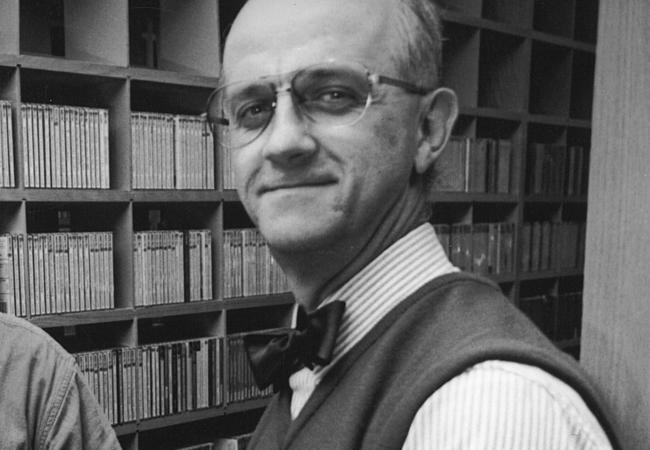
The thing I remember about Tom was a story told to me by a fellow MPR employee who played with Tom on the company softball team. Tom Keith was not physically imposing in any way. He was bald and of average height. But he was an outstanding athlete who had played on the varsity baseball team at the University of Minnesota.

The guy on the MPR softball team played first base, one season, when Tom played shortstop (or maybe third base… this was a long time ago). When Tom would field the ball and throw out the runner at first, he would throw so hard the ball seemed to ascend as it flew threw the air.

Tom Keith soon retired from softball and left it to the duffers. He died at the age of 64. Interesting what you learn about people. Jim Ed Poole, rest in peace.

Sue-Happy Orcas

October 31, 2011

Shamu is fed up and he’s suing SeaWorld. The orca argues his captivity at SeaWorld is tantamount to slavery, and that violates the 13th Amendment to the US Constitution.

This is a joke, right? But that would require PETA to have a sense of humor. PETA (People for the Ethical Treatment of Animals) has filed suit against SeaWorld, claiming it’s violating the constitutional rights of five killer whales who are being held as slaves and forced to do tricks. They (PETA lawyers, not the orcas) point out the U.S. Constitution doesn’t actually say it only applies to humans.

This is the kind of absurdity for which logical arguments are a poor fit. It may be true that our founding fathers felt no need to make it clear they were talking about human rights. But that’s only because the idea of giving civil rights to an animal was patently ridiculous.

If the case brought by Shamu is not thrown out by a judge, I wonder if the killer whales will be required to testify in court. Will they be deposed? Will the court be required to appoint a translator who speaks dolphin?

Some people have told me allowing lawyers to represent an animal who can’t communicate is no different from making sure a comatose person is fully represented, when the court is deciding whether he/she should be allowed to die.

I’d suggest that’s the exception that proves the rule. Also, there probably was a time when that person could communicate and could tell people what they might want to do in such a situation. Besides, the comatose person is a member of our species. Call me species-centric.

I’d also wonder what kind of a legal precedent would be set if PETA were allowed to represent Shamu and his supposed interests. Will my cat Molly take me to court because I denied her the right to have kittens by having her neutered? All she needs is a lawyer with nothing better to do.

This lawsuit by PETA has resulted in some animated conversations among fellow journalists, most of whom say it’s crazy. One colleague said if he were African American (whose ancestors really were enslaved) he would be very offended by this suit.

To me it looks like another case of humans arguing over animals, and claiming to know what they want. Animal cruelty does exist and it is offensive. But it isn’t a matter of what animals think about it, it’s what we think about it.

St. Francis told us that we and other animals are all God’s creatures. But we are not equal. The intelligence and technology of humans has put us in a class alone. We now control the fate of the environment and its other creatures.

We have the ability to destroy other species, not to mention ourselves. Mind you… life on earth will continue even if we damage our environment enough to wipe ourselves out. Other creatures will survive and thrive and evolve into other life forms, which may actually surpass us and our abilities.

But for now, animals are at our mercy. And we must show them mercy because they aren’t humans and they don’t have rights.

Beatles Cover Bands

October 29, 2011

I don’t normally get into acts that impersonate other acts, but I have a weakness for Beatles cover bands. It’s something to do with having grown up in the sixties. It’s something to do with the rich pop-culture landscape the Beatles created, and the unmistakable sound of their music… which, of course, was great rock and roll.

You find Beatles cover bands in the strangest places. Last weekend I listened to the “Baja Bugs” at the fall festival of my kids Catholic school, St. Didicus in San Diego. The Bugs have the look and the sound just about right, and they play with plenty of spirit. Over the past two years they’ve made the fall festival actually fun for adults.

Another Beatles cover band was a group of actors who made the mock documentary film, “The Rutles.” Cover bands always contain an element of satire, and the Rutles were fully satirical. The best known member of the group was Monty Python actor Eric Idle, who played one of the band members and was the documentary narrator.

If you haven’t seen this movie, and you’re a Beatles fan, be sure to rent it because it’s hilarious. Here’s a scene that shows the character who represents John Lennon meeting the person who represents Yoko Ono in an art studio. They go on to protest in a tub.

OK, maybe you think this stuff is dumb, or you just don’t get it, but it cracks me up! Beatles fans… rent the Rutles! (If the video is still available)

Kid Catalog Shopping

October 29, 2011


Sleep, Me & Shakespeare

October 21, 2011

 I love sleep. But I’ve become a suspicious and jealous lover since I began a new job that requires me to awake at 4:30 a.m.

 I have developed a routine that involves getting six hours of sleep overnight and an hour nap the following afternoon. It works, most of the time. When it doesn’t, I carry the heavy weight of fatigue.

 Weeknights, I now sleep in a small guest room on the first floor of my house while my spouse and kids sleep upstairs.

 Sometimes I lie in the dark, waiting for sleep to arrive, and I hope she understands she has a job to do and she’s late. My dicey relationship with sleep actually began four years ago when a traumatic head injury jammed some of the avenues in my brain that cause you to slumber. I’ve been taking sleep meds ever since.

 Here’s what Shakespeare had to say about wishing for sleep:

 O sleep! O gentle sleep!
Nature’s soft nurse, how have I frighted thee,
That thou no more wilt weigh my eyelids down
And steep my senses in forgetfulness?
Henry IV, Part 2

 I have a couple of days off this week to rest up. You just need to do what you can to get on sleep’s good side.  


The New Michael Zucchet

October 20, 2011

I host a morning drive-time news radio show and that means I interview news-makers. And that’s what brought me back in contact with Michael Zucchet.

Zucchet used to be on the San Diego City Council. But he resigned in disgrace before his first term ended, when he was charged and convicted by a jury of accepting bribes from a strip-club owner. He appealed the case and the appellate judge threw out his conviction, claiming the jury blew it and there was no credible evidence of a quid pro quo.
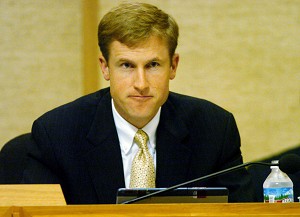
Michael Zucchet when he served on the city council.

The money the prosecutors characterized as bribes are normally called “campaign contributions.”

I encountered Zucchet again this month, for the first time in years, when I interviewed him about a proposal to reform the city employees’ pension plan. Zucchet, you see, has bounced back by landing a job as the general manager of a municipal union. Pretty good for a guy who almost went to prison.

I first saw Mike Zucchet nearly ten years ago, soon before he was elected to the council. He was in his early 30s but looked younger, thanks to his boyish, clean-cut face and blond hair. When I hosted a debate between him and his council opponent it looked like he was having a great time. The excitement of politics and the public eye lit him up and made him look like someone to whom nothing bad could occur.

This month he looked different. Though still physically fit, nine years had added weight to his frame. I watched him walk toward our building, as I waited in the lobby, and I wasn’t sure who it was. His posture and gate were different and his eyes were cast down. In the interview, the spark was missing. He acted like a union administrator who was doing his job.

We all get different when we get older. But I wondered if years of fighting criminal charges changed him fundamentally. The new Zucchet seemed more wary and less likely to have faith that things would work themselves out. That’s strange, in a way, since things actually did work out in his favor.

As a legal matter, you could argue that he was guilty as charged. But I wonder about charging politicians with bribery for accepting campaign contributions. Campaign contributions are a form of bribery, but they are a legal form of bribery. I never quite understood the difference between what Zucchet was accused of doing and what every other politician does. Apparently, the judge who threw out his convictions didn’t get it either.

Yesterday, I called him to ask a followup question to our earlier conversation, and he returned my call in the early afternoon when I was at home and about to take a nap. (You do this when you have to get up at 4:30 a.m.) I fumbled for a pad and pen to take some notes and asked my question.

Before I let him go I also asked him — just curious, mind you — if the U.S Attorney ever decided whether to order a new trial for him. Though a judge threw out Zucchet’s convictions, he let two charges stand, in case the government wanted to order a new trial on them. Zucchet answered me, saying no. In November, the government closed his case for good.

We should all be so fortunate.
Listening to Wisteria

October 13, 2011

The sun was casting long shadows but it was still hot on a day of Santa Ana winds when the temperature reached nearly 100 degrees. And maybe it was the heat that made the seed pods on my Wisteria plant start to burst like crazy.

Sitting beneath the Wisteria.

These pods crack open with a sound like a dry stick being broken. The two halves of the pod, and the flat black seeds inside them, are fired a distance of many feet so they can find a new place to grow. After school, we sat out front and listened.

The plant would be still and silent for several seconds then “SNAP!’ Sometimes the seeds would be fired right at us. Sometimes they’d hit the nearby walls of my house and ricochet from one to another in the corner by the front door. The snapping sounds of the opening pods would be immediately followed by a rustle of leaves, or the ping off a wall, or a few clicks as a pod caromed downward from stalk to stone to the gravel below.

Though we were hit by some of the seeds, no problem. They’re really small.

We sat, watched and listened for about half an hour until we had seen enough and it was time to do homework. Come winter (remember this is San Diego) the Wisteria will be clothed in purple flowers. But now, it sings its rhythmic song as it tries to make more Wisteria by flinging its seeds.

Dedication and Detoxification

October 13, 2011

The invitation I got for the dedication of the McDonald Center said to wear “business attire.” This was good to know as I attended the reopening of a treatment center in the name of philanthropist Marianne McDonald.

I was invited to this ceremony filled with well-dressed people because I wrote a story about McDonald’s dispute with Scripps Health, which used to be the home of the McDonald Center until the center got in the way of the wrecking ball they were using to renovate the hospital campus. The story aired on KPBS and Marianne tells me it helped get her problem noticed, and it helped her center find a new home.

McDonald is the daughter of Eugene Francis McDonald, the founder of Zenith Radio Corporation, who left her a fortune of about $100 million. Her life has been filled with riches and sadness. The latter has come from her family’s struggle with addiction and alcoholism. She told me her brother shot himself to death when he was high on drugs and alcohol. Her daughter Kristie was high on LSD when she played Russian roulette with a loaded gun and a group of friends. Kristie lost.

The McDonald Center has been moved to the campus of a competing health system in San Diego called Sharp Healthcare. The catered dedication was typical of its kind. There were lots of people there making connections and paying each other compliments. I recognized and spoke with Marianne’s son James, a garrulous man with a profane sense of humor and a hard-looking face. He speaks with an Irish accent he acquired after many years of living in County Kerry.

Programs that treat addicts and alcoholics are filled with emotion and stories of people who risk death to keep that euphoric feeling that comes with drug use. One man told me the McDonald Center saved his life. Marianne took the microphone at the dedicated and told us trees blossom to prove there is a God.

Marianne McDonald teaches classic drama at UC San Diego, so you could say she has made a profession of tragedy. Still beautiful at an advanced age, she thanked me for coming and for writing about her center and its tussle with Scripps.

I felt like a bit of a fraud at the event since I’ve seen no alcoholism in my family and I drink like a fish. But the hope for salvation is universal and we find it wherever we need it. For some in the grip of chemical demons, it can be found at treatment centers.

Seeing San Diego at Morse High

October 11, 2011

I’ve known many members of my generation for whom racial diversity is an imagined state of grace. They are the kind of people who have complained that San Diego, for instance, is so white. You still hear this at times, even though the Census Bureau assures us that non-Hispanic whites make up less than half the population of San Diego County.

I remember being at a party when a man who moved from the New York area was marveling at how white San Diego was. I suggested his view might come from the fact that he lived in Carmel Valley. No, he said, he worked at North County hospital where the clientele came from all over the area.

I neglected to additionally point out that 25 percent of San Diego County residents (at that time) had no health insurance. Was it possible that 25 percent was made up predominately of non-white people?

People who live in white ghettos are like the blind men feeling the elephant when they talk about a city’s lack of racial diversity, a perception they curiously bemoan even though they made a choice to live on the white side of the tracks. I’d like to encourage these folks to get out a little bit more, and maybe visit Morse High School.

Morse is located on Skyline Drive in what most people would call “southeast” San Diego. That’s shorthand for a part of town that’s poor, non-white and high-crime. I was visiting Morse High School to interview some people who were planting a garden that would be maintained by students and used by the school’s culinary arts classes.

It was just before noon when the bell rung and I saw hundreds of kids move from their classes to the lunchroom. Among all the kids I saw, I counted two faces that your average person would classify as “white.” I thought the white kids in this school must feel like black kids did in the high school I attended in rural Iowa. Out of place.

One of the teachers I spoke to claimed 40 percent of the Morse High School student body was Filipino. I didn’t know San Diego had so many Filipinos that they could make up a near majority of any public high school. All I knew is the kids I saw at Morse High looked black, Mexican and Asian.

My point is the geographic segregation of San Diego makes people in Carmel Valley believe the others just aren’t there. Out of sight, out of mind.

The culinary arts program, by the way, was a very chummy group. It was an outpost at a big urban school where kids of like mind could find a place to pursue a common interest and feel comfortable. Some of them wanted to train to be chefs. Some just wanted to make pesto and chile rellenos and pass the time.

I’ll make one last point, that’s entirely off the main point of this post. Take a look at this video of the school’s urban garden. The containers you see lining the chain link fence, and acting as planter boxes on the ground, are called Woolly Pockets. They’re basically porous bags you fill with dirt and grow plants in. You can put them anywhere. Just remember to water the stuff.