RAGBRAI 2018

Posted August 2, 2018 by tomfudge
Categories: Uncategorized

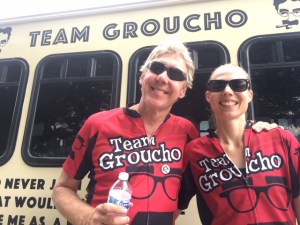
The NPR & Groucho teams beside their new bus.

This year I rode on the Register’s Great Bike Ride Across Iowa (RAGBRAI) with the cycling teams from NPR – aka No Pie Refused – and Team Groucho, lead by the great Bill Danforth of Shenandoah, Iowa. This year the Des Moines Register drew a line beginning halfway up the state and ending likewise, ranging from the little town of Anawa and ending in Davenport, with overnight stops at five towns in between. Some were places I knew very well, like Ames and Iowa City. Here are some highlights:

Teams Groucho and NPR get a new bus that plays the All Things Considered theme. With a disclaimer on the side of the bus, NPR riders assure listeners that no donations have gone pay for its purchase, decoration, fueling or upkeep.

The weather is so good it’s weird. There was virtually no rain during our cycling travels and by the end of the week we were seeing high temperatures in the upper 70’s. In July. In Iowa. In Jefferson I had a pleasure of being on a big open porch on a two-story home and seeing a sudden nighttime downpour blow into town and drench the neighborhood before moving on. All of us remained dry and well entertained as we sat in our chairs and watched the rain fall.

Disclaimer on bus.

For the first time I hear the band Hairball, as they performed Tuesday night in Jefferson. Hairball is a cover band playing 1980’s big-hair heavy metal tunes. Their act spans the gap between celebration and satire. They’re not bad, and they’re on stage with plenty of flashing lights, smoke and shooting flames.

My bike performs well but the gears and crankshaft started making sounds that make it seem that something’s amiss. I take my bike to roadside mechanics thrice with no effect. I finally decide to stop listening.

Don Gonyea and Richard Harris of the NPR team.

Team Groucho finds homes for us in RAGBRAI overnight towns where owners are willing to let us camp on their floors, use their showers and laundry machines. The custom is for all bike team members to offer a small and cheap gift to the host with a story to go with it. My gift – the Chico Bag – went over pretty well, and my story got some laughs. The Chico Bag is a tiny bag that’s stuffed with a bigger bag that emerges when you turn the small bag inside out. It came from the KPBS membership department. Thank you for your support! Of RAGBRAI, in this case.

Bill and Betsy Danforth, father and daughter, of Team Groucho.

We overnighted in Ames where my wife went to high school and where her father taught at Iowa State, and lived until cancer took
him last November. We got to ride our bikes into Cyclone Stadium and do a lap around the football field. That evening we hung out by a brewery outside of town where donors & listeners of Iowa Public Radio showed up to meet the NPR types. My wife’s stepmom
Rae showed up. We stayed in a neighborhood with big old two-story houses that were surrounded and shaded by strapping mature trees.

Cycling into Cyclone Stadium in Ames

In Newton we stay with an old couple. He’s a retired Episcopal Priest and she’s a former school teacher and a full-blooded Ojibwe Indian. Very proud of her heritage, she has a room full of framed artifacts from her culture, including a beaded women’s jacket, a pair of moccasins, and a photo of her parents harvesting wild rice on the White Earth Reservation. She captures us with her stories. Especially one she tells of her grandmother dying, and what grandma tells her and asks of her as she goes. A lot of us, sitting in the living room in silent attention, shed a tear. They also had a bottle of Dewars scotch, and I was very glad to have some.

Following the unprecedented NPR victory in pie-eating contest. Des Moines Register team is on the left.

NPR wins the pie-eating contest for the first time! The annual relay race between NPR and the Des Moines Register (one pie slice per person) has ended in disappointment for our side the two previous times we’ve done it. In this year’s contest, NPR gets a slow start but makes up for lost ground as our anchor team catches up and finally surpasses the competition. Our final eater, the diminutive Camila Domonoske, puts away her pie and opens wide her mouth to show the referee it’s all gone and NPR wins by an eyelash.

Camila done, at Mississippi River

Central Iowa is the part of the state where I grew up. There were plenty of hills to climb but usually a tail wind to give you a welcome push. I saw my stepmother in law in Ames. I ran into two sisters from my hometown that I hadn’t seen in 40 years. I stayed with my brother in the Quad Cities after rolling into Davenport and dipping a wheel in the Mississippi River at the end of the ride. More than sixty miles a day for seven days made for another RAGBRAI. I’ll be back. Maybe not next year but I’ll be back.

Me done.

Virus-free. www.avast.com
Using 35.74 GB

Program Policies

Powered by

Google
Last account activity: 4 minutes ago

Details

Goodbye St. Didacus

Posted June 15, 2018 by tomfudge
Categories: Uncategorized

It’s been 13 years since my wife Karen and I took our 5 year-old son Nicholas to meet Elizabeth La Costa, the principal of St. Didacus Parish School. Since then we’ve been going to teacher meetings, volunteering to maintain the library, writing the alumni newsletter, attending fundraising events and watching our kids grow up.

On Tuesday Karen picked up our 8th grade daughter Sophie at St. Didacus, making it the last day we would ever pick up a child there after school. Next year Sophie goes to high school. We had 13 years of investing memories in this place, with its plaster walls and tile floors, its blacktop playground, its long hallway that led from the south-end doorway to a school auditorium with the most uncomfortable seating I’ve ever known.

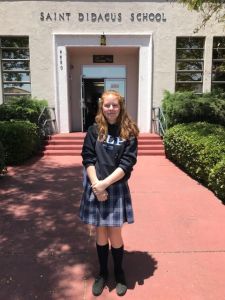
Sophie on her last day of school.

I grew up going to public schools so I suffered some culture shock when I first saw the Catholic school kids praying at a morning assembly. But before long I was charmed to hear the voices of children praying for everything from endangered animals, to soldiers in Iraq to unborn babies. Most of all, I saw my awkward, vulnerable son – who had been mistreated by other kids in a preschool where the teachers did little about it – in a place where he was protected by compassionate teachers who enforced a strict regimen of rules.

St. Didacus had a caring attitude that we noticed from the beginning. It was something we didn’t really see in the other Catholic or public schools we visited. Over the years, we had complaints about the place. Like the teacher who couldn’t be bothered to work with our son, who was having trouble in computer class. But we also remember the teachers who loved him and sent him home with encouraging notes and took the extra time to help him work through his learning disabilities. The years spent educating our kids and supporting the school were years of hard work that formed a lasting bond between us and the K-12 school. Our relationship with the parish coincided with a personal journey of mine that solidified my religious faith.

Now, we are moving on to a different part of our life, with one kid in college. The other will go to a Catholic high school where – a St. Didacus teacher joked – all you had to do was throw the money over the fence and let the school do the rest. No more setting up for Fall Festival or cranking out alumni newsletters. It’ll be easier.

As 13 years have gone by, the classes at St.  Didacus have been getting smaller. Fewer kids means fewer tuition payments. It’s a trend at almost all parochial schools in the U.S. I sometimes wonder whether my kids will soon be among the few who can look back on attending a Catholic grade school where the tuition was cheap, the classrooms were filled with immigrant offspring and the schools were firmly planted in an urban neighborhood.

We have been part of the long, imperfect tradition of Catholic education. I know that not all memories of parochial schools are fond ones. But with one of them my family shared a worthy task and many years of love and toil. Saint Didacus school is a place we’ll never forget.


Geman Beer

Posted May 7, 2018 by tomfudge
Categories: Uncategorized

Showing someone the inside of your fridge is an act of intimacy because so many secrets are revealed. It shows not just your tastes and preferences but your history. When it comes to the beer in my fridge, all of these are true.

I learned to drink beer at the age of 17 & 18 and I learned it in Germany, where I was a foreign exchange student in the late seventies. At the time German beer had a bitter tang to an American, to whom the only beers widely available were bland, fizzy pilsners like Budweiser and Pabst Blue Ribbon.

But since then things have changed.

Now we live in the age of craft brew, with the object to be making a beer strong and hoppy, which I think refers to that bitter taste we got drinking Deutsche Bier in 1978. But American craft brews have taken it to a higher level than seen in traditional European beer making.

I remember being in them UK maybe five years ago and tasting, at a pub, an IPA. That’s what they called it, India Pale Ale, but the strong taste you get in an American IPA was not there. It was very mild in comparison,  and had a much smaller alcoholic kick. In fact I noticed this with lots of English beer.

My theory is that the Brits (men, at least) like to spend an entire Sunday afternoon drinking and socializing at a public house. If you’re there for the duration, drinking up to eight pints of beer, you’ve got to make sure the brew is pretty weak so the patrons can stay sober up enough to make it home.

By contrast, consider your average American IPA. It’s strong and very hoppy and probably has an alcohol content of seven to eight percent. Drink two and you’re very tipsy. Drink four and you’re hammered.

Now let’s get back to the subject of my fridge.

After exploring the breadth of the craft beer movement, starting with Pale Ale in the ’90s and IPA after that, I found myself turning back to Germany beer. Two beers I often buy are Beck’s and Bitburger Pils, both of which were popular beers when I was a teenager in Hamburg, Germany.

Beck’s was brewed in Bremen, a little ways south of Hamburg on the Autobahn. Today, thanks to the acquisition by beer conglomerate Inbev, Beck’s beer that’s sold in the U.S. is brewed in St. Louis, but it still taste like a German beer. I buy cans of Bitburger at Trader Joe’s and I’m pleased to see their advertising slogan “Bitte ein Bit” has endured. And, apparently,  it’s still brewed in Bitburg, Germany.

German pilsner today tastes brisk and light, compared to many American craft beers, but it still has the terrific flavor I learned to like many years ago. The alcohol content of the German beers I drink is about 5 percent. That I can deal with for a daily brew.

So God bless the American craft brew business because they’ve made American beer worth drinking. But German pilsner is a rocket from my past that tastes just as good as it did when I first put my young innocent mouth to a bottle.

P.S. Some of you probably spotted a Guinness stout, hiding behind the German beers in my fridge. It’s my wife’s not mine. Though I tried for years to appreciate the taste of stout, it was wasted time. I think it’s terrible stuff. In fact, that beer has been in the fridge for six months. I don’t think my wife really likes it either.


Remembering My Father (My eulogy)

Posted April 8, 2018 by tomfudge
Categories: Uncategorized

When some people die it can be a challenge to find good things to say about them. But doing a eulogy for my father is an easy assignment. The great comic of the 20th century Will Rogers used to end his act by saying “I never met  a man I didn’t like.” My dad was like that. He was unfailingly friendly and kind. There may have been a person my father didn’t like, but I can’t remember any.

Jim Fudge in the Navy, WWII

Some stories of my dad are pretty good.  Like the time he called the police when a squirrel crawled in the window of my brother’s bedroom in my hometown, Grinnell, Iowa. I didn’t actually see this story develop because I had to leave early to my job detasseling corn that summer. But I relish his retelling of it.

Like how he started by finding my brother dead asleep as he tried to rouse him to the danger of the squirrel. To when the police arrived (and they did come), two armed men to confront the squirrel in our house.  Somehow they managed to get the animal to exit the window from where he came.

My dad was a great storyteller.  And he did believe a good story deserves to be retold. And he retold lots of them, many times over. It was rare for  me to hear a story only once from dad. Doug McCleod, or maybe his wife Sue, told me of how they had a relative who told stories over and over, and they would hold up fingers to indicate to them how times they had already heard the story the person was about to tell.

When my dad was a very young man he served in WWII, which I think was the adventure of his life.  If he were here today he may agree with that, or maybe he’d think marrying my mom or  having my brother and me was a greater adventure.

But after a lifetime of listening to his war stories I actually got to interview him about his  war experiences for my employer, KPBS, for Memorial Day, 2015. We heard the story of how he rode a train across the country to San Francisco on his way to a deployment in the Pacific, and walked with his buddies through a train car full of female service members, WACs. And how a German torpedo slammed into the hull of  their ship, but it turned out to be a dud.  I still have a recording of that interview and I cherish it.

He gave me that interview for Memorial Day, though it wasn’t a memorial day for him. Today is his memorial. So goodbye dad.  You had a  great life, and I’ll see you again when I get there.


Memory Loss and a Night in the Hospital

Posted March 21, 2018 by tomfudge
Categories: Uncategorized

It’s 6 AM and I have a view from my fifth floor hospital room of the San Diego River gorge. The bluff on the other side of the river is a black wall because the sun still isn’t up. On the floor of the valley the neon lights of car dealers and a Wendy’s restaurant gleam in the dark and the Lego blocks of a dozen small shops form the line of a strip mall.

With the morning dawn the bluff slowly takes shape with its creases and colors. Cars and trucks move on Mission Gorge Road as people make their way to work and appointments. I ended up here yesterday after getting a big knot on my head.

My wife says I called her from my workplace, not knowing how I got there. That’s when she came and got me and took me to the hospital. I didn’t want to spend the night in the hospital but the wife insisted. So here I am in a fucking hospital where nurses put an IV fastener on my chest in case I needed an emergency blood supply.

Mission Gorge, San Diego, in the early morning from a hospital room.

Sunlight fills Mission Gorge and I get tired of sitting in my room and looking out the window. I wander down the hall to the nurses’ station wearing the robe they give to patients. There’s a bustle here as the shift changes and patients come and go and they’re wheeled away on gurneys and nurses and docs gaze at computers and clipboards.

The nurses wear blue scrubs, the doctors wear green ones. I speak with three different doctors who visit my room.

I got the knot on my head after I left home on my bike on my way to Trader Joe’s to get some groceries. Work is a block from the grocery store and somehow that’s where I ended up.

I remember a dog appearing out of nowhere as I rode fast on my bike, but I don’t know if I hit the dog or swerved to avoid it. All I know is I have a knot on my head and I had what they call “transient amnesia.  I probably lost control of the bike and crashed, but there were a couple of  hours there that I just can’t remember.

I also can’t remember what happened to my bike. It’s gone and I couldn’t find it at work. One of the nurses said I should look for  it on Craigslist, go to where they’re selling it and take it back with a baseball bat. But I couldn’t find it on Craigslist. Turned out in my fog of memory, I actually locked it in front of a Starbucks. That’s where I found it four days later.

Meanwhile my dad is gone. I got the call from a hospice nurse at 10:30 pm on Thursday, a couple days before I ended up in the hospital. It was time. He was comfortable. At least that’s what they told me.

Watching my Father Die

Posted March 16, 2018 by tomfudge
Categories: Uncategorized

His room at the nursing home is maybe ten by 12 feet. An oxygen machine near his bed hisses and exhales as it makes a constant din and my dad lies in his bed with with his mouth open and his eyes shut.  The hospice nurse told me he can probably still hear and understand me, even if he doesn’t respond. The problem is I don’t know what to say.

You imagine what it’s like to be with a parent near their time of their death but the story you come up with is something they’d put in a movie. You have some emotional arguments. There’s some reflection on the life past. Some pondering life after death. But real death is not that kind of a drama.

My dad is 93 and he started to go downhill mentally about two years ago.  He got late-onset Alzheimer’s. He no longer recognized his wife. We moved him into a “memory care” nursing home where he would occasionally show signs of his old self but slowly lost the ability to stand. Then he couldn’t finish a sentence. I would come by to visit and — often as not — find him dead asleep in his chair, looking a lot like he does now.

When there’s no heart disease or cancer to kill you, you just slide down a gentle slope until you lose your faculties and are no longer able to swallow. That’s where dad is. He can’t swallow either food or water. I told the nurse that should mean he has just a few days to go. But she tells me she has seen people go on for weeks like this. Weeks? With no water? It doesn’t make sense but that’s life. Or death I  guess.

The nurse asks me how I am. I tell her my father’s death doesn’t bother me. What has bothered me is seeing him in such a helpless pathetic state that I no longer recognize the man I knew.  I hope to God something kills me before I get that far.

I visited him this morning and tried to talk to him. I tried to think of things to say, focusing on telling him he’s had a great life and it’s fine if he’s ready to go. In his eyes I saw no recognition that I was there. When I held his hand he didn’t squeeze mine.

Sometime soon he’ll die and I’ll try to remember the man he was, who held me when I was small. Maybe I’ll cry. Maybe from grief. Maybe from relief.


The Awards Shelf

Posted February 16, 2018 by tomfudge
Categories: Uncategorized

It’s in a recording studio in a corner of the building that isn’t used very much.  A reel-to-reel machine still sits there with its editing block where you’d cut out slices of audio tape with a razor blade. It hasn’t been used in close to 20 years. Behind that are the awards.

My daughter found them — waiting for a ride home — as I was  checking something on the computer because she looked into a space it never occurred to me to look.

When I came to KPBS we were still using those tape machines and I’m sure I’ve seen some of these awards before, when they were kept in a more prominent place. The Golden Mic Awards are on the top shelf. Some of the mics (they are golden) have  fallen off the tops of the trophies. Emmy’s dating back to 1978 are also falling apart, the plaques that name the winning entry had come off after the glue dried up.

They honor stories about important issues of the time and we gave each other awards for doing them. But memories fade and awards get old and fall apart, and I guess we eventually wonder why we thought they were such a big deal. The subjects seem to be the same ones we talk about today.

It reminds me of old cemeteries and the forgotten people they speak about. I remember seeing a cemetery in East London that the owners left to the elements. Grave stones had  fallen over and wild plants were consuming the grounds, making a true symbol of death and rebirth and mocking the conceit that we can enshrine a life that has passed like millions of others.

For dust thou art and unto dust shalt thou return.

I don’t know how long those awards will stay on those shelves, though I imagine they will stay there until the next building renovation when someone will find them, like I did, and finally decide they need to go to the landfill. Until then they will deteriorate, nature will follow its course and we will see what becomes of our pride.


Star Wars’ Endless Rebellion

Posted January 9, 2018 by tomfudge
Categories: Uncategorized

Last night my wife Karen and I saw the most recent, and surely not the last, movie in the Star Wars franchise, Star Wars: The Last Jedi. I came to it with high expectations and came away with mostly positive but various views. It was good. It was also too long.

But I’ll resist the urge to go into the fine points of film criticism and zero in on my main point about the decades-long Star Wars saga. How long can they keep telling the same story?

The first Star Wars film came out when I was 17 but it’s still fair to say I grew up on Star Wars. I saw the first three. Skipped the next three, which were actually the “first” three in the story line. (I hear they all sucked) I started up again with The Force Awakens and I’ve seen the next two after that.

Though never a Star Wars geek, I spoke the Star Wars language with its many references and allusions… a language shared by nearly all Americans of my age. I admired the genius of George Lucas in creating a myth so powerful that to resist it was futile.

But then I saw The Last Jedi and I wondered how much longer this rebellion can keep on rebelling, especially if the point is to keep cranking out good movies.

Sure, Star Wars is a fantasy, but a fantasy won’t make sense if it’s not grounded in reality, and George Lucas’s world is grounded. The Empire is clearly Nazi Germany. Take one look at Darth Vader’s SS uniform and that becomes obvious. The Force is borrowed from Christianity’s Holy Spirit.

The rebels are… OK that’s a little more tricky. They’re the good guys, for sure, but are they the French Resistance in WWII? America has a strong mythological story of good-guy rebels but ours fought the British, who weren’t quite the same tasty villains that the Nazis were.

And these Star Wars rebels just don’t seem to have a plan, or any allies for that matter. At the end of Return of the Jedi (that movie came out 35 years ago) our rebel buddies have killed Darth Vader and they’re partying with the Ewoks and everything seems great. But next thing you know the Dark Side is back in business and everything sucks again.

So there I was watching the end of The Last Jedi where the rebels are on the run — again — from some new incarnation of the dark lord. It’s just like it was at the end of The Empire Strikes Back. Like I said… they’re telling the same old story.

Rebellions don’t go on forever, unless it’s by some institutional fakery. You know, like those old commie leaders who wanted have a continuing revolution so they could accuse of people of being counter-revolutionaries and lock them up or string them up.

The American revolution showed how a revolution leads not to more revolution but to a new institutional authority. It was an authority that was flawed and racist and expansionist, but it did lead to something. The Star War rebellion doesn’t seem to be going anywhere.

I’ve been watching Star Wars for what feels like my whole life but all good things come to an end. I know there will be a sequel but The Last Jedi could end up being the last Star Wars I’ll ever see.


Kenny’s Revenge

Posted November 29, 2017 by tomfudge
Categories: Uncategorized

Our bike ride through the San Diego backcountry took place in a hot sun on our way up to 2,500 feet of elevation on roads sometimes straight and sometimes switchback.

I rode with Matt, Kenny, Jeff and Andrew. The ride was billed as Kenny’s Revenge, because last time he did it they say Kenny just about died trying to complete the 45-mile trip. Sadly he didn’t get his revenge. The mountain kicked his ass one more time.

If Kenny hadn’t been there I would have been the one they had to wait up for. Matt, Jeff and Andrew were all native San Diegans, all a lot younger than me and very fit.

In fact, Andrew was a positive maniac when it came to bike training. He’d ridden three times on RAAM, the Race across America. Though we started at a parking lot at the Jamacha Junction, Andrew didn’t a park a car there because he’d driven his bike the 20-some miles from his home in Point Loma to our starting place.

Kenny and Matt are my fellow co-workers. Jeff is a young, black-haired guy with a small frame and enough energy to spend our roadside breaks riding wheelies. He lived in the same apartment building as Matt, their units separated by a common wall. Jeff claimed if he wanted to go riding with Matt he just had to bang on the wall.

I couldn’t tell what color Andrew’s hair was because he never took off his cycling helmet. An attorney by profession, Andrew talked pretty much non-stop. When he reached a summit where we’d stop for a while, waiting for Kenny to catch up, he’d ride back down the hill to egg Kenny on and climb it again with him.

Eventually we’d see two figures coming slowly up the hill, but before we saw them we’d hear Andrew’s stream of verbal encouragement.

Jeff riding a wheelie.

The “Kenny’s Revenge” route was the toughest ride I’d ever done in San Diego. But there were payoffs, and they came in the form of awesome downhills. Near the end we zoomed down some mountain switchbacks, leaning our bikes into the turns and feeling the air rush by. Other payoffs: The amazing views of rugged hills across the a valley once we passed the halfway point.

It was a fun time with some cool people and a minimum number of douche bags, flipping us off as they rode by in their trucks.


RIP Peter Reilly

Posted November 14, 2017 by tomfudge
Categories: Uncategorized

It was a four-hour plane ride to Des Moines then a half hour drive to Ames, Iowa where the temperatures were in the 20’s. Unseasonably cold for the first part of November. We were there for Peter Reilly’s funeral.


Peter Reilly

My wife Karen’s father was from New Jersey but he lived in Ames more than forty years, teaching bio-chemical engineering at Iowa State. He died on November 2, 2017 of intestinal cancer at the age of 78.

My family of four all went to his funeral and we stayed at a Hilton hotel on the edge of town, though the edge of town wasn’t very far from everything else, because it’s Ames.

I haven’t seen a lot of death in my closest family, and I’ve only attended one funeral inside that group; my uncle Homer’s. We stood in a room at the funeral home as Homer lay in an open casket, looking like a prone statue as my aunt Doris said something to me about how he looked, hugged me and cried a little.

The visitation for Pete in the sanctuary of St. Thomas Aquinas Church was different because his ashes were in a box and so it seem less of a “visit.” I and the other close family formed a receiving line. Pete’s friends, neighbors, colleagues, fellow parishioners, former students and two cousins formed their own line that curved around the alter, moving slowly as they waited for their time to give us their regards.

Pete’s brother Tom did not show up for the funeral.

For the family it was two hours of greeting people. All but Rae, Pete’s widow, had to quickly figure out what their connection was to the deceased. Then we drummed up a short conversation. I learned that the impression Pete and Rae made on their community was huge.

They belonged to St. Thomas for four decades. They rarely missed a Sunday mass. They always sat in the first row. Rae was my wife’s stepmom, and she served on the committee that expanded the church. Pete would typically linger for an hour after mass to talk with people about anything possible. At the visitation we shared stories about how ending a conversation with Pete typically meant you had to tell him at least twice that you “really had to go.”

Pete was accomplished in his field. In fact he was named a distinguished professor at Iowa State. He was a nerd. At the funeral the priest told the story of how Pete had visited 60 countries, and that doesn’t count those countries where he only had airport layovers. Who told him that? Pete did.

Karen and Sophie in line for lunch in the church basement after the funeral

He was obtuse when it came to understanding many facts of life. That includes the trauma his daughters went through dealing with a family that had been split apart, or the trauma the girls felt, just being teenagers.

He had quirks and blind spots. He could be a snob. He knew how to hold a grudge. But with it all, Pete really liked people. He loved to meet them and talk to them, and he helped a lot of them though his teaching and his sponsorship of study-abroad programs.

At his funeral I thought about that movie It’s a Wonderful Life. Pete’s wonderful life in Ames, Iowa, was not so different from George Bailey. And as I watched the people standing in that slow-moving line at the visitation, I asked myself how many people would miss me when I died. How many people would remember me as somebody who helped them, made time for them and really enjoyed talking to them.

In the hotel, the day after the funeral, I saw the University of Texas women’s volleyball team as they got breakfast. They were beautiful girls who were all at least six feet tall.  They won their game against Iowa State… undefeated in the conference, one of them told me in the elevator.

On the plane to Chicago (our layover) I sat next to a guy who lived in Chicago but had season tickets to Iowa State football games. He grew up in an Iowa town of 850 people and, like Pete, talked to me non-stop from liftoff until we landed at O’Hare.


Temps in the 20’s in Ames, the Iowa State campanile in background.

He said his baseball coach in high school was the shop teacher and he made the players try to field baseballs with boards strapped to their hands, instead of gloves. Good training, he claimed. This guy also told me he played three sports because athletes had to do that in a small town, otherwise they wouldn’t have enough guys to field a team.

In small towns, you’ve got to be involved. You’ve got to coach a team. Serve on the volunteer fire department. Plan the church expansion. Pete was involved. He’ll be remembered fondly.