Archive for the ‘Uncategorized’ category

Stolen Skateboard

April 11, 2010

If you see a skateboard in Normal Heights that has green long-board wheels and the word “Think” written in green letters on the bottom, call me so I can have a chat with the person who took it. The board I got for my son’s tenth birthday was stolen from the front of my house just a couple of days after it was gifted.

I haven’t complained much about crime in my neighborhood even though it happens. In the dozen years I’ve lived here I’ve had a car window smashed and the car burgled. I think they stole $10 in change. I’ve had another car key-scratched. Thieves ransacked my garage after they found my garage door opener in an unlocked car. In one very odd event, someone dug up a small succulent plant on my front berm and made off with it.

But nobody in my family has been mugged, assaulted or threatened. As far as I know nobody has even tried to break into my house. It’s been quite a switch from the crime waves of the 80s and 90s. The local media’s obsession with crime is crazy in light of what’s really going on. If you’re a crime victim statistics mean nothing. Even so, crime has been going down for the past ten years and it shows.

But then there was that skateboard.

Its theft violated a father’s act of love. The guys at SK8Box on Adams Avenue, where I bought the board, said they’d ask around and watch for it in local skate spots. I don’t expect them to nail the jerk but I’m sure their network has a better shot than the SDPD. My neighborhood isn’t quite a small town but can be hard to hide in Normal Heights.

Meantime, I’ll be watching for green wheels and a green “Think” as I see skateboarders — most of them innocent I’m sure — role through curb cuts and cross the street and as they do circles on the  basketball court in 39th Street Park. Thieves beware the vigilante force. Honest folk… let me know if you see green wheels.

California Politics go to Pot

March 29, 2010

Californians are trendy and so are their politics. And the political obsession of 2010 is a spindly weed that makes you high when you smoke it. Potheads have managed to get a proposition on the ballot that would legalize all uses of marijuana. So far, marijuana has been legal for medicinal uses only. But the Regulate, Control and Tax Cannabis Act of 2010 would allow sale and use for any reason you desire.

Supporters of legalizing marijuana say their proposition would solve a host of social and economic problems.

Supposedly, it would remedy our state budget disaster by generating a huge amount of sales tax revenue. It would free up cops and DA’s to arrest and jail dangerous criminals because they wouldn’t waste their time prosecuting people who sell pot. So… legalizing marijuana would make us richer and safer, not to mention happy and blissful.

The march toward legalizing marijuana in California began 14 years ago with the passage of prop 215, which allowed for medical use. Unfortunately prop 215 has been nothing but trouble. It put state law in direct conflict with federal law, which does not allow any sale or use of marijuana. The proposition was also badly written. It’s short and vague, and it’s required years of legislative work to try to clarify it for practical use.

Look… if cannabis has medicinal value, and some studies show that it has, we already have an established and tested institution for selling prescription medicine. It’s called a pharmacy.  In the ideal world we’d throw out prop 215, make sure marijuana clears all of the legal hurdles to get approved for public use, let doctors prescribe it to worthy patients and let patients pick it up at their local drug store.

If, on the other hand, California voters decide to legalize marijuana for medical and recreational use by passing the “cannabis act” in November, it’s a whole new ballgame and a whole new fight between the state and the feds.

Last year, Obama’s justice department basically said they’d look the other way if marijuana use was allowed under state laws, and they would not enforce federal prohibitions. But that policy was made with the understanding that any legal marijuana use was medicinal. I doubt the feds will be willing to ignore their drug laws if people start selling and smoking pot just to get stoned.

Besides, if California unilaterally decides to legalize marijuana use, but cultivation and sale remain illegal under federal law and the laws of every other state, won’t that simply make California a huge new market for the existing drug cartels?

It’s possible that smoking pot will be no different from taking a shot of whiskey a hundred years from now. There may be no good reason to use drugs, but humans always have and they always will because drugs are fun. Some people say getting drunk or high is fundamentally no different from kids, on a playground, spinning around until they get dizzy. Changing consciousness is a fundamental human desire, and drugs are a risky but convenient way to do that.

Let’s just think twice and three times before we make a new drug an accepted part of our culture. It’s possible we’ve got enough already.

Demon Prius

March 19, 2010

I thought the Toyota Prius was a safe, nerdy car driven by responsible citizens who want to end global warming. But a 24-mile freeway ride by a San Diegan named James Sikes has turned the Prius into a steel death trap ruled by mechanical phantoms.

In case you hadn’t heard, Sikes claims his 2008 Prius took off on its own one day, accelerating out of control as Sikes desperately jammed on the brakes. He says brakes didn’t work and he finally stopped after a state cop pulled alongside him, while traveling over 90 mph, and told Sikes to depress the brake and parking brake simultaneously. Sikes later said he was afraid to put the car into neutral or turn off the engine, despite being told repeatedly to do it by the cop and a 911 dispatcher.

Soon after the event, Toyota staged a theatrical press conference in a football stadium parking lot where they said Sikes’s story appeared to be hogwash. They tested the car and the brakes were fine. Shifting into neutral worked fine. Depressing the brake and accelerator together engaged an override system that shut off the engine, and there was nothing wrong with the car’s electronics or computer software.

You’d expect Toyota to say all that. But the National Highway Safety Administration has basically said the same thing. I know a little bit about this story after covering it for public radio. Besides, I drive a Prius too.

Sikes’s story became international in scope because of the Toyota floor-mat scandal and millions of recalls of Toyota vehicles. But the inability of Toyota or the feds to reproduce his harrowing expedition has led to many theories about what really happened. Some people think Sikes, a bankrupt realtor, was faking it in order to sue Toyota. Some people think he was just stupid. Some believe Toyota is denying the facts as they play defense in the face of multiple lawsuits.

What people think happened that day, on Interstate 8, says a lot more about them than it says about James Sikes and what did or did not happen to him.

It’s very hard to listen to the 911 tape of Sikes (I have heard it) and not believe he was really scared. If he faked it, he’s an outstanding actor. Yet the fear of Toyota in the general public seems entirely out of touch with reality. The fatal crash last August of a Lexus in San Diego, due to an accelerator stuck on a floor mat, put Toyota under a microscope.

That kind of examination reveals lots of problems, even ones that don’t exist. Suddenly, nearly every report of unexplained acceleration in a car involved a Toyota. That’s wasn’t the case before the Lexus crash.

I don’t know what was going on with James Sikes’s car and we may never know. Lately, I have practiced putting my Prius into neutral. The shifter acts kind of funny and yes, it does take a little bit of practice. There is a great irony that a Prius was the car accused of dangerous acceleration because it is such a nanny car. When you fail to buckle your seat belt the dashboard beeps at you then starts beeping double-time if you ignore it.

Maybe it’s a good thing that we have too many lawyers, ready to sue if a car maker messes up. But if James Sikes sues, it will definitely be time to wonder whether he’s a better actor than I imagined.

PS   Listen to an interview of me on this subject that aired on KPBS, March 17th.

The American Dream on Steroids

March 11, 2010

Real estate costs are the sum of location-location. And when the location has uncommonly mild weather, and is wedged snugly between coastal mountains and the Pacific Ocean, those costs are terrifically high.

But the San Diego real estate market means more than that to the people who live here. It has a powerful, magical aura. The ups and downs of home prices are like a force of nature that can win wars or doom civilizations. Five years ago, real estate prices were at their zenith, buoyed by a giddy faith that they could only go up. It seemed like half the people I knew sold real estate at least part-time.

When that bubble popped, we all became agnostics. And cold-hearted realism makes me think it’s a good time to buy. I’m looking for a bigger house.

This desire runs contrary to my puritanical nature, which says 11 hundred square feet is more than enough in which to raise and house a family of four. But temptation drives me to take my hard-earned home equity (driven upwards during a long ride on the inflation train) and plow it into something with one more bedroom and one more bath.

I have to say that upsizing is something I’ve resisted for at least a dozen years. I bought a Normal Heights bungalow in 1998. Barely two years passed before my real estate agent began to wonder whether my family was “bursting out” of our its little shack. I’m not sure we even had any kids yet, which meant we’d only be bursting out because we’d bought too much crap and needed a bigger house to store it all in.

Once you decide you need a bigger house, the people who want to help you buy it and finance it are happy to reassure you that you’ve made the right decision. One mortgage finance guy told us that spending more money on a house was a great idea because our interest deduction would increase by leaps and bounds… by five thousand dollars a year in one home-buying scenario.

His logic underlay a thing I call the super-sizing home-buying mentality. Buy the bigger meal at McDonald’s and you get more food for the money. Never mind that you didn’t want the extra food in the first place and you really are paying more than you need to. The same thinking applies to buying a bigger house: If you don’t buy more house than you need you’re just giving Barack Obama five thousand bucks a year he doesn’t deserve.

House hunting is a voyeuristic adventure that lets you see your home city from the inside out. This is true even though realtors do all they can to make the house you’re looking at as impersonal as possible. Photos of family members, little kids’ artwork… anything that tells you that this is someone else’s place is banished from a house, as it’s being shown, so that possible buyers can better imagine themselves living in it.

The realtor’s charade includes staging the house by setting the dinner table and even renting fancy furnishings that were never were used by the current owners. Some homes are sold by investors who’ve refurbished them and want to turn a quick profit, and once you’ve seen a few of them they all look about the same. The tell-tale sign is granite: Granite counter-tops in the kitchen, granite-lined showers in the bathroom,  granite, granite, granite.

I grew up in a house that was built before WWII and that’s what I’m looking for today. I say this even after seeing many other families, of the educated classes, migrate to San Diego’s new northern suburbs in search of more space and better public schools. But I like the look of old neighborhoods. I like plaster walls and wood floors. I’ve got no quarrel with people who prefer the suburban aesthetic. Old homes are just more my thing.

Today, the San Diego home market is sluggish after going through nearly four years of devaluation. Lots of home owners owe more than their houses are worth. Foreclosures and short sales are everywhere. Lenders have started asking hard questions and actually saying “no” when they don’t think you can make payments on your dream house.

If I end up staying where I am, I’ll still feel lucky to live in the nice weather by the sea. I’ll also be able to maintain a smug attitude, knowing that I’m living in a house that has plenty of room for people who value the right things. Let those new-rich slobs keep their McMansions! I’m doing just fine. Unless something better comes along.

Chelsea King and the Monsters in Us and Among Us

March 7, 2010

I could see the TV-news vans and their satellite dishes as I drove toward the parking lot, in north San Diego, where the press conference was scheduled. A tight row of cameras were aimed at a podium that held at least twenty microphones. Soon, the county sheriff stood at the podium and told us that a body had been found in a shallow grave, and investigators believed it was the body of Chelsea King.

Chelsea King was a pretty 17-year-old who disappeared four days before. A 30-year-old registered sex offender was arrested. Police say semen found on King clothing matched the offender’s DNA. Nobody’s been convicted in this case. But the story reminds us that a family’s worst nightmares can happen. Innocent girls are raped and murdered by monstrous human beings.

Stories like this touch us so deeply and make us so angry that it’s hard to remember that they are uncommon. Media hype of violent crimes, committed by strangers, is what causes us to shelter our children like we never have before. (I wrote about this in a previous blog post, Remembering the days when kids ran wild)

The media indulge our fears and hatreds with excessive coverage of rare and horrible crimes. As a journalist, I think these stories distort our view of the world. But as a parent, I understand why they get so much attention. I’ve sometimes thought about what I’d want done to a man who committed such a crime on a member of my family. I think you can imagine. 

I oppose the death penalty, but not for morale reasons. I don’t think it’s wrong for the state to kill people who commit our most horrible crimes. Call it justice or call it vengeance. It’s the job of our courts to deliver both, and early death is an appropriate end for people who’s only motivation for terrible, calculated violence is selfish desire.

Unfortunately, our justice system is not perfect and killing people convicted of murder inevitably results in innocent people dying. California’s way of administering the death penalty also seems to involve letting people sit on death row for decades while they exercise their rights to appeal. That must be hellish for families of murder victims who endlessly wait for the state to deliver the justice they were promised. It seems we’d be better off just letting our worst offenders rot in prison and know that they’ll never leave.

I can’t imagine anything worse than the violent death of a child. If I were the parent I’m sure I’d believe in an afterlife. The belief that somewhere and somehow I’d see and hold my child again would be the only way I could continue. So I suggest we believe in that, and hope for that, for Chelsea King and her family.

An Invitation to the Compton Cookout

February 27, 2010

James Baldwin

A week ago news broke about a party attended by some white students from UC San Diego. It was called the Compton Cookout and it was timed to take place during black history month. Male invitees were supposed to dress and talk like Compton homeboys. Women, attending the party, were supposed to act like “ghetto chicks” by talking loudly and wearing cheap clothing.

The party caused a great commotion which culminated, a week later, in somebody hanging a noose in the University library. The noose incident was simultaneously more serious and less serious than the Compton Cookout. It was a true threat and a crime under California law. But it was the act of one or two people, not a group, and one that can’t be written off by anyone as kids just being kids.

When the story of the Compton Cookout hit the newspaper the response of the university administration was predictable and appropriate. Chancellor Marye Anne Fox denounced the party in grave tones as she met for a couple of hours with black students. The black students, also predictably, told her what she did and said weren’t enough.

The Compton Cookout is the kind of event whose meaning is immediately trivialized or aggrandized, depending on who’s reacting to it. To whites it was just a bunch of frat kids acting like morons. To blacks it’s one example a profound racism that runs through society. Both of them are probably half right.

Lots of writers have pondered America’s original sin of racism. One of those writers was James Baldwin who said, “The white man needs the nigger because he can’t tolerate the nigger in himself.” Maybe the white kids who went to the Compton Cookout were longing to express a part of themselves they both admire and despise.

But what does the Compton Cookout mean to the rest of us? I didn’t attend the party so I don’t feel responsible for what happened there. I’m also not convinced that any other students at UCSD should be held responsible. One of the demands black students put to Chancellor Fox was that she require all undergraduates to learn “diversity sensitivity.” I don’t think students should have to attend a series of lectures about racism on account of one incident they had nothing to do with.

But I will say this.

When we poke fun at others, the object of our fun-making can be an issue. I remember when a veteran golfer named Fuzzy Zoeller commented on Tiger Woods’s 1997 Masters tournament victory, which allowed Woods to choose the menu at the Masters Champion Dinner. Fuzzy joked that someone should tell Tiger not to serve fried chicken and collard greens. K-Mart and Dunlop ended their sponsorship of Fuzzy after that.

I’ve wondered what would have happened if Woods had been British and Zoeller had joked that he shouldn’t serve mashed potatoes and kidney pie. Would Dunlop have stopped sponsoring him for that? Of course not. It’s a double standard. But there’s a reason for it.

High status and large numbers are a great salve for the pain of being mocked. Holding black folks up to ridicule in the UCSD community, as they did at the Compton Cookout, is like picking on the small kid in the schoolyard. The same is true of making fun of Indians by turning them into sports mascots who look and act ridiculous.

By contrast, the University of Notre Dame has never been criticized for having a mascot who’s a goofy Irish Leprechaun with his dukes up. In that case, the white Irish Catholics at Notre Dame are making fun of themselves, and that’s okay!

The best ways to avoid the insults and the pain of race and class conflict is pretty simple. Practice love and understanding. Do unto others as you’d have them do unto you. Walk a mile in another one’s shoes. That may sound simplistic, even cliché. But it’s a proven formula that requires neither money nor a new set of curricula.

Unconnected

February 16, 2010

Americans carry on a national conversation that’s driven by the media. You have to be connected to be a part of it. And I am profoundly unconnected when talk turns to popular culture.

I know what makes pop culture news because I spy it in headlines and I overhear conversations about it. But to me it’s white noise. It’s like the low din you hear coming from the freeway that’s five blocks from your house. You know it’s there and you know what it is, but you don’t give it any thought.

In recent weeks I’ve heard that Jay Leno replaced Conan O’Brien as the host of the Tonight Show but O’Brien is still making a lot of money and may be getting another show. I haven’t watched the Tonight Show for years and I’ve never seen Conan O’Brien do his thing. But you can’t help hearing about him.

My daily newspaper arrived about a week ago and I saw a headline that said Beyoncé had just won several Grammy awards. But who is Beyoncé? Her image passes in and out of my field of vision as I walk past newsstands or see TVs turned on in public places. I think she’s a popular singer and I may have even heard a recording of her during one of my many trips through the urban wilderness. But aside from that, I don’t know anything about Beyoncé and I’ve never formed an opinion about her.

This has been my reality for many years. In 1994 someone told me that rock star Kurt Cobain had committed suicide. I asked, “Who’s Kurt Cobain?”

We need famous people because we need people to talk about. They are the characters we cast in our folk tales. They are people to admire or despise.  The problem (for me) is that new communications technology and media competition have forged a celebrity manufacturing machine that generates product at a dizzying rate.

Andy Warhol summed up our obsession with fame by saying that soon everyone would be famous for 15 minutes. That’s only a slight exaggeration in an age when people are endlessly transformed into public figures for their talents, their beauty, their wealth, their misdeeds and their notorious use of fertility drugs.

If a person’s celebrity endures but their distinctions are unclear they are famous for being famous, a fact that is absurd but also logical in light of the gaping content hole the news and entertainment media need to fill every day.

The media are not the message but they do challenge us to decide what is really important for us to know, and making that decision speaks to our values. Celebrity culture values the individual, not the community. In a culture obsessed with stars it’s no wonder that CEOs of major companies make 200 times what the average company worker makes.

Okay… maybe I’m taking this too seriously. Maybe I just find information about the careers and personal lives of famous people to be boring and I’m not a big fan of most things that qualify as popular culture. And I’m not putting down Beyoncé. For all I know she’s the new Ella Fitzgerald.

But whether we’re famous or not, a hundred years from now very little of what we do will be remembered. I remember Garrison Keillor once saying he celebrates his children and grandkids because his family is the only thing he’s created that’s likely to last through the ages. So if you’re looking for celebrity news, watch your daughter’s soccer game and celebrate the joy that came from it. Read good books. And if you have no idea what music kids are listening to today, it doesn’t matter.


Finding a Place to Park

February 6, 2010

39th Street Park

The character of a neighborhood is found in its parks. For more than ten years my family and I have been getting fresh air and exercise at three parks that lie within a mile of our house: 39th Street Park, Kensington Park and Trolley Barn Park. 

 My neighborhood is Normal Heights. It got its name for it’s proximity to San Diego State, which was a teachers’ college or “normal school” back in the old days. Since then San Diego State has moved elsewhere and Normal Heights has become a racially mixed inner-city neighborhood. Its main street is Adams Avenue, which divides the district along economic lines. North of Adams is the better side of the tracks, moneywise.

Thirty-ninth Street Park didn’t exist when we moved here. It was a bare field where road-building crews parked their trucks and bulldozers. Interstate 15 passes less than a half-mile from my house and it stretches from the Canadian to the Mexican border. But somehow it took until 2001 to fill in a two-mile gap in the freeway right in the middle of San Diego. 

When the state finally filled the I-15 gap it agreed to build three parks along the new stretch of freeway. One of them was 39th Street Park. My kids still call it the new park.

Go to 39th Street Park as the sun is going down and you’ll see lots of families of different colors. This is an immigrant park. You’re as likely to hear Spanish there as English. Arabic and Somali are commonly spoken. The blacks play basketball and the Mexicans play soccer. Families rope off the cement tables near the playground when they want to reserve space for a gathering. You can tell the difference between the African families and the African-American ones by the absence of men in the latter group.

Just on the other side of the freeway is Kensington and it’s a different world. The mayor lives there. So do lots of other high-income white folks. Kensington Park is tiny… two patches of green on either side of a small library. One patch has grown a small crop of play equipment. In the late afternoon moms and dads, still well-dressed from work, push their kids in swings and chat with each other. During the day, toddlers go there with their Mexican nannies.

Trolley Barn Park is about a mile west of my house where you cross over into University Heights. This used to be home to an actual trolley barn before the automobile pushed trolleys to the margin of urban American transportation. Today, Trolley Barn Park is a place where lots of people let their dogs off leash (illegally). The park is mostly white and partly gay. It’s popular with the yuppie crowd. During the summer they have concerts there on Friday evenings.

Parks are places where community takes place. They are backyards for people who don’t have their own. You hope they are bustling and safe, and in my neighborhood they are. When my kids are adults and think about where they grew up, I think they’ll see the park.


My Old Hometown and the Big War

January 26, 2010

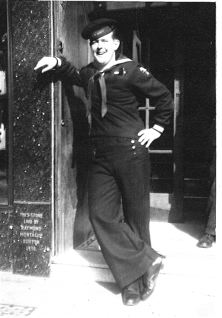
James Fudge in Southampton, UK

General George Patton once told the men serving in his 3rd Army why they should be glad they were about to fight the Germans. Patton told them that in the future, when their grandchildren sat on their knees and asked them what they did during the great World War II, they would not have to say, “I shoveled shit in Louisiana.”

Some of Patton’s soldiers died in battle and didn’t have a chance to tell any children or grandchildren anything. But I’m sure most of those who survived came to believe they really were the happy few Shakespeare described in Henry V. I know this because my father, age 85, is among the remaining men who served in WWII.

His story is one that’s told in a book edited by George Drake, the former president of Grinnell College. It’s called Our War and it’s a collection of essays by and interviews with WWII veterans from my hometown of Grinnell, Iowa.

My father was a Navy signalman who served in the invasion of Normandy. Another man, Ken Christiansen, was a forward observer for a mortar platoon in Germany and France. Cleo Strawser was a gunner on an aircraft that took pre-invasion photos of islands in the Pacific. Another, John Pfitsch, actually did serve in Patton’s 3rd army.

They tell stories of a war machine that was huge, complex and highly technical. The enemy was often unseen because they attacked with mortars and artillery shells, not with guns or knives. My father describes a rare experience of seeing German POWs behind barbed wire on Omaha Beach and hearing one of them sing Santa Lucia in a tenor voice as the other prisoners hummed an accompaniment.

If you served in the war your best asset wasn’t courage, reason or faith. It was luck. Christiansen tells of a day when he and some other enemy spotters were spotted, themselves, by a German artillery team as they dashed across a beet field. Christiansen prepared to die as the Germans finally drew a bead on his location but he was saved by a ditch that suddenly appeared before of him. He and his partners dove into the ditch and covered their heads as the shrapnel whizzed above them.

The noise of the big guns was literally deafening. My father, who was a musician, is convinced he’s always had a hard time hearing certain pitches due to the hammering the big guns gave to his ears. Madison Tomfeld, who served with the Marines in the battle for Okinawa, said the worst thing about combat was “the noise.”

I grew up hearing my father’s stories of serving in the war. I heard about the fights that broke out during shore leave, the endless game of craps on his ship and about seeing dead bodies floating near the shore during the Normandy invasion. Meanwhile, I came of age with no military experience and no inclination to serve in a country where the men who came back from Vietnam were seen as either monsters, victims or misguided souls.

My father was a college professor who worked in a place where being anti-war was an article of faith. But I remember talking to him the year Jimmy Carter required all young men of a certain age (my age) to register for the draft after the Soviet invasion of Afghanistan. I was complaining to him bitterly about it when he shocked me by saying, “Well, I guess you’re not a team player!” It seemed like such an unlikely thing for him to say. Yet when I think about the team he played on in the European theater it makes perfect sense.

Serving in World War II was the adventure of my dad’s life, and there’s nothing I’ve done that can compare. It seems stupid to be sentimental about war and the misery it brings. But as our country’s World War II experience dies off with the people who had it we will lose something important.

I’ll end with a quote from Christiansen, one of Grinnell’s WWII vets, who gave three reasons why he fought in the war. “First, you fight for the guys on your right and your left, whose lives depend on you and vice versa. The second thing you fight for is you don’t want the people around you to think you’re yellow. And the third thing you fight for is you wanted to get it over so you could go home!”


Thinking of Malcolm X after Martin Luther King Day

January 20, 2010

Racism is the original sin of the United States and the effort to banish it is a history that’s populated by heroic figures. Martin Luther King and Abraham Lincoln may be at the top of the list. But another martyr to the cause was Malcolm X.

The powerful story of his life, with its many changes and revelations is told in his autobiography. The book ends with epilogues by journalist Alex Haley and the actor Ossie Davis. Davis’s memorial reflections are very powerful and I’ve never forgotten them. So I’ll observe MLK Day, a couple of days late, by sharing the following two excerpts of what Davis wrote about Malcolm X almost 45 years ago.

Protocol and common sense require that Negroes stand back and let the white man speak up for us, defend us, and lead us from behind the scene in our fight. This is the essence of Negro politics. But Malcolm said to hell with that! Get up off your knees and fight your own battles. That’s the way to win back your self-respect. That’s the way to make the white man respect you.

You can imagine what a howling, shocking nuisance this man was to both Negroes and whites. Once Malcolm fastened on you, you could not escape. He was one of the most fascinating and charming men I have every met, and never hesitated to take his attractiveness and beat you to death with it. Yet his irritation, though painful to us, was most salutary. He would make you angry as hell but he would also make you proud. It was impossible to remain defensive and apologetic about being a Negro in his presence. He wouldn’t let you. And you always left his presence with the sneaky suspicion that maybe, after all, you were a man!

Malcolm X was shot to death in New York City, February 21, 1965.