Archive for the ‘Uncategorized’ category

Learning to Ride the Bus

March 11, 2013

The loft of the dance studio was filled with props, parts and tools. A box of stakes. A box of wood wedges. A collection of theatrical facades made from Styrofoam to look like rows of rocks. I stood halfway up the makeshift stairs to hand it all down, piece by piece, to another parent of a kid of the school

They will use it to make a float for the St. Patrick’s Day parade. The kids will dance on a flat truck bed that’s decorated with fake rocks. They’ll staple a skirt to it and put up a short fence to prevent kids from falling off.

I’d agreed to come and help get stuff down from the loft but there weren’t a lot of people there when somebody said, “So when do we need to get this thing ready in time for the parade?” The answer was Saturday at 6 a.m. in Balboa Park. Shit! I didn’t think I’d volunteered for that.

But I’ll be there with my drill, box of screws and a staple gun.

Wisteria blooms in Maech.

Wisteria blooms in March.

Her ears are soft and red and they hurt when we tried to put her new earrings back in. My 8-year-old girl wants to get big and getting her ears pierced is part of the deal. I’ve watched her sleep while she wore her first ones, cut-glass studs that are supposed to look like diamonds. But we didn’t leave the new ones in last night. She got back from another trip to the piercing parlor and I heard she would have to wear earrings to bed for two years to keep the holes from closing up.

It takes some commitment to become a big girl with pierced ears.

The wisteria in front my house has become a hillside of purple flowers. It’s that time of year. Rains come in winter. Trees blossom and bees descend on them to lend a humming noise. Rainy season will end soon and I pray for more. I was bred in a place where rain-fed crops are the stuff of survival. But in the Southwest water generally comes from pipes, not the sky.

Meanwhile I teach my kids to take the bus. They need to start taking it home from school, and it will just take a little practice. The first time Sophie couldn’t get the hang of feeding a dollar into the bill wringer. She then tried to stuff five quarters into the coin slot all at once and they got stuck.

The second time I reminded her of that and it made her sulk at the bus stop, crouched against the wall of a shop as she hid her face in her hands. But she did better putting the money in that time. I tell them they have to grow up and become more independent. The city isn’t so scary as long as you know where you’re going and have a cell phone. We’re still working on that second thing.

The bus winds down a hill into a canyon and uphill to the place where (I tell them) they have to pull the cord to request a stop. It’s just a ten-minute walk home, where the wisteria blossoms and I can still watch them fall asleep at night.

February 17

February 17, 2013

A dog like I used to have. An overnight mountain snow lies on the ground and the dog bounds and rolls around in it. His fur is trimmed short and I’m not sure what kind of dog he is, and have to ask to find out it’s a Golden Retriever.

He chases people who slide down the hill in a sled.

In a courtroom she walks before the judge. She has a ruddy face and is using a cane. She’s charged with stealing money from a foundation started by her rich husband. She did it so she could gamble.

Once she was mayor of the city. She was mayor of San Diego back in the 80’s. Before that she was one of a family of 13 kids.

But she never had any kids of her own. What do you do when you’re 66 and in trouble and you don’t have any kids?

Road trips are good even if you’re only going 50 miles. My wife and I were in the front seat and our children were in the back as we drove into the mountains to be in the snow.

The trees were covered with hoarfrost and clouds pressed on them to cover their tops.

Winter is short here and it quickly becomes spring, though spring is not much different from any other time of year. Should I give up dreaming for lent? I wish I could give up the pain in my legs.

Life is long and too much the same. I wish I could be like that dog in the snow. I would love the snow and love knowing that I have kids in the back of the car. Not like that poor woman walking with a cane.

Each day death gets closer to the old man. It’s not welcome but it’s something he asked for, like the stuff that fills up your garage when you live someplace too long. Your walk and your wit take the long way to get places and you stumble over the clutter of memories and even more things that are forgotten, until death takes it all to place where we throw things away.

Her lawyer asked me, “What’s your game?” I said poker. But I had a better hand because I knew I had more that I could gamble and lose. So I never sat in the casino where screens light your face and you push the buttons that are guaranteed to take your money.

What if we never won? What if fools with golf clubs never hit the perfect shot that climbed higher and higher on its way to the green and just barely succumbed to gravity? Winning makes us think we aren’t really losers even when we are guaranteed to be.

Death is guaranteed. We can just do it well.

Light Rail Tweets

January 19, 2013

There’s a blizzard of info-nonsense that blows across cyberspace all day that takes the name Twitter. And I try to monitor some of it with a software thing called TweetDeck. In TweetDeck, I not only have a column that shows tweets from people I’m following. It also has columns that show categories of tweets.

I can search the Twitter universe for certain words or phrases. This can be handy if you’re a reporter who’s waiting for some news to break. The minute some expected event happens – Supreme Court ruling, whatever – somebody out there with an Internet connection will tweet and spill the beans so you can follow up.

One search term I have programmed into TweetDeck is “light rail.” I’m not expecting any big news, necessarily. But I figured I might hear about some interesting studies, stories or developments that I can turn into news.

It turns out the stuff I got in my light-rail column was a lot more interesting.

It’s not news. Far from it. It’s a collection of gripes and trivial observations made by people who use light rail. The first thing I learned as I started to look at this stuff is people really do call light rail light rail.

I thought that was an expression only academics and transit wonks used, while real people called it the trolley, the train or something like that. Nope. The people who ride it call it light rail, and when they complain about the loud drunk they had to sit next to as they were headed downtown they talk about the guy on the “light rail.”

Not all of the tweets are from San Diego. They have light rail in Minneapolis, Denver, Boston, Sacramento, Phoenix, Portland, etc. Most of the time I can’t tell where these people are. I just know they’re using light rail.

Here’s what I’m talking about:

–Oh god someone just brought delicious smelling curry onto the Light Rail train! Just remind me how hungry I am, Indian Diaspora! Thanks! :p

–@Ned_Miller some random nigga who got on the light rail lol

–Barely made the light rail and accidentally left 50 cents at the pay station. I prolly just made a hobo’s day today. #GoodSamaritan **

–Why is this lady cussing her reflection out on the light rail? #werido

–On this ghetto light rail with crack heads and ratchet children. Smh

–We are riding the light rail for the first time!!! http://t.co/zDjXnGAT

Every day brings a new collection, all of them connected to a photo of the correspondent. And while the details change the substance remains the same. I sometimes wonder why I keep the light-rail search tag. Why do I enjoy reading these pointless, aimless, often-profane tweets?

Maybe it’s the beauty of small talk. Somehow, it’s comforting to hear people broadcasting their small rants, stories and enthusiasms.  Put it all together and it paints a perfect picture of everyday life.

And… come to think of it… life is the very thing these tweeters are observing. I’m sure I’d be less interested to read the tweets of people who rant about something they saw on TV or something they read in a magazine. But put someone in the midst of humanity, riding in a light-rail car? Now THAT’s something I might want to hear about.

Meanwhile I’ll try to tweet more. I guess someone out there will be interested in hearing what I have to say, as small as it may be.

Christmas Diary: 2012

January 2, 2013

It helps when the weather tells you it’s Christmas. This year we had temperatures into the 30s at night and a week of rain, on and off. In Southern California, wet and chilly conditions give a sufficient feeling that the weather had become bracing, and it’s driving you inside a comfortable home that’s colored by a Christmas tree.

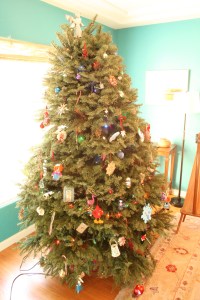
X-mas treeIn my family, the holiday comes with a blizzard of gifts, thanks to some compulsive shopping and numerous grandparents buying for not many grandkids. The streets of my neighborhood had a generous offering of Christmas lights. There are displays of elves, reindeer and Santa wearing shades as he rides in a hot-air balloon. These blowup figures sound like vacuum cleaners as you walked by them.

A few blocks away, one house has a statue of the Virgin Mary with a halo that lights up at night. It’s not bad, but you can’t see the figure too well when it’s dark so it looks mostly like a stray circle floating in front of the house.

We decided this year to buy a Christmas tree from a tree farm in the country… something we’d never done, and it turned out to be a mistake. It started with long arguments about what kind of tree to get, and ended with us buying the worst Christmas tree I’d ever owned. It had many gaps in the foliage and fungus growths on the branches, and it was so lopsided it broke my tree stand.

The next day I bought one of the trees in the parking lot at the mall.

This Christmas I received a historic gift: A bike. OK, to say historic is laying it on a little bit thick. But seven years ago I also got a bike as a Christmas present, which, a year-and-a-half later, got flattened by a car as I was hit on the way to work. I wasn’t flattened but ended up in the hospital with TBI and had to go through three months of rehabilitation.

I had barely ridden a bike since then, the one exception being a cheap folding bike I briefly had. It was falling apart and got stolen from the front of Von’s at my urging. See this blog post from a year ago for more on that story.

My son has an active fantasy life about living in a place that has cold and snow. So for Christmas he asked for (and got) a sled, snow pants and winter gloves. Strangely, his dream came true on New Year’s Eve when we drove 50 minutes to mile-high Laguna Mountain. We found several inches of snow had fallen and there were plenty of hillsides to sled on.

I worked during Christmas week, though like Bob Cratchit I had Christmas Day off. The holidays were otherwise similar to ones past, with visits from in-laws and nagging children to write thank-you notes.

Finally my wife and I are mailing Christmas cards, covered with photos of the family. This is when we try to recall whom we’ve known over the years and to also remember the last time we’ve gotten in touch.

It’s a sad exercise that reminds me that friendships are not forever and they fade with time spent never seeing one another. Do we send a card to Jeff, whom we haven’t spoken to in God knows how long, or would that be ridiculous? Maybe one of these days I’ll look for him on Facebook.

Christmas is great and it’s a hassle, and now it’s done. On Saturday I’ll leave my two trees on the curb to be picked up as green waste. I’ll pull the Christmas lights off the roof gutters and put them back in a box. The days are short, spring is a long way away and it’s time to get back to ordinary life.


From Egg Farm to my Backyard

December 31, 2012
Chickens

Brown leghorns we got from the cramped cages of an egg farm.

My chicken coop out back had been home to six chickens before three of them died. On Friday, we replaced those three by transplanting three chickens from a nearby egg factory.

This is the kind of egg farm that’s been outlawed by California Proposition 2. Chickens there are confined in rows of cages that allow them to lay eggs, but not do much else. Unfortunately, Prop 2 was written by a committee of fools and it’s still being challenged in court for being unworkably vague.

My new hens are brown leghorns that are past their egg-laying prime. That’s why the farmer wanted to sell them. But they will still lay enough to satisfy my needs for a few years, so I adopted them. You might say I rescued them, in the way some people rescue retired racing dogs. If these hens hadn’t been sold to me, they would have probably gone to make chicken soup.

The girls show their history in many ways. Being crammed into small cages caused them to lose a lot of feathers by constantly rubbing against steel wire. Most noticeably, the fronts of their necks are bare from reaching into a deep metal food trough. Their beaks were trimmed to make them less “peckish.”

They are now in a backyard chicken coop where hens lay eggs and roost. My chickens descend into an enclosed run in the morning, and wander around my property in the afternoon when we decide to open up the door to the run. But the factory hens are unaccustomed to going anywhere.

So far, they are alarmed by the sheer spaciousness of their new quarters. They gingerly lift and replace their feet, as if they think the ground might swallow them up. They seem to have learned how to feed and drink, and they are beginning to peck at the ground. They follow the native birds into the coop at night, but they haven’t yet used the roosting bars.

One thing I will say for them: They are producing eggs. Over the past two days we’ve gotten two from the three new chickens. They’re not so traumatized that their bodily functions have been put on hold.

The farmer who sold them said moving them to a new environment might cause some “mortality.” So far so good. If one or two of them do die… well, they’re just chickens. But I hope they survive and I hope they have a couple more years of egg laying in them. I also hope their feathers come back and they start to look more like the handsome hens we have already.

Please DON’T Have a Happy Pearl Harbor Day

December 8, 2012

Somehow Pearl Harbor Day always gets me. A few years ago, I was hosting a radio show and the producer or someone told me to mention it’s Pearl Harbor Day. So I said over the air, “Happy Pearl Harbor Day!”

The angry calls immediately came into the station. Pearl Harbor Day is a solemn occasion, they said, and why is this moron telling us to be happy! KPBS management went into damage control and eventually it all died down. Until yesterday.

Again, I was hosting a talk show and, again, the producer said I should mention the occasion. “Happy Pearl Harbor Day,” I said. The process repeated itself. Angry calls. Damage control. Stoney looks from station managers.

I thought the first event was just a couple of years ago, but it must have been longer past. Otherwise, the request to “mention Pearl Harbor Day” would have set off at least a faint alarm bell.

So what’s my problem with Pearl Harbor Day? I guess I’m just not sure what to say to people about it. I’m not in the habit of offering people a Pearl Harbor Day salutation. If it’s New Year’s Day or Christmas, that’s easy. Merry Christmas! Happy New Year!

But Pearl Harbor Day? Do I wish people a somber Pearl Harbor Day or a ponderous Pearl Harbor Day? I suppose the thing to do is just say, “It’s Pearl Harbor Day,” and leave it at that. But the pressure of preparing for a live show didn’t give me time to imagine a proper reference.

I wrote an apology to listeners, which I’ve copied below. These days I rarely do live broadcasts, and I don’t know why they always seem to land on Pearl Harbor Day. With some luck, that coincidence will not be repeated.

“On Friday I appeared on KPBS Radio’s Midday program. It was Pearl Harbor Day and I wished people a ‘Happy Pearl Harbor Day.’ My intentions were good but it was a poor choice of words. The attack on Pearl Harbor was shocking and tragic, and its anniversary is not a time to invite people to be joyful. As the son of a WW II Navy veteran, I’m sorry if any of you were offended.”

-Tom Fudge

The Death of Prop 34

December 3, 2012

The 2012 election had some high points, and the vote on Proposition 34 was not one of them. The initiative would have ended the death penalty in California. It was voted down. It would have been remarkable if it had passed. But it didn’t.

If you think that means the state can go ahead killing axe murderers, here are a couple of facts. Though it has more than 700 people on death row, California has not executed anyone for six years. California has condemned about 900 people to death since 1978, but it has only executed 13.

The death penalty in California is a joke, and it’s not very funny. It’s a expensive farce for one thing. Given the cost of death penalty appeals, the capital phase of murder trials and maintaining death row in San Quentin, the legislative auditor estimated the state would save $100 million a year if the death penalty was gotten rid of.

Furthermore, it’s a joke that’s told on the families of murder victims. We made a promise to them that the murderers of their sons, daughters and spouses would be put to death. But the condemned are a lot more likely to die of old age than die of execution.

I thought of that when I voted on Prop 34, which would have taken that broken promise and put it in writing. If the initiative had passed, all the existing death sentences would have been commuted to life in prison without the possibility of parole.

I lived the first 37 years of my life in Midwestern states with no death penalty. I didn’t feel any more unsafe, and I expect California will go that way eventually. Religious devotion and civilization run against capital punishment, and I think it’s just a matter of time before it’s gotten rid of here.

How that will happen is a good question. The last state to do away with the death penalty was Connecticut. And while they abolished the death penalty for all future criminal cases, they also left it intact for the people who were on death row. That sounds like the most promising path for California.

The people now in San Quentin were sentenced to death, and we should carry it out. That won’t please the ideological backers of the abolishing the death penalty. But we’d be finishing what we started, and we’d be keeping the promises we made to those families.

That would also make voters more likely to accept the abolition of capital punishment. I, for one, wouldn’t shed any tears for the people being put to death. They made a choice to abuse, rape and kill and they’ll suffer the consequences they should have fully expected.

But ultimately the death penalty is too high a price to pay for justice, and it depends too much on a judicial system that’s prone to error. I do wonder what should be the ultimate punishment for people who commit our most terrible crimes. Should it be life in prison without parole? And if it’s life in prison, should serial murderers get access to TVs and computers while they’re incarcerated? Should they get plenty of time to socialize and exercise?

Should the people who commit unspeakable crimes that shock us to the core be treated in prison no differently than someone who held up a liquor store?

This year Anders Behring Breivik was convicted in Norway of murdering 77 people, most of them kids. He was sentenced to 21 years in prison. Twenty-one years?? Is there any American who wouldn’t find that lenient to obscene proportions?

But Norway is a different country and they have to live with their decisions. In California, we have to decide what equals justice. We tried the death penalty,  and that just didn’t work.

Sidewalks for Bikes

November 23, 2012

It was a weekday night. I went to a drab meeting room in a neighborhood library to attend a meeting of the College Area Community Council. They were talking about making it safe for cyclists to ride on Montezuma Road.

A city traffic engineer was there to present a study, and I had my own report to give: I was hit by a car and nearly killed five years ago as I was riding my bike to work on Montezuma.

Bikes are not cars or pedestrians. But up until now the conventional view has been to treat them like cars. Same road. Same rules. That’s been the catch phrase.

But bikes aren’t cars. They don’t perform like cars. They aren’t as fast, and above all they don’t have the steel skin that protects the operator.

The community council meeting began with the pledge of allegiance and acceptance of minutes of the past meeting. When they got to the presentation of the city engineer, he began by explaining his department’s bureaucratic locus so we’d best understand his function. I stared at my watch, thinking of the two kids I left home alone.

Finally, the engineer showed a map of Montezuma Road with car-bike crashes pinpointed (Check out the map above). I saw mine. I also saw the accident that claimed the life of Charles Gilbreth earlier this year. Since 1999, there have been 49 bikes hit by cars on Montezuma Road. Two of those crashes were fatal.

There were some people in the crowd I recognized including Jim Baross, a former head of the local bike coalition who once told me cyclists shouldn’t worry about being killed by a car because that would ruin a motorist’s day.

It was his clever way of saying bikers shouldn’t be timid about sharing the road with cars. Even then, I didn’t even think  it was funny.

I used to chastise cyclists who would ride their bikes on sidewalks. It was illegal, after all. But I don’t think like that anymore. I think people on bikes are like pedestrians who need the same kind of protection from cars. That’s at least true of four-lane roads like Montezuma, where traffic moves nearly as fast as it does on freeways.

When it was my time to speak to the community council I walked up to the podium at the front of the room. I said the painted bike lanes on Montezuma were a joke. Sharing the road with cars might be fine on a quiet residential street where the cars don’t go too fast, but not on major thoroughfares.

I left early to get back to my kids, and we’ll see what comes of it. I was in Germany in the summer where I saw their streets bordered by broad sidewalks that were split into two lanes… one for peds and one for bikes. That’s smart. I wish we would do that here.

Harp in the Living Room

November 10, 2012

Most musical instruments are pretty compact. They don’t take up a lot of space and they travel easy.

It becomes more difficult when you play a drum set or a stand-up bass. A piano isn’t a big deal because transporting it to gigs isn’t even part of the discussion. You play whatever piano is there, and if they don’t have one you don’t play.

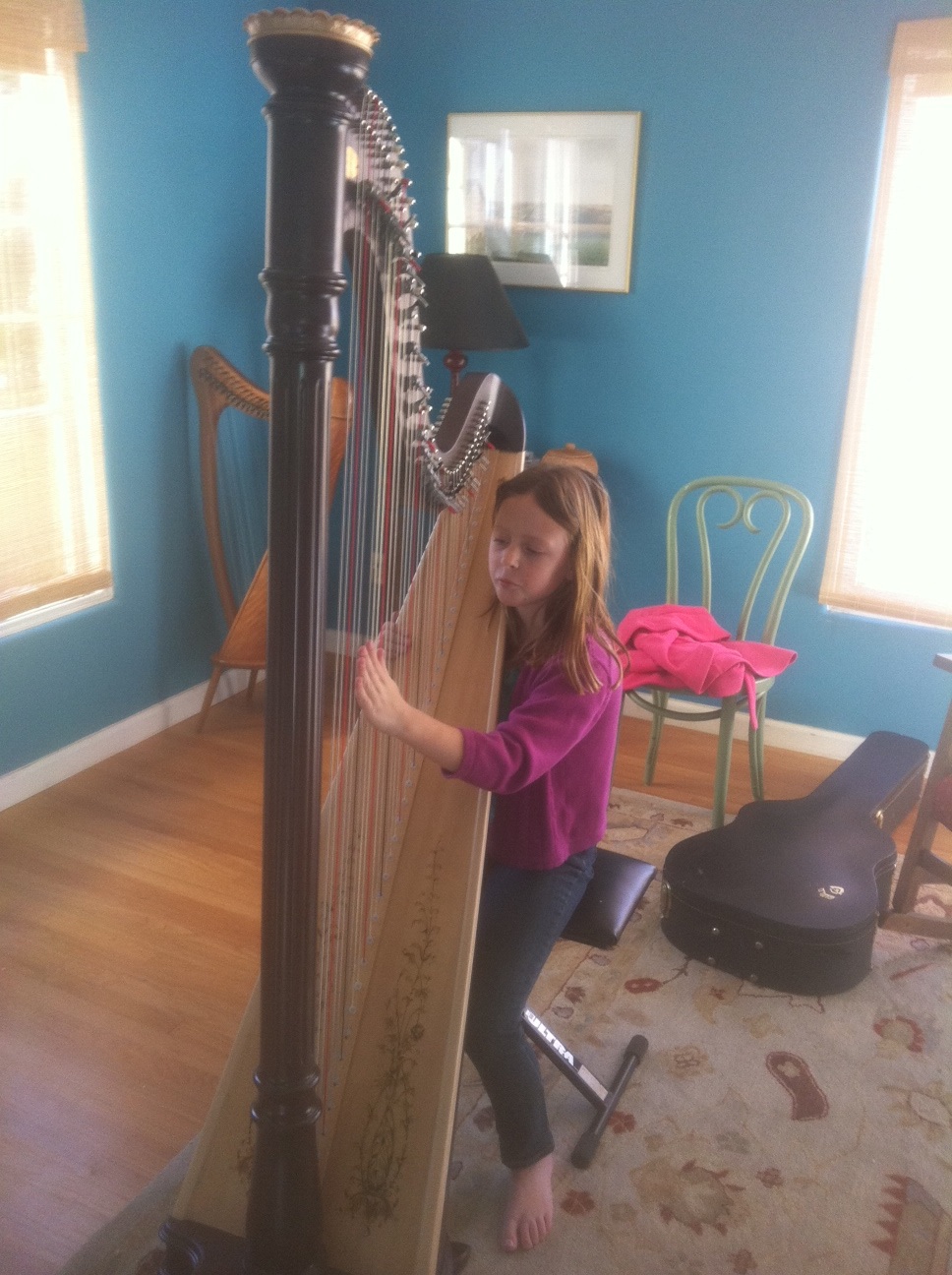
And then there’s the harp. I just got my daughter a new harp since she grew out of the old one. I got a call from a delivery guy who said he was on his way, and I asked him if he was bringing the harp.

“I have no idea what it is,” he said. “All I know is it weighs seventy pounds.”

Now it’s in our living room. It’s like a piece of furniture… kind of the way a piano is.  You need to put in a place where you can get at it, where it’s going to look good and where it’s not going to get in the way.

Lifting it is not too hard, but toting 70 pounds in the shape of a harp through doorways and trying to get it into a car is either a two-person job or something that requires a dolly. Add 10-20 pounds and you’ve got a full-sized concert harp, something my little girl isn’t quite ready for.

This one has a gilded crown and two stabilizing feet at the bottom in the shape of lion’s paws. Sophie wanted that. And her teacher told us it’s important for a young player to love her harp.

My family is a musical one and Sophie may or may not become a serious harp player. But she works at it and she enjoys performing because she likes to be special.  Meantime the harp will look good and give our house the air of refined artistry.

Moving a City of Cars

November 4, 2012

I remember traveling on the Interstate when I was a kid. It had two lanes in each direction as it rolled through the Iowa countryside. The roads were fast and they seemed huge.

Now I live in Southern California and I travel on freeways. They have at least four lanes in each direction but they seem small, and they are slow.

Freeways create cities whose parts are dense yet distant. That density is felt the most on the road in the late afternoon. That’s when I fight my way to my parents’ house to get my daughter and then fight my way to her harp lesson.

Freeways also create mobile cities of people isolated in their cars. Over a couple miles of compressed traffic I imagine seeing the entire population of the small town I grew up in, even though this community isn’t as populated as it looks since one car typically has only one person.

Sometimes I see two or three people inside another car, and they’re talking to each other. They’re laughing and smiling despite the challenge of holding their place in a line of undulating speed. Otherwise I see solo drivers staring straight ahead. They cling to the hope that space will magically appear and give them a clear path to their destination.

But in a city like this your destination is the traffic jam. It’s a part of life. Doesn’t have to be, but it is. Maybe those people laughing and smiling understand that.

People wear the steel and glass of a car like a suit. But it’s also your house when you’re part of the mobile city, which moves in unison until parts break off to reach another place that people imagine is better.

But don’t think about that. Because you’re on the freeway now and it’s your slow road to the paradise we share.