Archive for the ‘Uncategorized’ category

Baseball at My Desk

August 30, 2015

A baseball is a perfect thing. It’s just the right weight and size for being thrown fast and far. It pleads with your hand to hold it and squeeze it. And the flex of your hand muscles on the ball and the soft popping of joints feels like a long drag on the cigarette you’ve been craving.

Baseball

I used to have a desk partner named Mark who played high school baseball and kept a ball next to his computer. I realized I spent a lot of time picking it up and holding it. Then Mark moved across the newsroom and I finally went to Big Five sporting goods on a weekend and bought an official major league ball.

I hold it when I’m thinking. I twist it in my grip and rub the rawhide like a pitcher between throws. Sometimes I lean back in my chair and lob it toward the ceiling and hear the slap as it falls and hits my palm.

Baseball has always been my favorite team sport. My dad played the game when he was a kid. I was a little league catcher. There are dreams of baseball stardom I had when I was young that are wrapped up in that ball, and there are memories of great wins by my favorite teams though many more heartbreaking losses.

Now when the routine of earning a daily living gets to me I can reach over and feel that dream maker in my hand. Its red seams and the white rawhide pick me up and hurl my spirit into the blue sky of summer.

The Midwest in the Dead of Summer

August 10, 2015

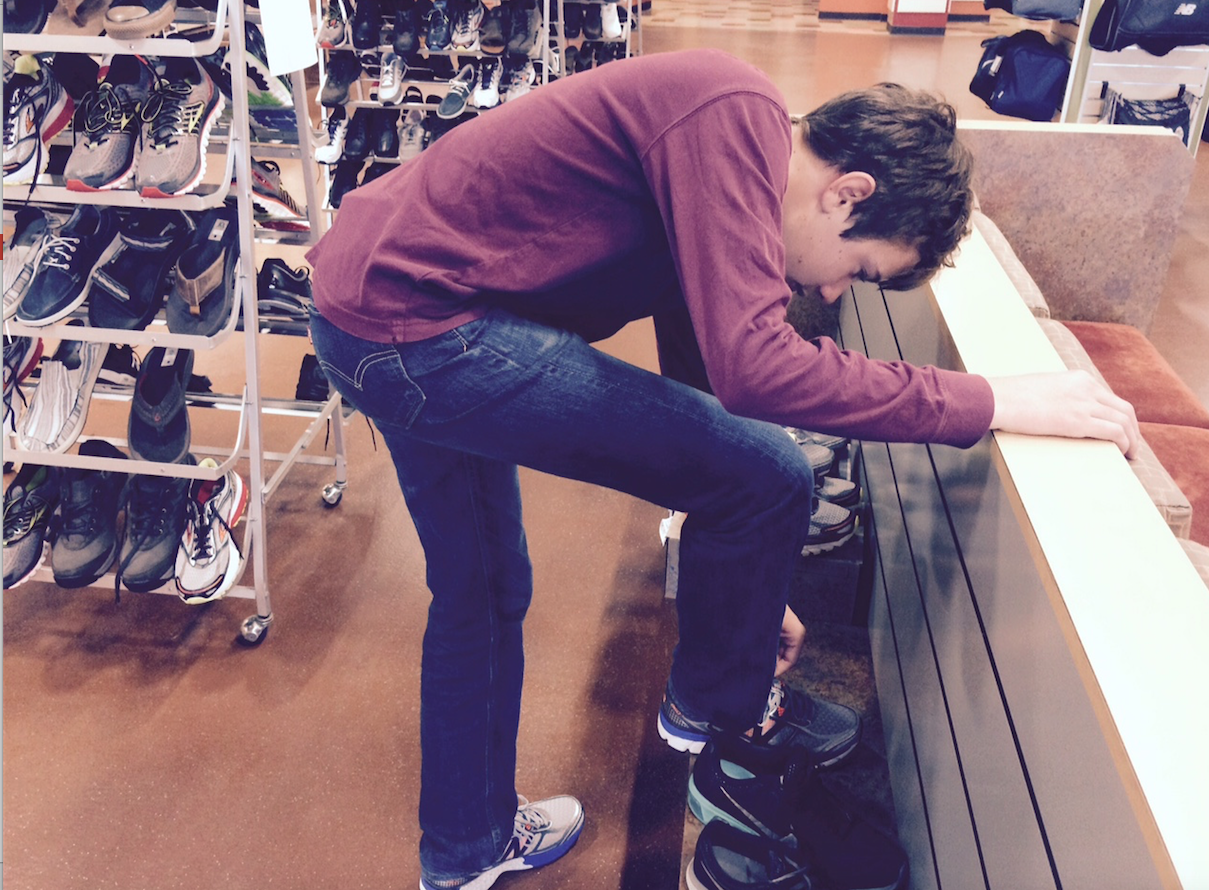
I remember being a teenager and shopping for shoes with my mom. The shoe salesman wouldn’t know whether to talk to me since I wasn’t paying for them. I’d mumble something then he would bring two boxes, and he and my mother would stare at me as if I was something very difficult to read. Were they afraid I would snarl and kick my shoe off?

Nick Shoes

I thought of this as I watched my teenage son trying on shoes in a store in Bloomington, Indiana. It was near the start of a two-week period I spent visiting my wife’s family in the Midwest. My son, still growing and unsure of how the world will fit around him, finally found some sneakers he liked. Then his mom told him it was time to go.

Southern Indiana was hot and muggy in July and the backyard of my in-laws house, normally the home of white-tailed deer, was empty. We were told they typically flee when they have guests.  Disappointing.

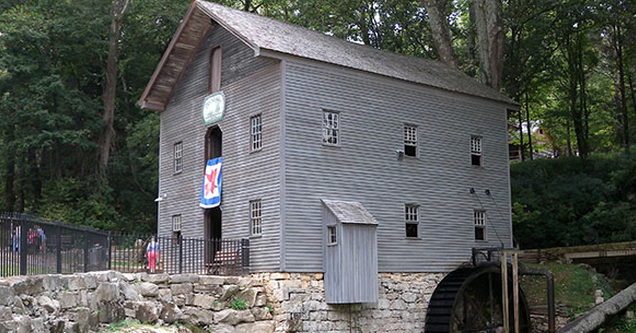
We made two trips out of town. One was to a 19th century mill, south of town, and another to a mansion in nearby Columbus. The Mill was in the hilly, tree-covered country that makes southern Indiana a part of the South. In the northern part of the state the accents are as flat as the farmland. Here the words are bent and in a way would look baroque if you could see them.

We got a tour of Beck’s Mill that still has two millstones that were turned by the water that came out of a cave in a hillside. Our tour guide looked like a queen. She was tall, straight and beautiful though she must have been 75 years old. Her face shone with a smile as she spoke in her splendid drawl and showed us the history of that gray barn, which ground corn downstairs and turned weaving machines upstairs, all powered by water. Some of the corn was made into whiskey back in the day.

Beck's Mill. Southern Indiana.

Beck’s Mill. Southern Indiana.

The next day we saw a mid-century mansion owned by the Millers, the industrialist and philanthropic family of Columbus, Indiana who ran Cummins Engine Company. The house had a conversation pit and floor-to-ceiling windows surrounding the place. The interior of the house was frozen in time (they lived there in the ’60s) with its carpeting, sleek furnishings and the purple couch in the master bedroom parlor.

Our tour guide was a local woman. Plump and cheerful, she spoke like a woman who must have socialized with the Millers at the country club. The place is now owned by the Indianapolis Museum of Art.

We drove to Ames, Iowa after stopping in Moline to see my brother. Pete and Rae are my in-laws and they live in Ames. They sit on the couch and read every evening while listening to classical music and visiting them was like visiting grandparents. We spent five days in Ames and it was more than enough.

I never fell in love with my wife’s hometown. It’s flat and homely with architecture that fits the plain Midwestern look of the place. But Ames is surprisingly prosperous and has, according to Pete, the highest property values in the state. The people are handsome in the way you’d expect of those who live on the right side of the tracks.

I grew up in a small town a lot like Ames or Bloomington; a college town with new people coming and going but — when you live there — a small town all the same. When you hire a contractor to work on your house you don’t just know him. You know his wife and your kids know their kids. If they have grown kids you know that their son George recently got married and moved out to Denver and you ask the contractor how his son’s doing out there.

Sophie & Nicholas in front of the house I grew up in.

Sophie & Nicholas in front of the house I grew up in.

The places we visited were the places I spent the years of my youth. The humidity, the green landscape with its forests and endless acres of farm fields are memories that get more and more distant. Going there used to feel like going home but it doesn’t anymore.

Finally we got to Minnesota, where we would stay in an Air B&B and get a flight home. I lived there for 17 years. Minnesotans are kind but not outgoing and not eager to talk to outsiders.

Minneapolis is flat and covered with a uniform grid of streets. It’s a great place to bike because you can get places on side streets. They’ve got a light-rail system that takes you to places you really want to go. There are small neighborhood meat markets. And did I mention the Mall of America?

I visited the new stadium of the St. Paul Saints baseball team and ended up in the office of owner Mike Veck, a swaggering showman who insisted I be let into his new ballpark for a look at it after the receptionist told me no.

Our last night there, Karen and I had dinner with old college friends of mine, Marita and Jeff. They were both at our wedding. Jeff was the best man.  They were cheerful and never ran out of things to say, happy exceptions to the general rule of Minnesotans being withdrawn.

Then I came back to San Diego. My kids may imagine there being better places, but I know this is home. There are other places that used to be home for me, but not any more. God willing, I’ll leave San Diego when I die.

Mall of America

Mall of America

Rain in July

July 19, 2015

One of the first things I learned about the San Diego climate was that it simply didn’t rain in the summer. Once April is done you won’t see rain until November. But this weekend it came down in buckets.

It started with some stray drops around 10 am and you don’t think anything will come from it. But by noon the houses across the street were in the white filter of a downpour. Even more rare, it was a thunderstorm.

Sophie and I began to count after I saw a flash out the window, to guess how far away the lightning was. One was real close. It was a blinding white light immediately followed by the explosive clap.

What we were seeing were the remnants of tropical storm Dolores. The storm brought humid air in its wake that was sometimes stirred by the winds but mostly it held us like a heavy robe and made the temps in the 80’s feel a lot warmer. Am I living in the tropics? Will I hear frogs croaking in the trees?

Folks around here get excited when it rains, especially now that we’ve still got a long ways to go to recovered from a four-year drought. The plants in this desert cling to life and life just got easier, thanks to the blessing of rain in July.

When All Things Seem Wonderful

June 25, 2015

We forget that life is precious when trials and responsibilities wear us down. But there is a state of mind that makes us face the fact without force or obligation. In fact, it comes to us with such stealth that we don’t realize it until much later.

Years ago I traveled to Italy with my wife to visit friends, and I tasted a Suave wine in an outdoor restaurant in Bergamo. It was the most wonderful white wine I’d ever had. When I returned home to Minnesota, the taste was so memorable that I had to find a case of it. After lots of searching I was able to find a half case, which a local wine seller said he’s hold for me if I’d come by soon.

I bought the bottles. I took them home, opened one and a poured a glass. I now see myself holding the wine in my mouth after expecting it to overcome me, just like it did before. It tasted plain. Not bad, but plain. It was a glass of white wine that tasted like lots of others I’d had before.

I lay in bed that night thinking about it and realized what was wrong. There was no sunny terrace, dotted with tables. There was no old city of Bergamo below the hilltop. I tasted the wine on a holiday when I was carefree in the company of friends. That magic was what made the Suave taste so good.

I thought of this when I was reading “David Copperfield” by Charles Dickens a couple of days ago. The named character tells how he fell in love with a girl. They were only children when they shared a home for two weeks on the English seaside. Years later, David Copperfield wrote of it:

“It seems to me, at this hour, that I have never seen such sunlight as on those bright April afternoons; that I have never beheld such sky, such water, such glorified ships sailing away into the golden air.”

Weeds

June 17, 2015

Merriam-Webster defines a weed as a plant that is “not valued where it is growing.” This is good to remember when you see plants taking root in your garden that were not part of your calculation. They’re only weeds if you wish they weren’t there.

Mexican Evening Primrose in my Garden

Mexican Evening Primrose

Every spring and early summer a plant called Mexican Evening Primrose emerges in my yard. My backyard is large, because it backs onto a canyon. I never planted the primrose or planned for them. They simply appeared. But they have delicate pink flowers that paint the land with dabs of color that combine in waves that break just short of the fence.

When wild plants are desirable I call them volunteers, not weeds. Aside from the Mexican primrose, there is the tomato plant that came out even though I had decided I wasn’t going to plant a vegetable garden to spare water in a drought..

There is the Wandering Jew, a pretty plant with deep green leaves and tiny blue flowers. It’s fast growing and its stems stab roots into the ground as it walks across it. To keep it in check I tear off some parts and feed them to the chickens, never killing the whole thing.

Even dandelions are not entirely unwelcome because they’re happily eaten by the livestock. Same goes for the oxalis, a wild plant that looks like clover and runs mad in a San Diego winter. It’s a pest, I suppose, but it looks like a green blanket tumbled over the ground with tall yellow flowers. When I finally lose patience and tear them out, they don’t go to waste because there are the hens to feed.

Over the fence my yard gives way to a canyon that’s wild, in a sense, but like all of nature it’s touched by our presence with exotic trees and shrubs that were never seen two centuries ago. Humans have dominion over the plants and animals just like it says in the good book but it’s always slipping away. I’ll lose my grip on my plot of land as long as they’re not bunch of goddamn weeds.

Looking back on a distant past

May 31, 2015

My work and my family are things that intersect every day though I try to keep them at a comfortable distance from each other. My family includes my parents who also live in San Diego and are nearing the end of life. They have a nexus with my work life since I work for an NPR station and they are long-time listeners to public radio. If I’m on the air and they manage to hear it, they call me and tell me so.

Jim Fudge in Southhampton, UK during WWII.

Jim Fudge in Southhampton, UK during WWII.

Last week my father actually became part of my work. I was planning to fill in for a talk show called Midday Edition and we were approaching Memorial Day. In daily journalism it’s one of those days when you’re never quite sure what to talk about. You’re half-staffed because a lot of people have the day off. Government isn’t in business and you’re typically reduced to covering the same old ceremonies you did last year.

But since the day is about the armed forces, and it’s the 70th anniversary of the end of World War II, I jokingly suggested I could interview my dad. It turned out not to be a joke. My dad served in the Navy in WWII. He was at Omaha Beach on D-Day.

So the Friday before Memorial Day he walked with his cane into the Midday studio and sat down in front of a microphone to talk with his son about his war years.

His spoke at a halting pace and his stories were littered with stammers and um’s & ah’s. The magic of audio editing cleared a lot of that away and the version that aired was better, but still him.

When I listen to it I hear his history and the history of my lifetime, spent listening to those stories. He told just one story on the air that I’d never heard. It was of the time his mother made him promise, before he left for the war, never to smoke or drink alcohol. They were promises he immediately broke.

I inherited my father’s voice and in the past they have been so similar that I was mistaken for him by people calling our family home. But now my dad has the voice of an old man.

Two years ago, on Memorial Day, I remember going with my Dad on an Honor Flight to Washington D.C. with a lot of other vets his age. Today, WWII is an experience that binds us and separates us. When he is gone, World War II will start to seem like a distant past. But I’ll still have a recording of him talking about it.

The State of Marriage

May 28, 2015

The Supreme Court has just heard arguments in a case of gay marriage that will be ruled on in 2015. This time, I hear, there will be no dodging the issue by ruling on technicalities, like they did in the California “Proposition 8” case two years ago. The court will decide whether or not states can restrict marriage to a union between a man and a woman.

I stated my views about gay marriage in a post I wrote in this blog five years ago, and they are the same today. Though today I’m more or less resigned to the fact that marriage has become a contract between two adults that doesn’t really have anything to do with kids.

My past opposition to same-sex marriage has been based on the fact that the institution of marriage has changed over hundreds and thousands of years, generally for the better. But it has always been a union between a man and a woman for the purpose of having children and creating new families.

Today, most people I know feel no obligation to replace themselves on earth. Marriage, in their minds, is about finding an intimate partner to share time and expenses with. The plummeting birth rate in developed nations should be proof enough that this adult pairing has become an end in itself. And if having kids isn’t what it’s all about, then same-sex, opposite-sex; what’s the difference?

Back in the days when marriage was about having children, we had a problem of overpopulation, which caused suffering and war. Reduction in birth rates is a move in the right direction.

Even so, the situation we’re now seeing in developed countries will be a problem, if it isn’t already. Countries like Germany and Italy are halving there native populations with every generation by having only one child per woman. Can they afford that? Are they really willing to accept the rates of immigration they’ll need to keep their populations sustainable? I doubt it.

Getting back to the U.S. situation… while I still believe in marriage as a pact between a man and a woman, I also believe in democracy. And if most Americans think gay marriage is the way to go, who am I? I’m just one vote. And yes, I would tell the Supreme Court to let the voters decide. The law is allowed to discriminate between partnerships, in whom the state has different levels of interest. The state is very interested in the state of a relationship, which gives rise to children who must be cared for. Couples without kids? They just aren’t that big a deal.

So Supreme Court, leave it up to the states. If public opinion is trending so strongly toward gay marriage, then gay marriage will prevail. It will be the choice of a democratic society, and I will make my peace with it. In fact, I already have.

Time to Walk the Chicken

April 19, 2015

Retail markets are based on cultural assumptions. And you assume a person walking into a pet store probably has a dog or a cat. If it’s a dog you take it for walks.

Chicken HalterBut what are pet stores supposed to make of the urban chicken movement? People in urban areas these days are keeping chickens for the eggs and the meat. Or so I thought. Is it possible these urban hens are not livestock but pets, just like the dog and the cat.

A co-worker of mine was in a pet store and spotted a product I’d never heard of. They were called chicken harnesses and, knowing I kept hens, she sent me a photo, thinking I might be interested. I was, though not because I wanted to buy one.

Let’s say you had one of these chicken harnesses. You put a chicken in it and fastened a leash to it, as shown in the promotional picture. What would you do next?

There’s no point in putting a hen in a harness if you just keep it in the coop. The chicken wire already prevents escape. So they must suppose you would take the chicken out on the sidewalk and walk it, like a dog.

I’ve always thought the mainline pet store retailers would eventually take aim at the urban chicken market. But I thought they would do it by selling, you know, chicken food. Instead, they’re selling something you can use to take your chicken for a walk.

Suburbia has always been a mix of rural life and city life. It’s city life in a professional sense but it’s rural in the amount of land it takes up. Until now, that land has been dominated by a monoculture of grass, mown by dad. But that is slowly starting to change as chickens and edible landscapes take hold.

Pet stores will get it. But it’ll take some time.

Environmental Puritanism Revisited

April 6, 2015

I was reminded of something this week that I observed a few years ago, which is the kindred connection between modern environmentalists and old fashioned Puritans. I wrote about that in this blog back in 2009. In the April 6th edition of the New Yorker, Jonathan Franzen mentions it in an article called Carbon Capture.

Cotton Mather

He describes the connection between environmentalism and New England Puritanism by saying:

Both belief systems are haunted by the feeling that simply to be human is to be guilty….And now climate change has given us an eschatology for reckoning with our guilt: coming soon, some hellishly overheated tomorrow, is Judgement Day. Unless we repent and mend our ways, we’ll all be sinners in the hands of an angry Earth. 

I had to look up eschatology. But you see where he’s going. Whether it’s the killing off of megafauna in the new world, deforestation or global warming, it’s all our fault. But put the “guilty human” argument to your average world citizen he says he’s just trying to live a decent life. Don’t we have that right?

Economists see human life as a business of taking the greatest advantage of goods and resources that exist. Capitalism convinces us that satisfying our wants is the meaning of life. But consider the possibility that materialism is killing our environment and our happiness.

Environmentalists can’t give in to Puritanism. It’s a fringe way of thinking that leads to hypocrisy and cold heartedness. The only route is to promote happiness. Being happy means living in God’s grace. It means being healthy. Being happy means not having a long, nerve-wracking commute. Moderation is a virtue. When it’s hot, slow down.

The Puritans are right that we’re all sinners, but to be human also means to accept forgiveness. We can also look at our lives and know that things can change, and maybe we’ll be happier if they do.


A Guilty Verdict & What I Told the Police

February 9, 2015

It was more than ten years ago, when I was still the member of a karate dojo in Clairemont, San Diego. Bilji was a member too, but he had been arrested.

“Was there anything else you heard?”

The homicide detective asked me that question, not long after the arrest. He had called me on the phone to ask about a meeting we had at the dojo. I talked with him for a while and I thought we were done. But there was one more thing.

“Did you hear someone say that Bilji said he felt like he could kill that guy?”

Bilji was a big man. About six feet tall and built like a football player. His skin was dark. He had a bookish manner, a deep soft voice and wire-rimmed glasses.

He was married to an American woman and they had a little boy. As time passed it became clear the boy had some  problems. I can’t remember what it was but he was maybe autistic. Mentally challenged somehow.

Bilji and his wife broke up. Bilge kept training at karate. He also took Japanese sword classes, called Bato Do. Bilji’s wife started seeing a man who lived in Del Cerro. The man turned up dead. Bilji was arrested for murder.

Like I said, our sensei called us into the dojo to talk about what had happened. The meeting ended up being a bad idea. As we talked about it there was one guy. He was a black Englishman. I can’t remember his name. He was sitting near the back of the room and he said something.

“What did he say?” I asked someone who sat closer to me.

“He said Bilji once told him he felt like he could kill that guy.”

I said to the people in the group that we should stop talking about this because we all might have to talk to the police.

“Hey. I don’t say nothin’ to the man!” said Larry, a guy from Detroit who got the tense room to calm down with laughter.

But after about three months the man had me on the phone. Oh sure, I said, our karate instructor asked us to come to the dojo and he told us Bilji was arrested. He told us he went to see him in jail and Bilji tried to make a joke about it, avoiding the topic.

“Was there anything else you heard?”

I think it was true that I didn’t hear the incriminating statement he asked about. But someone told it to me and it was not contradicted by the guy who said it. Should I have just told the detective what he wanted to hear without him dragging it out of me? It was the truth and I knew it would come up.

Maybe it’s natural to not trust the police and not to want to tell them everything you know, even when you believe in the rule of law and you don’t think murderers should be allowed to get away with it.

Bilji was convicted. He stabbed the man his wife was dating to death in his house. Word had it that he did it with his Bato Do sword. I don’t know what has happened to Bilji in the past ten years. Maybe he appealed the conviction and got off somehow. But my guess is that he’s still in some California prison with a long way — maybe life — to go.

I remember the stuff Bilji used to tell me. He was a member of an Indian family but spent most of his childhood in Nigeria, where he learned to be streetwise.

He told me he meditated, which I did too. So now I try to picture him on the floor of a prison cell, sitting Japanese-style with legs folded beneath him, his eyes closed and his hands resting on his thighs. You empty your mind of thoughts to find some spiritual peace. For Bilji, it could give him a moment to stop thinking about his son, his past life and the things he has done.