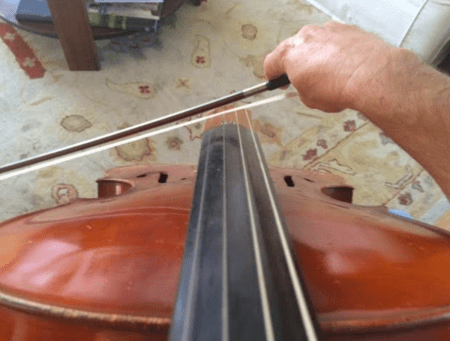
My childhood is a faraway place I know through memories that become smaller as time moves on. I thought of this as my parents moved out of their condo and into an old folks home, and I got some of the things that had followed them but they no longer could keep. Like their photos. And the cello I played as a kid.
I hadn’t played it for 35 years. Nearly that entire time the cello lay on its side under their piano in a soft case that was slowly disintegrating. The bow hadn’t been re-haired since it had last been used and the strings were old and stiff. The instrument was still fine though. So far as I can tell it’s in as good shape as it was when I was 20. More than I can say for myself.
My cello was built in Mittenwald, Germany. I named it Herman when I was a kid because kids give names to things that mean something to them, though I’m not sure I liked my cello since it represented the hard work of practicing, which I dreaded every day. But when my wife suggested we sell Herman, along with a guitar I stopped playing years ago, I said no. Selling the guitar was fine but the cello touched something in my past that was bigger.
The thought of losing Herman made me take a greater interest in it. I asked Tasha, my daughter’s harp teacher, to refer me to a shop in San Diego that sold instruments and repaired them, and she sent me to the Violin Shop, which was run by a family that had known Tasha since she was a little girl.
You might expect a stringed instrument shop to be downtown or on some old neighborhood main street, sort of like the place in Chicago where my family bought the cello more than 40 years ago. But the Violin Shop was in Sorrento Valley, a small-scale Silicon Valley where San Diego’s high-tech and life-science industries are wedged into big glass buildings on a suburban landscape.
I had to make two passes at the building that contained the shop until I knew what my GPS was pointing at, and I managed to spot the store’s name on a sign along the four-lane road.
Once inside, I left my bow with a man named Carlos and made an appointment with the proprietors to buy new strings the following week. I felt like an ass when I asked questions because the cello had become so unfamiliar to me with the passing years. I was like a man who was struggling with some subject he always left to his wife.
“Are bows still strung with horse hair?” I asked.
“I use raccoon hair,” said Carlos.
It was a joke. I left with the impression that yes, they still use horse hair. I dropped Tasha’s name to Mr. Smith who runs the place and he smiled because that’s what people do when they think about Tasha.
Prior to all this, I’d ordered some sheet music; Bach’s six unaccompanied cello suites. In there I found a minuet I once performed. And when I got my cello set to go — new strings, rehaired and rosined bow — I sat down to play.
My hands remembered. Pressing the strings against the fingerboard stung a bit because I’d lost my calluses and I had to reach farther for notes than I recall. But the feeling was still there. Regaining the muscle tone I used to have seemed within reach. The bow found the strings and pulling it over them brought that wonderful tone.
So now what do I do?
My body has a memory that had become smaller but not by much. Do I practice and get better? I am still a middle-aged man with a life full of stuff I need to do. I never dreamed of being an outstanding cello player and I never will be. But being able to do it at all seems like a gift. It’s a little like a poem you were forced to memorize in high school that you remember decades later and you finally understand.
My parents will not live much longer. I’ll practice that minuet until I get good at it again and I’ll play if for them. That’s the least I can do.

 CUL-DE-SAC