If you see a tree in San Diego it doesn’t belong here. Aside from the riparian oaks along the San Diego River and the pines high in the mountains, our trees are transplants from other places. Urbanization, paradoxically, has given San Diego a forest. And nowhere is our man-made forest more wonderfully contrived than in Balboa Park.
Different people have different ideas of what a park is supposed to be. Some think it’s a piece of nature in the middle of the city. Go to Mission Trails Park (not really in the middle of the city, but close) and that’s what you’ll find. But most parks are better described as green spaces where we find recreation and contemplation.
Balboa Park is San Diego’s most prized possession and there’s nothing natural or native about it. That’s true of its displays of Spanish renaissance architecture and its conglomeration of exotic fauna (at the Zoo) and flora. Mike Marika told me they have about 500 species of trees in the park.
Mike is a city arborist who takes care of the trees. He’s got a sunburned complexion and an absent-minded way of speaking that makes him fit right in with the park’s casual air. Still, when you’re waiting to meet a park official he’s not the person you expect will show up.
We met in the park’s desert garden on Park Boulevard and we spoke as Mike wandered around turning on water spigots. I asked him to stop calling the plants by their Latin names. This was a problem because many of the plants in Balboa Park are so rare they don’t have common names.
He pointed out a jumping cactus. There was a palm, which looked pretty ordinary to me, that he said was grown from seeds found in the tombs of the Egyptian Pharaohs. He told me about the park’s aloe bainesii that Ted Geisel (Dr. Suess) would sketch during his many visits. Look at enough of Geisel’s cartoons and you’ll eventually see it.
I asked him what was the horticultural mission of Balboa Park. Mike said he knew the park had one but he couldn’t remember what it was, though it had something to do with introducing new varieties of trees.
“If there’s something out there, somebody has probably tried it here,” said Marika.
As we stood on the edge of Florida canyon, Mike stopped talking mid-sentence to point out a tarantula hawk wasp as it wandered along the ground in search of prey. A large black bug that’s brilliant orange along the top, it captures tarantulas and lays eggs in them.
“So there are tarantulas in Balboa Park?” I asked.
“Apparently so,” he said.
The desert garden pretty much takes care of itself and it’s emblematic of a shift in focus toward drought-tolerant plants. The water expenditure to maintain Balboa Park is great. And some of the non-native trees are victims of deadly pests. Eucalyptus trees are under constant assault by the lurp psyllid. Predatory insects have been introduced to kill the lurp psyllids, but Mike said they can be slow to catch up.
I asked Mike Marika what was his favorite tree in the park. He said, not surprisingly, it was the almost 100-year-old ficus macrophylla, A.K.A. Moreton Bay Fig, that sits near the front entrance of the Natural History Museum.
The park has put up a fence around the tree to prevent compaction of soil and, Mike said, to prevent kids from carving their initials in it. I told him I loved the ficus trees near the San Diego Historical Society whose roots reach like fingers down a nearby hill.
The urban forest has many charms. It’s our erratic skyline and our shield to the sun.
Editor’s Note: This visit with Mike Marika was first published in 2011.
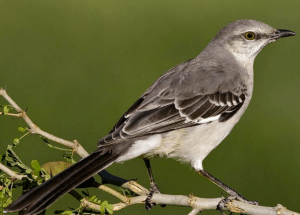 I was stunned by the music of this bird. Lately I’ve become accustomed to hearing it but I still cannot anticipate where her song will go next. The more astounding thing for me was learning what the bird actually looked like. I expected awesome colors. Maybe not an artsy mosaic but at least a brilliant red or blue.
 CUL-DE-SAC
