Archive for October 2014

A Place I Remember

October 17, 2014

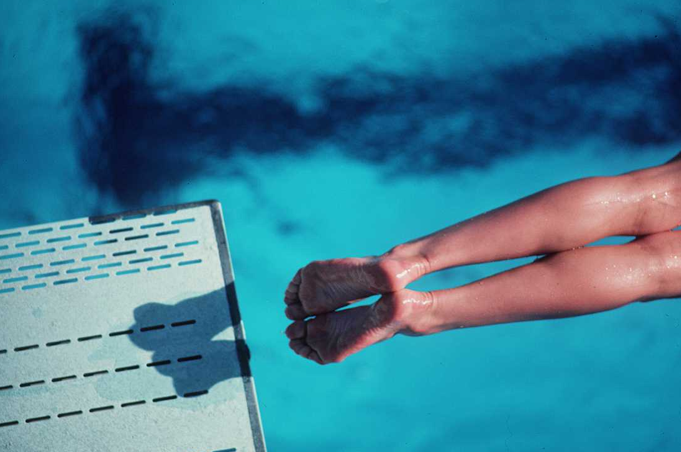
I walk the length of the diving board. I jump onto the end, the board flexes and throws me into the air. I do a somersault and then try to stab the water quick and silent with my fingertips.

I’m in high school and I’m a diver on the swim team. I wasn’t gifted but I was good enough that my dives took me straight to the bottom of the pool.

Diving Board

It was there I had the feeling. It was the deepest part of the pool, cement painted blue with a black drain in the center. I waited for a moment before I pushed off the floor then burst out of the water and into the sound of the swimming hall.

I thought about that moment until it was my turn to dive again. I jumped, I left the board, touched the water and went to the bottom. My breath was held in and I listened to the quiet. I didn’t want to emerge back into that clamorous room and see the marks they’d give me for my dive.

I dove twice more and each time I’d linger longer below the surface. A teammate told me they began to wonder if I was okay and if someone should jump in to fish me out. But I stayed down there because I liked it.

My mind was still. I didn’t have to move. I didn’t even have to breath. I was held steady in the water’s soft grasp. I knew I would have to come back to the world again, but for a while my mind and body were in perfect peace. Even now, almost 40 years later, when life gets in my way, I think about being at the bottom of the pool.


Repeating Car Talk

October 14, 2014

I don’t just work in public radio, I listen to it. Maybe that makes me an ultra-nerd, but there is one show with a good-hearted comic spirit that has made it a welcome exception to other NPR fare that can be way too serious. That show is Car Talk.
Tom:Ray

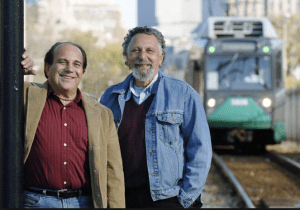
The tappet brothers. Ray on the left and Tom on the right.

If you follow public radio you know by now that that Car Talk is running on fumes. By fumes I mean reruns. This began two years ago. But the reruns, like the hundreds of new shows they did, are so brilliantly produced and edited that I am only now beginning to notice that the mechanical mishaps described by callers are sounding pretty familiar.

Of course, the show didn’t just have great production values. It had Tom and Ray Magliozzi. It was like I’d turn on the radio every Saturday morning and be able to spend an hour with my two favorite Boston uncles.

Somehow Tom and Ray managed to always be funny, never be mean and to always leave you with some sound advice, like a good uncle should. You might wish they didn’t laugh so much, for instance. But if you did, it brought on an affectionate roll of the eyes, never an irritated scowl that made you turn off the radio.

In fact, it’s that thing about giving good advice that was the show’s saving grace.

I say this because I can’t think of one entertainment show on TV or radio that I haven’t gotten tired of. Sometimes it takes a while. I probably listened to a Prairie Home Companion Show for 20 years before I finally decided I’d heard enough news from Lake Wobegon. But Car Talk has never lost its freshness or appeal.

How did they do it? Lemme answer that by posing another question. If you stripped Car Talk of every laugh and every joke; if Tom and Ray stopped fooling around and did the show dead serious, what would you be left with? You’d be left with a show where you still learned a hell of a lot about cars.

Car Talk mined the depths of an incredibly rich topic, that miracle of modern engineering called the automobile. And Tom and Ray seemed like they knew it all. I don’t think I ever came away from a show without knowing something new about cars. Maybe I learned what was causing that rattling sound that typically comes from the driver’s side front wheel. Or maybe I found out how a car’s computer software could be reprogrammed to change the fuel injection and boost performance.

The show had myriad opportunities to delve into the affections we have for our cars, and the fights we get into with some no-good relative who sold us his beater. But it was the hard info about cars that kept me around. The charms of the tappet brothers were great but eventually I’d get tired, even of them.

In a strange way, Car Talk was the quintessential public radio show. It ultimately succeeded because people always learned something when they heard it. Public radio fans (and employees) like the medium because it makes you feel like you’re still going to college. Tom and Ray taught us classes about mechanics, engineering and computer science, just by talking about cars. And they did it in a way that made you laugh.

As time goes on, the reruns will start sounding more like reruns. Car Talk will have to come to an end, assuming the tappet brothers have no plans to come out of retirement. We get tired of hearing the same stories over and over, even when we’re hearing them from our favorite uncles.


Update, November 3, 2014: Rest in Peace, Tom Magliozzi.


Hope for the Human Race

October 13, 2014

Not long ago I wrote on this blog about nature’s gift of violence and the absurdity of trying to eliminate violence in a society that still sanctions and even celebrates it in places like the military and the National Football League. But here’s the good news: Just give us a few tens of thousand of years of evolution and we’ll probably get more peaceful.

That seemed to be the conclusion of a KPBS talk show interview I did, in which two guys talked about a coming symposium on human domestication. You know about our domestication of dogs, cats and farm animals. Well, according to the hypothesis of people in the field, we’ve done essentially the same thing to ourselves over the life of the human species.

Social skills and social organization have caused us to value peaceful collaboration above strength and aggression. So human evolution has selected individuals for social skills, not the angry stuff. Highly aggressive people and people who can’t get along with others have been banished, executed or imprisoned by societies. Think about it. Their isolation or disappearance means they can’t have progeny and pass along their traits to offspring.

This process, over thousands of years, has even had an effect on our physical aspect. We now have smaller teeth and more fragile bones than did our forebears 100,000 years ago.

Listen to the interview to get the indepth version of the story. But here’s what one of my guests, Harvard Prof Richard Wrangham, said about the possibility that we will become yet more peaceful and domesticated in the distant future:

The happy thing here is if you look at the historical and prehistorical evidence, humans have been getting more peaceful in detectable time, and it seems likely that is going to continue. Whether or not it’s due to evolution, social institutions, or changing morals, that’s uncertain. But the nice optimistic news is that, in general, we are becoming less violent.

If only I could live to see the evolving reality.


Reusable Bags are so White

October 5, 2014

The State of California just passed the first statewide ban on giving disposable plastic bags away at grocery store checkout counters. The American Progressive Bag Alliance (I LOVE their name) wants to get the law overturned in a referendum, but they’re just a bunch of plastic bag makers who want to keep making money.

I think it’s a fine law and I’m OK with bringing my reusable bags to Safeway. But — please — reusable bags are so white.

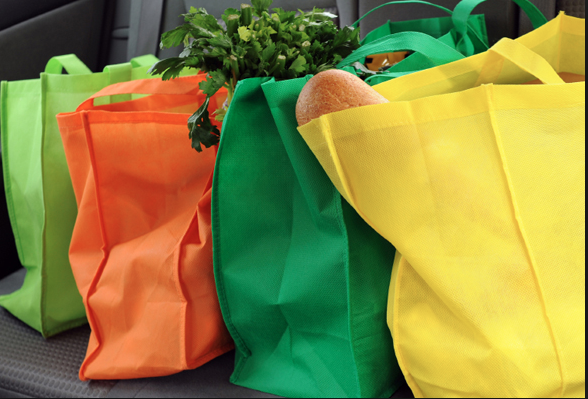
BagsI know this from going to the City Heights farmers market. It’s the closest farmers market to where I live and that’s why I frequent it. As a white man I’m definitely a racial minority there. Not complaining, just saying. The food stands are operated by a mix of Africans, Mexicans and Vietnamese who sell a lot of greens I don’t recognize. They sell raw peanuts. What do you do with raw peanuts?

There was a time when I brought reusable bags to put stuff in, but it was embarrassing. By the time I bought the fruit, or whatever it was, from the cashier she had already plucked a plastic bag from the role and put the stuff in it.

“Excuse me, but I brought my own bag.”

They would look at me, fish the fruit out of the plastic bag and give it to me to drop in my ecologically friendly tote.

Pious jerk! No, they probably weren’t thinking that. But they probably did think I was a well-heeled white man who was so sated and comfortable that he actually had time to think about what kind of bag he should bring to the farmers’ market.

Everyone at this market was carrying around food in disposable plastic bags except for the middle-aged liberals who condescend to shop there and carry their reusable bags; well-worn of course because insisting on having shiny new bags would exhibit a lifestyle that was unsustainable.

Reusable bags are way too white here, so I chose to respect the local custom. Do we need to get rid of disposable plastic bags? We don’t need to but we should, if only to prevent our planet from being covered in the damn things, which are carried by the wind like kites.

My point is that worrying about reducing the number of plastic bags in the world is a privilege of wealth. And that’s why poor immigrants who go to the City Heights farmers market aren’t concerned about it. They got bigger fish to fry.