Archive for March 2014

Jazz & Race & Growin’ Up White

March 23, 2014
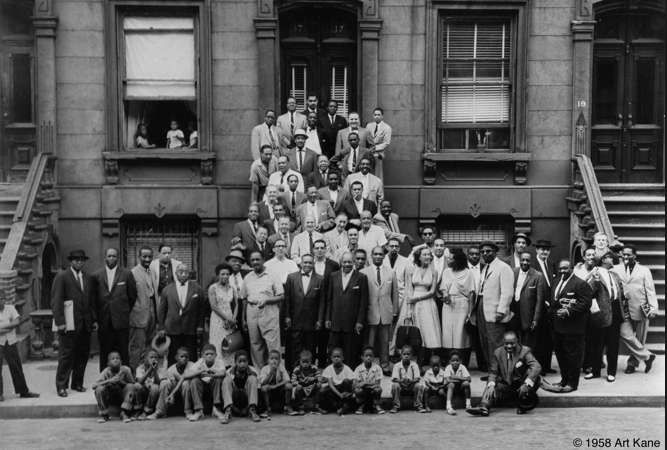
Great Day

Jazz stars posed for a photo called  ‘A Great Day in Harlem.’ It hangs in my bedroom.

I grew up in a place so white that Italians were people of color. Today it’s hard for me to imagine anywhere in this country quite like it. When my brother first saw a black person, in Grand Forks, North Dakota, he asked her why her skin looked like that. In Grinnell, Iowa there was one black family, one Jewish family and one Mexican family in a town of 8,000.

What I knew about black people came from TV, the news media and from records.

Thing about my brother and me… we grew up in a musical family. When other kids our age listened to pop singles on the radio, we got into jazz. And we couldn’t help noticing that the greatest jazz players — nearly all of them — were black men.

I loved (still do) the excitement of jazz. The swinging rhythms and the amazing invention. Those black jazz musicians seemed like gods to me.  I was learning to play instruments and I knew how hard they were to master. Jazz artists could play with such speed and virtuosity, and not just that. They were making it up as they went along!! Somehow each note was spontaneously combusted. How did they do it?

The astounding musical improv of the jazz musicians was something I could barely even imagine. Yet I was forced to try to imagine what kind of people lived in African America, a place that I simply never saw. I knew about the history of slavery and racial bigotry and the poverty that black folks suffered over the years. But just as I wondered at the artistry of the jazz men I was puzzled by the stories of violent crime in urban black communities, the black power movement and the fights between the black and white when they started busing school kids in Boston.

What was going on? If the jazz musicians were gods were black criminals devils? The distance between them and me and the images filtered through the media made it hard to believe they could be mere human beings. Today I live in a place were black people are part of the landscape but not a part of my personal life. The barriers are lower and less visible but we have not overcome them.

My brother and I played jazz music when we were in our teens. I played drums and he played upright bass. In fact, Jim still plays bass in jazz combos where he lives in Illinois. He’s gone much further than me, being able to understand the musical invention I found so miraculous.

Years of time and miles of distance have caused my brother and me to grow apart, but we still have the common language of jazz. He sends me CD’s in the mail, like the recording I just got of sax players Johnny Griffin and Eddie “Lockjaw” Davis playing live at Minton’s, wherever that is. I hadn’t heard Eddie Davis play in decades but I immediately recognized the voice of his horn. It’s quick and graceful but starts to shout when he wants to heighten the drama.

I listen to that CD on my car stereo and it takes me back to the days when I played jazz records until I wore out the grooves, hearing the amazing sounds of the black men who played it.

Dante: Leprechaun

March 17, 2014

I’ve never read anything by Dante, though I know he wrote something concerning hell fire and I have a bust of him in my house. Maybe it’s strange to display his likeness when I know so little about him, but there is a family history behind Dante.

Dante

My wife is Irish on both sides. But one grandparent was Italian; family name, Galdieri. My wife’s great-grandfather Galdieri was an Italian immigrant who trained as a engineer but found work as a tailor and clothing designer after he crossed the Atlantic and ended up in New York. He kept a black head-and-shoulders statue of Dante in his library, and it’s the same one that sits on an old chest today in my family room in San Diego.

Like the chest, it came west in a U-Haul trailer after my wife an I visited her Grandma in northern New Jersey and brought home odd sticks of furniture and pieces of art that Grandma was willing to part with. Believe me, it wasn’t the good stuff. So we got the bust of Dante.

He must have been a serious dude because the Dante bust wears a scowl. He has a sharp chin and a beaked nose and his expression is a constant invitation to parody. That’s why we are always putting hats on him. During the Christmas season he wears a Santa hat. In the summer he wears a straw fedora that I sometimes remove and wear myself if I need protection from the sun. This week he’s a leprechaun in observance of St. Patrick’s Day.

So Happy St. Patrick’s Day.

Train Trip

March 16, 2014

I love trains. I love the sound of them and sight of them.

I loved looking across a broad valley in Eastern California and seeing a train engine in the distance pulling what must have been a mile of freight cars along a lonely desert track. I remember when I was young, being in love with a girl who lived in an apartment right next to a train track and hearing the sound of the train passing by as I lay next to her.

Amtrak Surfliner

Amtrak Surfliner

Even now I love being on a train. Last week I took the train to LA for work. The green line trolley in San Diego took me to the Old Town station, where I caught the Amtrak Surfliner to Union Station in Los Angeles, where I got the gold line trolley that took me to Pasadena. The Pasadena station was just two blocks from my hotel.

You get a big comfortable seat on the train. The ride is smooth and (on the Surfliner) you have a view of the Pacific Ocean and the setting sun. When happy hour rolls around you can walk down to the dining car and get a beer and a sandwich.

On the way back I had to wait for about 50 minutes at Union Station for my connection. The stone floors of the main terminal are a glossy mosaic. The wood ceiling looks like the inside of a church, and soft leather chairs connect in a row.

Hurtling across time zones in the cramped seats of a jet or battling freeway traffic masquerade as progress, but think about taking the train.

The Fuel of Choice

March 11, 2014

Sometimes an offhand remark makes you realize something that never occurred to you. This happened when I was telling the mother of a 1-year-old about choosing a school for your kid. In San Diego your choices are many, and you can end up sending your kid all across town to get just the right place.

That must have a big carbon impact, she said.

Well, I suppose it does. If my 8th grade boy gets into the charter school High Tech High, and we decide to send him there, that’s a 12 mile drive… and that’s the price of choice.

When I was a kid we attended the neighborhood school. It may not have been the best school in town but it was the one you went to because that was how the system worked and we didn’t question it. But then came school busing in a lot of big-city school districts, which ended up being a lousy idea. Then they gave us school choice, with magnet schools and charter schools.  The system was jury-rigged to try to achieve some level of class and racial integration. Admission to High Tech High, for instance, is based on a lottery and your chances are best if you come from a zip code that isn’t sending a lot of applicants.

But getting back to the old carbon footprint, transporting your kid all around town to attend school takes a lot of oil and gas. So does importing French wine and taking overseas vacations. It’s odd to think of myself as the kind of father that tells stories of how tough life was when I was a kid. It wasn’t tough because I grew up in a safe, middle class environment. But life was simpler and it was a lot more sustainable than today, from a standpoint of energy.

I walked or rode my bike to the neighborhood school. I ate Wonder Bread and Cheerios. My parents owned one car and one TV and my dad kept Budweiser in the fridge. Aside from one flight to New York when I was an baby, I never flew in a plane until I was 17 years old.

Today we suffer the tyranny of choice: Multiple schools to choose from and an endless supply of products that are a computer click away, which, of course, they aren’t really because somebody in a warehouse in Fresno has to put the product in a truck and send it to your house.

I serve on the board of a group that was just renamed Circulate San Diego. It’s a mix of two groups that had been called Walk San Diego & Move San Diego. The goal is to make our city less dependent on car travel and to encourage people to walk, ride a bike or use public transportation. I won’t go into the whole sales pitch but hopefully you can see how this can make people healthier, reduce greenhouse emissions and make our neighborhoods safer and more sociable.

Our biggest challenge is changing American culture from one that is fully dependent on car travel. But in order to make that change, what do people have to give up? Some convenience. Some speed. Some privacy. And… some choice.

The local school may not be the best for your child, but that’s what you settle for. Same goes for the local grocery store. To reduce air travel, and huge carbon impact that has, maybe a road trip to Joshua Tree or a fishing trip to Minnesota takes the place of a jaunt to London. It’s a journey back to the life I led growing up in a small town in the Midwest, or the life big-city kids knew when they walked to school, played in vacant lots and hopped on a bus or a streetcar if they were feeling really adventuresome. We didn’t expect a lot so that’s what we got.

Americans today have grown up in a culture that says you can have anything you want. All it takes is a little money. But this isn’t a true choice. It’s a tyranny of choice that makes choosing the right goods or services an obligation that’s more important than your physical health or peace of mind.

The freedom of choice demands constant decision-making even when it comes to trivial things, and it is fueled by an energy source that can bring environmental calamity. Maybe it’s time to choose something else.

The Night I got Stopped by the Cops

March 7, 2014

The job of the police isn’t supposed to be easy. Suspects aren’t supposed to be grateful when they’re taken into custody. Cops are supposed to be questioned when they stop or arrest somebody. So here’s my question: Why I was stopped by police last month?

I was riding a bike about three blocks from my house when someone yelled at me from inside a squad car. I was dressed in jeans and a T-shirt and was riding at night without no front or rear light. Maybe law-abiders practice better traffic safety. But neither of these guys told me I was riding without a light or a crash helmet. I wasn’t a motorist stopped for having a brake light out.San Diego Police

The officers were two big white guys who were probably a good 20 years younger than me.

Are you carrying identification? one of them said.

I shook my head no. They asked me where I lived, and I told them my address and said I could show them the house.

Just stay right there, they said.

For the next five minutes one of them went into the squad car and, I assume, ran my name and address through the computer. Pretty soon they were saying, You can go now. Just doing our job. You said you had your garage burglarized? Then you know why were here.

When I had said I had no I.D. one of them pointed out that I wasn’t required to carry I.D. Hey buddy, this ain’t a police state!

I got home and felt my back pocket. I was carrying I.D. When you’re stopped by the law you’re wigged out and I guess you’re just not thinking straight.

Maybe I should be flattered the police think I’m still young enough to get involved in street crime.

It was the second time San Diego’s finest had questioned me. The first time I was outside a strip mall in City Heights, just a week after I’d moved to town, and I was removing the license plates from a car. OK. I know that could have looked suspicious, but it was my car. I was removing my old Minnesota license plates to put on the California ones. The cops had been eating lunch in a Mexican restaurant. I had just come out of a hardware story, also in the strip mall, where I’d bought a screwdriver and pliers to do the job.

People like me assume that if the police are stopping you they’ve probably got some kind of reason. Maybe they get it wrong — in my case they did both times — but what the fuck. They’ve got a job to do.

Ever since I’ve been a reporter I’ve heard folks in the black community say they are stopped and questioned just for being black. One of the reporters where I work just did a story about police being accused of stopping black motorists for no good reason. It might as well have been a story I did 20 years ago. The same accusations. The same denials.

We all live in a human skin but we don’t live in the same world.  It’s different for women than for men and it’s different for blacks than for whites. Sometimes you’re treated very differently, depending on your color, and even if you’re treated the same it doesn’t feel the same because you expect to be treated in a certain way, and so you read stuff into what the other is doing or saying.

A journalist named James Fallows used to live in Japan and he remembered going to a meeting full of Japanese men in suits. The Japanese guys were already there, and they looked at their watches when he walked in the door to point out that Americans were rude and never arrived on time. On the other hand, maybe they were just wondering what time it was.

We can all get on the wrong side of power and I guess you never know what that’s like until it happens. And we can all be hated for what people see when we walk in the door. Love is the only antidote.

End of the Day

March 2, 2014

Sundown now comes before I leave work. Most days I take my bike and have to drive home in the winter darkness. The battery-powered red light in back winks a quick rhythm as I skirt the edge of a four-lane avenue, crowded with fast-moving cars.

I must be mad to still bike in Southern California. Most people give it up once they get hit by a car. But I still live in idealistic disharmony with the world around me.

Portrait

It takes ten minutes to get home. My kids have been done with Catholic school for a couple of hours and my 86-year-old mother is watching them. She doesn’t have to watch them but she likes to. It’s a break for being at home all day and putting up with my dad.

I can’t decide whether people in long marriages who live together until they expire make perfect sense or if they require a huge act of will. Someone did a study. It showed divorce rates go up after people retire. Now that would make perfect sense. ‘Living with you was fine when you were away at work most of the time!’

My parents are about to have their 60th anniversary. How do they do it? Maybe I’ll find out. Time for a drink.

I rattle two ice cubes at the bottom of a cocktail glass as I reach for a 1.75 liter bottle of Tangueray. I measure two drams. I always measure. The gin soaks the ice cubes so they lose their frosty sheen and make gentle cracking sounds. I add tonic (don’t measure) and finally the crucial garnish; a wedge of fresh lime which I squeeze to release its nectar before I drop it in the drink. I have a lime tree in a big pot out in front in case of emergencies.

The Tangueray dulls my senses and my mind takes a walk. I think of last Saturday when I took my son to apply for St. Augustine High School. He’s in 8th grade and we’re trying to figure out what the next step is.

When I went to pick him up I saw Nicholas in the courtyard of Vasey Hall, standing alone as usual. He waved to me and I saw him in the context of the other kids. He’s handsome. He’s unathletic. His khaki pants ride high on his waste and he looked like he wished he were someplace else.

I had been dreading this part of the application process because this was the interview. My son is shy and quiet, and he’s not a talker. He should be talking to his friends about girls and sports, and he should be able to turn that on when a school counselor asks him why he wants to go to Saints. Everybody calls St. Augustine Saints. But Nicholas is not a normal kid and that’s something I’ve known for years.

How did it go? I asked.

I don’t know, he said.

But then he tells me he didn’t think it went very well.

In the kitchen at home my dog stares at me, yearning for something. He has a sweater my wife knitted for him, and I imagine taking him for a walk in it. But it’s hard enough for me to be seen with a small Chinese lap dog in public. Maybe I should have another shot of gin since the first two felt so good, though I know that’s almost always a mistake.

My wife comes home. The kids are finished with homework and they start asking for things. My daughter wants to use the TV in the adjoining family room so she can watch Buddies, a series of shows about talking dogs you can get on Netflix.

No! I tell her, you are not going to chase me out of the kitchen with your show about talking dogs!

Now I’m having cheese and crackers and a glass of wine. And it drives me crazy listening to the banal dialogue they write for kids’ programs like Buddies. I have already spent too much time watching Golden Retriever pups with their mouths computer animated as they talk, being pursued by bad guys who want to capture and sell them as pets for some mean fat kid. I remind myself my daughter is only 9.

I start thinking about drugs for some reason. What drives a person to drugs. Despair? I was talking with a guy on the street in Minneapolis and that’s what he told me. But that’s a despair I’ve never known. And I know this as I look around my house at the end of a working day where my daughter is waiting to watch an episode of Buddies.

Me, I can’t really complain.