Archive for February 2014

Paying for Part of a Future in South Sudan

February 14, 2014

It looked like a typical garage sale in Clairemont. The tables were covered with used household goods, and kids were selling hot chocolate for 25 cents following a Saturday morning downpour. The only thing that seemed different here was a white van parked on the street that had “Southern Sudanese Community Center” hand-painted on the side, along with a flag I didn’t recognize.

The garage was attached to a house owned by Molly Wauson, and the sale was raising money to build a school in South Sudan.

Molly Wauson is a St. Didacus Parish School parent who is applying for 501c3 status for a non-profit called “Shaping Bright Futures.” The inspiration arrived last year when her 4th grader Abby wrote an essay about the people called the “lost boys” of Sudan. Soon after that she met a man named Mathew Riek, a former lost boy who ended up living in San Diego.

Onetime lost boy Mathew Riek with Molly Wauson.

Onetime lost boy Mathew Riek with Molly Wauson.

Abby and her mother were riveted by Mathew’s story, and they were inspired by his dream of building a school in his home village in South Sudan. That was when Molly Wauson began fundraising at a variety of places, including St. Didacus.

“The kids at St. Didacus were incredible!” said Wauson. “They raised over $850 by bringing in their jars of pennies.”

Mathew Riek is a small man with a slight build whose ebony face is animated by frequent smiles. His pleasant, peaceful nature seems at odds with the story of violence and desperation that ruled his childhood.

“I dodged bullets. I walked in the desert with lions in the cover of the dark of night. I starved and was thirsty, and was so tired,” he said.

Riek says he was a goat herder as a boy in his native village of Buaw. But Sudan’s internal war sent Riek on the run at the age of 12. After walking for what he said was a thousand miles he found refuge in a camp in Ethiopia. But political warfare in that country drove him out again at gunpoint, and he returned to Sudan by crossing the infamous Gilo River, with its dangerous rapids and man-eating crocodiles.

He lived in a camp in Sudan until the government sent planes to bomb it, and Mathew Riek fled once more, finally ending up in the Kakuma refugee camp in northern Kenya. He survived nine years there, often having to fight with other residents over the slim rations of food and water.

But eventually some American charitable groups arrived with the promise of resettlement. He remembers having to write an essay about his experience, memorize it and then meet with a representative of the Immigration and Naturalization Service (INS).

“You had to tell your story to the INS and try to get it right, because if you don’t tell the story the same way as you wrote it you might not come to America,” he recalls.

Mathew did make it to America after being sponsored by Catholic Charities. Now he’s focused on building his life and partnering with Molly Wauson and others to build a school in his village. Wauson said they are looking at an overall cost of at least $30,000, and their philosophy is to build it one brick at a time, at $3 a brick.

“We are using the people in Mathew’s village who learned in the refugee camp how to make their own bricks,” she said, adding that there will be a considerable expense in providing and transporting materials.

Wauson said children in Mathew Riek’ s village need the walls and the roof of a schoolhouse to make instruction consistent. Now, the kids have their lessons under a tree and they can’t hold classes during the rainy season or when it’s too hot.

Riek adds that education is his first priority for helping the kids of South Sudan, where the official illiteracy rate is 73 percent, though he expects it’s actually much higher. As for his own family, Riek said he’s lost his father and his mother. All that is left of his family are his three sisters.

“My sisters don’t have a home. They don’ t have education. But thank God they’ re alive.”

Note: This is story also appeared in the St. Didacus School newsletter “Future Vision.”
 

Falling Down

February 10, 2014

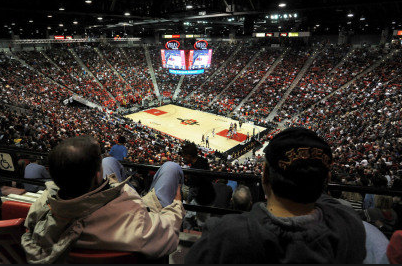
The basketball arena sat in a bowl about 100 feet in front of us and 20 feet below us after we were dropped off on 55th Street by my wife. Viejas Arena was lit up for the San Diego State basketball game and my dad was walking toward it, his eyes straight ahead. Does he see those two steps coming? He knows he has to descend to get to the arena gate so he must know there are steps. Right?

Dad never made it inside Viejas Arena

Dad never made it inside Viejas Arena

He didn’t. And as he was walking with his cane he tripped on the first step, he fell and landed right on his face. I’d seen it happen before. My dad, born in 1925 and who served in D-Day in World War II, can’t catch himself with his hands before his head hits the ground. I don’t know why. I guess when you’re 89 years old you just can’t. He broke his glasses and bled like a faucet. There’s something about cutting the skin on your face that makes you bleed like that.

The arena security detail soon took notice. Before long he was surrounded by cops and paramedics who were continually asking him if he knew where he was and what year it was. They were handing him paper towels to press against his forehead. Then a fire truck arrived. “They know we’re here!” said one member of the emergency crew assigned to the Aztec game. “I don’t know why they still come. ”

One guy asked my dad whether he took any medication. Are you kidding? He’s an old man. He takes tons of medication! No, we don’t have a list.

My wife hadn’t been gone for a minute after dropping us off when my father hit the cement. So I called her and told her to come back. She took him to the Scripps Mercy trauma ward and emergency room once we got him loaded him into the car.

This game was a birthday gift from me to my dad. Three tickets together were tough to get, given how well San Diego State was playing. After my dad headed off, mom and I decided to take in the rest of the game. There was nothing we could do and dad was continually saying he’d ruined it all. OK. We’ll stay for the rest of the game so the evening wasn’t all ruined.

But as the student section of the arena shouted, danced and held signs aloft and while the Aztecs took apart a much lesser foe, the whole time I was thinking: Why didn’t I just tell him he had to hold my arm while we were walking in? Why didn’t I jump in front of him when I saw those steps coming?! My parents have gone to these games before and come out beaming and saying how great it is to be around young people. The closer they come to the end of life the more they love the antics and blundering spirit of college kids.

When the game was done I drove to Scripps Mercy to spell my wife and make sure dad was getting what he needed. He was in a draped-off bay of the E.R. where he lay on a bed, his face a bloody mask and his left eye swelled shut. In the hallway, a man lay on a mobile bed and was wearing a net bag over his head. We later learned it’s to prevent the patient from biting or spitting on docs and nurses. In a neighboring bed a man with twisted, matted grey beard lay silently. He looked like one of the frequent fliers: homeless men who can end up in emergency rooms dozens of times a year.

Scripps Mercy can be a tough place on a Saturday night. Maybe that’s why the majority of nurses there are men. This is where I ended up when I was hit by a car, and my brain injury caused me to be confused and belligerent. I was mentally blanked at the time and I recall none of what was in the official report, and I didn’t realize the nurses who sometimes had to wrestle me back into bed were perfectly able to do it.

On the night my dad fell, a nurse came into the waiting room to tell me my dad was getting up and wanted to leave. I put away my book and went back to tell him he had to wait for his stitches, and the doctors really thought he should stay until morning so a surgeon could look at the eye-socket bone he cracked during the fall. He was rigged up with tubes and sensors. I imagined him trying to talk away and being pulled to the ground by all those attachments.

Big city E.R.’s are sad places where tragedy and need come in the door and can wait forever to be tended to… not that it’s going to do much good in a lot of cases. As for my dad, I guess he’ll keep falling until one day he doesn’t get up. The rest of us are no different. But then there are those kids in Viejas Arena, dancing to the time-out music and making asses of themselves to distract the visiting team as they shoot free throws. Death would be impossible without life. Foolish, sexy, unapologetic life.

4S Ranch is just Another Suburb

February 9, 2014

It was about 15 years ago. A huge housing development called 4S Ranch was in the planning stages in San Diego’s northern reaches, and its developers were lobbying for building permits. It was the typical political drama in which companies want to build and sell houses, and everyone who already had a house did whatever they could to stop them. The opponents gave us the familiar refrain about too much traffic and environmental impacts.

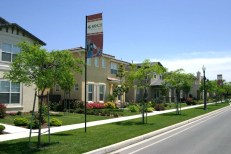
4S Ranch

The response of 4S Ranch was to say this was not another plain-old suburban housing tract. This was going to be like a small town. It’ll have a central business district. It’ll have schools. It’ll have sidewalks. I remember seeing the architects’ vision of the future, shown in attractive drawings.  Smiling neighbors would wave to each other across the street. Parks and sidewalks were populated with people. Residents would stroll to the business district to buy groceries. It was the “old-fashioned small town” meets “new urbanism” story.

But a couple of days ago I drove through 4S Ranch to see what it was really like. Basically 4S Ranch today is a suburb with sidewalks.

Don’t get me wrong. The fact they have actual sidewalks and berms makes the streetscape greener and more pleasant. But nothing about 4S Ranch gave me the impression that people were spending a lot of time rubbing shoulders on the streets or getting around in anything other than their personal car.

The “business district” had a few stores, but it looked a lot more like a mall than a small town center. Curving car lanes carried drivers from nearby streets into its parking lot, giving it the look of a place that did not invite pedestrians. Throughout the entire development, on this particular day, the sidewalks and front yards were empty.

Did the developers of 4S Ranch sell us a bill of goods? If they really did think the concept could work, it was wishful thinking.

Unlike downtown San Diego or, say, Mission Valley, this development was never conceived as a job center. So, for one thing, you’d have to drive elsewhere to get to work. And – by the way – are the people who buy into new suburbs the kind who really want to live in a village? Or are they just looking for a nice house and a good school district? These folks probably think little of driving 15 miles to go shopping.

I have spent a fair amount of time covering urban development and redevelopment as a reporter. And there is a lot of lip service given to smart growth and anti-sprawl development. They sound good, but I haven’t seen much to convince me that is the way people in Southern California want to live. Developers want to make money. They don’t want to change culture. So until gas prices or global warming take us there, places like 4S Ranch won’t be much more than a sales pitch.