Archive for November 2012

Sidewalks for Bikes

November 23, 2012

It was a weekday night. I went to a drab meeting room in a neighborhood library to attend a meeting of the College Area Community Council. They were talking about making it safe for cyclists to ride on Montezuma Road.

A city traffic engineer was there to present a study, and I had my own report to give: I was hit by a car and nearly killed five years ago as I was riding my bike to work on Montezuma.

Bikes are not cars or pedestrians. But up until now the conventional view has been to treat them like cars. Same road. Same rules. That’s been the catch phrase.

But bikes aren’t cars. They don’t perform like cars. They aren’t as fast, and above all they don’t have the steel skin that protects the operator.

The community council meeting began with the pledge of allegiance and acceptance of minutes of the past meeting. When they got to the presentation of the city engineer, he began by explaining his department’s bureaucratic locus so we’d best understand his function. I stared at my watch, thinking of the two kids I left home alone.

Finally, the engineer showed a map of Montezuma Road with car-bike crashes pinpointed (Check out the map above). I saw mine. I also saw the accident that claimed the life of Charles Gilbreth earlier this year. Since 1999, there have been 49 bikes hit by cars on Montezuma Road. Two of those crashes were fatal.

There were some people in the crowd I recognized including Jim Baross, a former head of the local bike coalition who once told me cyclists shouldn’t worry about being killed by a car because that would ruin a motorist’s day.

It was his clever way of saying bikers shouldn’t be timid about sharing the road with cars. Even then, I didn’t even think  it was funny.

I used to chastise cyclists who would ride their bikes on sidewalks. It was illegal, after all. But I don’t think like that anymore. I think people on bikes are like pedestrians who need the same kind of protection from cars. That’s at least true of four-lane roads like Montezuma, where traffic moves nearly as fast as it does on freeways.

When it was my time to speak to the community council I walked up to the podium at the front of the room. I said the painted bike lanes on Montezuma were a joke. Sharing the road with cars might be fine on a quiet residential street where the cars don’t go too fast, but not on major thoroughfares.

I left early to get back to my kids, and we’ll see what comes of it. I was in Germany in the summer where I saw their streets bordered by broad sidewalks that were split into two lanes… one for peds and one for bikes. That’s smart. I wish we would do that here.
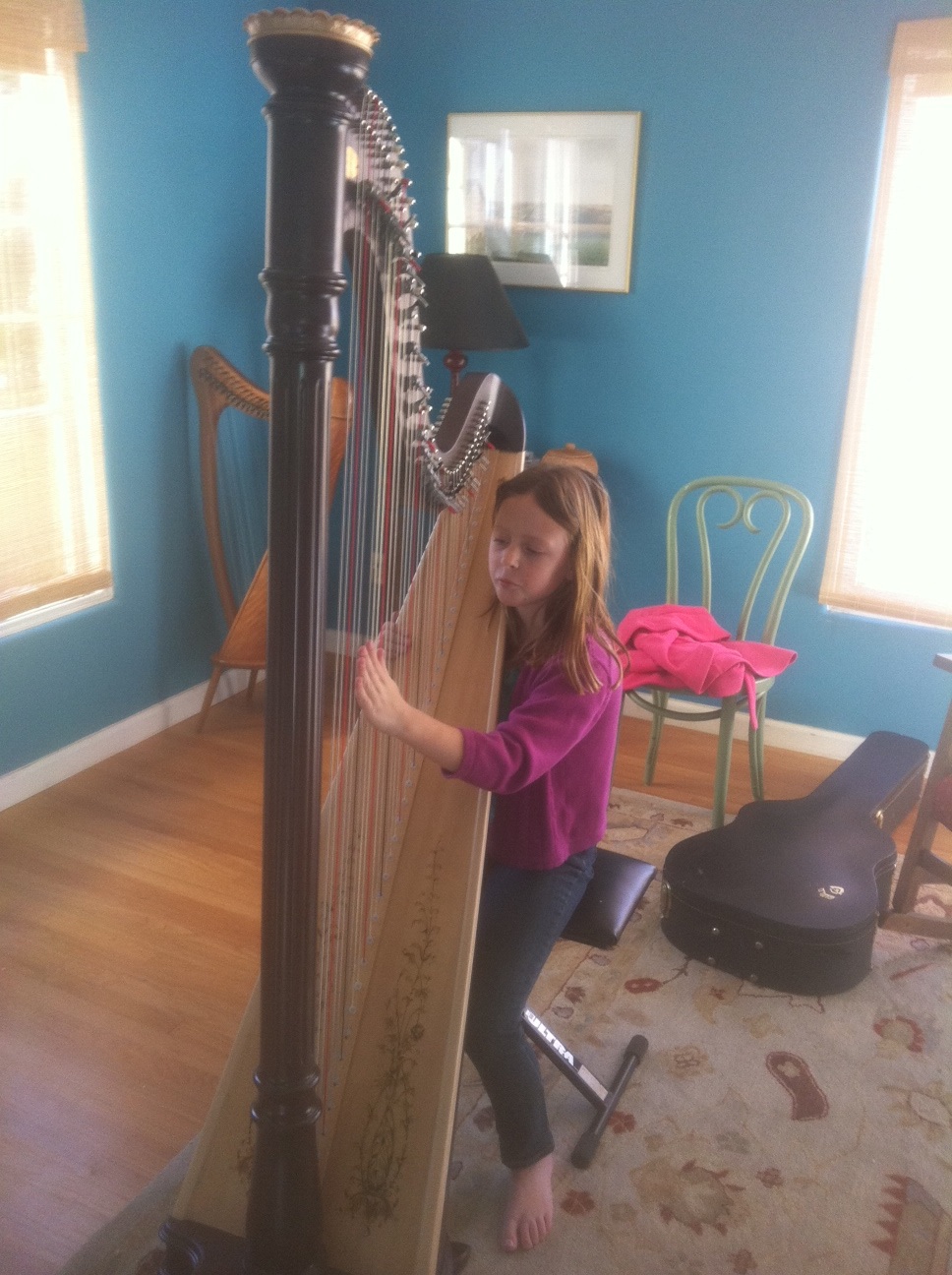
Harp in the Living Room

November 10, 2012

Most musical instruments are pretty compact. They don’t take up a lot of space and they travel easy.

It becomes more difficult when you play a drum set or a stand-up bass. A piano isn’t a big deal because transporting it to gigs isn’t even part of the discussion. You play whatever piano is there, and if they don’t have one you don’t play.

And then there’s the harp. I just got my daughter a new harp since she grew out of the old one. I got a call from a delivery guy who said he was on his way, and I asked him if he was bringing the harp.

“I have no idea what it is,” he said. “All I know is it weighs seventy pounds.”

Now it’s in our living room. It’s like a piece of furniture… kind of the way a piano is.  You need to put in a place where you can get at it, where it’s going to look good and where it’s not going to get in the way.

Lifting it is not too hard, but toting 70 pounds in the shape of a harp through doorways and trying to get it into a car is either a two-person job or something that requires a dolly. Add 10-20 pounds and you’ve got a full-sized concert harp, something my little girl isn’t quite ready for.

This one has a gilded crown and two stabilizing feet at the bottom in the shape of lion’s paws. Sophie wanted that. And her teacher told us it’s important for a young player to love her harp.

My family is a musical one and Sophie may or may not become a serious harp player. But she works at it and she enjoys performing because she likes to be special.  Meantime the harp will look good and give our house the air of refined artistry.

Moving a City of Cars

November 4, 2012

I remember traveling on the Interstate when I was a kid. It had two lanes in each direction as it rolled through the Iowa countryside. The roads were fast and they seemed huge.

Now I live in Southern California and I travel on freeways. They have at least four lanes in each direction but they seem small, and they are slow.

Freeways create cities whose parts are dense yet distant. That density is felt the most on the road in the late afternoon. That’s when I fight my way to my parents’ house to get my daughter and then fight my way to her harp lesson.

Freeways also create mobile cities of people isolated in their cars. Over a couple miles of compressed traffic I imagine seeing the entire population of the small town I grew up in, even though this community isn’t as populated as it looks since one car typically has only one person.

Sometimes I see two or three people inside another car, and they’re talking to each other. They’re laughing and smiling despite the challenge of holding their place in a line of undulating speed. Otherwise I see solo drivers staring straight ahead. They cling to the hope that space will magically appear and give them a clear path to their destination.

But in a city like this your destination is the traffic jam. It’s a part of life. Doesn’t have to be, but it is. Maybe those people laughing and smiling understand that.

People wear the steel and glass of a car like a suit. But it’s also your house when you’re part of the mobile city, which moves in unison until parts break off to reach another place that people imagine is better.

But don’t think about that. Because you’re on the freeway now and it’s your slow road to the paradise we share.