GERMANY
It had been 35 years since I came here as a high school kid with very little knowledge of life but a strong passion for getting out of the small town in Iowa where I lived. This month I went back to Hamburg, Germany to see the family I stayed with, and with whom I’ve kept in touch with ever since.
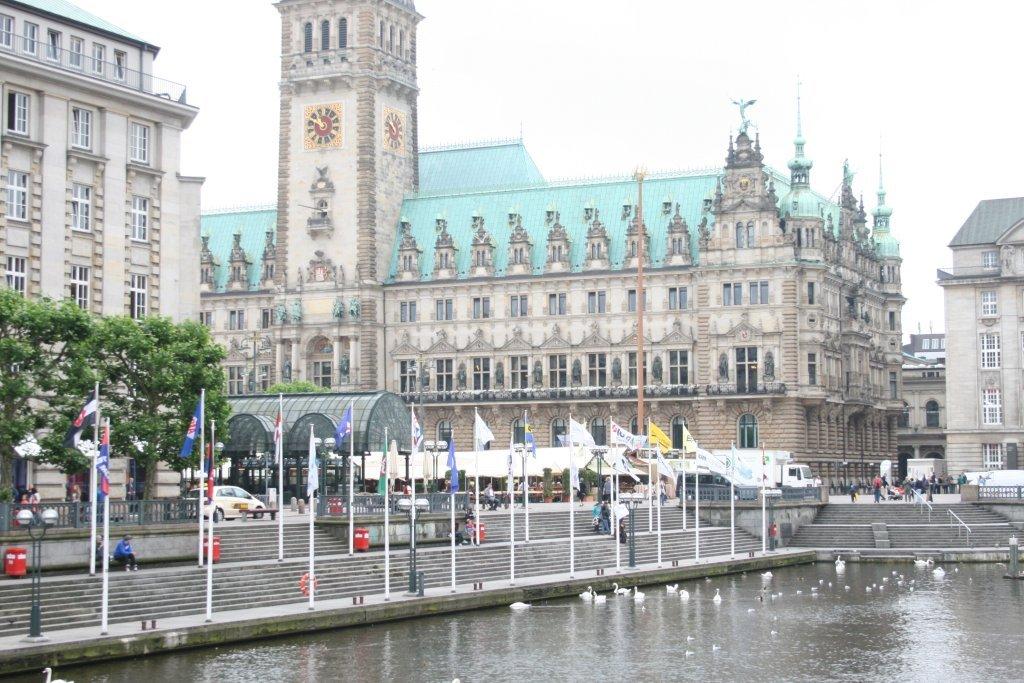
Hamburg Rathaus
Northern Germany in mid-summer stays light until 11 p.m. The landscape is flat and the people are not friendly. Kind? Generous? That’s true of lots of them. But most of the people of Hamburg don’t meet your eyes when you see them on the street and, even when they do, there is no nod of acknowledgement.
Even in the former village, now suburb, of Pinneberg, where I stayed, I got very few “Guten Tags” as I strolled along the streets.
My German family is mostly intact. Dietrich, the father, has passed away though mother Vera remains healthy at the age of 75. My American family of four stayed at the home of Sabine, the eldest daughter, who lives in Pinneberg with her good-natured husband, Knut. It’s Sabine’s third marriage. Sabine is strong-willed but pleasant and I’m not sure why she’s had bad luck in marriage. Maybe her other husbands were less good-natured.
Lutz, Vera’s son, is laid-back and handsome and speaks with an American accent, learned in Vienna, Virginia while an exchange student there. Carola, another daughter, lives in Bremen. Her, I didn’t see.
In fact I was told my visit was one of the few times any of Dietrich and Vera’s offspring actually got together. Despite living in close proximity, they are not close. I thought my distant and tenuous relationship with my brother was a familial negligence and I’m a little ashamed of it. But I guess it’s more common among siblings than I thought.
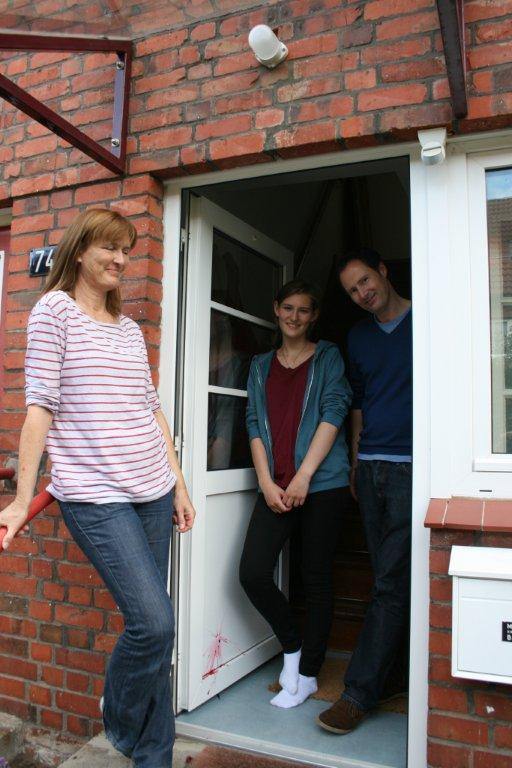
Katje, Ula and Lutz stand in the doorway of their row home, originally built in 1939 for workers who were faithful to the Nazi Party.
Hamburg is a city of graceful, sober architecture, nearly all of it rebuilt after being flattened in the bombing of WW II. The last time I came here was 16 years ago, and I was shocked by the amount of graffiti, something almost entirely unseen when I first saw the city. This summer, I was still struck by the lack of attention to cleaning it up. You’d expect that of the Germans, after all.
Graffiti aside, I expected to see more changes in Hamburg. Much has happened in Germany since I lived in a country, divided into east and west, back in 1978. Yet Hamburg was pretty much the same place. There was evidence of a slow slide into an Americanized way of life: More urban sprawl and more use of the car. On the other hand, the great racial diversity you see in American cities and places like London and Paris was absent.
Even my old neighborhood of Barmbek, which I was told had gotten poorer and therefore a likely magnet for immigrants, looked surprisingly white. And despite the closure of Barmbek’s old department store, Herti, which has turned into a dirty, beat-up shell at the end of the district’s main street, the local shops looked busy and solidly leased. The apartment building I lived in at Rübenkamp 12A was in fine shape and newly renovated.
I spoke with Knut about the nature of immigration to Germany, and why I didn’t see more of it. He argued Germany was not an immigrant nation. That sounded strange to my ears, being an American. I take his point that not every country sees itself as a likely, if sometimes reluctant, receptacle for refugees. But in a country where the birth rate is nearly as low as one child per women, I don’t understand how Germany cannot see immigration as the only future they are bound to have.
One harsh realization of my trip to Hamburg is that my German sucks. OK… it’s not that bad, and if I had to use it I’d do well enough. But the fluent use of English in northern Europe has seen a dramatic increase. The people there seem to effortlessly shift to English whenever they’re in a gathering with one or more non-German speakers. Even when you speak German pretty well, you’re not expected to use it and if you stumble just a bit, your conversation partner immediately shifts to English.
In France, I’m told, you’re expected to speak French, regardless of how well the natives know your language. I would have preferred a little more of that in Germany. I just want a little practice. That’s all!

Life on the streets of Lubeck.
The highlight of the trip came outside of Hamburg, when we took the train to Lűbeck, which is about 40 miles away. It’s an old Hanseatic city whose old town is beautifully preserved. Four-story facades of buildings with terraced outlines face narrow streets that are mostly closed off to car traffic. The main church is a soaring Gothic thing that has the tallest nave of any brick church in Europe.
In Lűbeck we noticed something we’d also seen in Hamburg: Lovelocks. Lovers scratch their names into a lock, fasten it to a bridge and throw the key in the river. They promise that if they break up they have to dive into the river to retrieve the key. Very romantic.
Before we left Hamburg we had a dinner party at Sabine’s house attended by her daughter Michal and her betrothed, Sebastian. Sebastian is a guy who’s a business consultant who is the very opposite of a North German stereotype; warm, talkative and funny. He told me he once worked in the U.S., where he told a guy he was from Hamburg. The guy asked if that was near Cheeseburg. For dinner we ate hamburgers made by Knut that included eggs and breadcrumbs (Knutburgers).
The next day we left the Hamburg airport for Dublin.
IRELAND
Taking kids on a European vacation in the summer has its downside. You pay a premium for airline tickets in order to drag an 8 and 12-year-old to a place they don’t care that much about. Castles? Old churches? Medieval history? Am I supposed to find this exciting? Frankly, I think my kids would rather go to a San Diego waterpark than go to Europe.
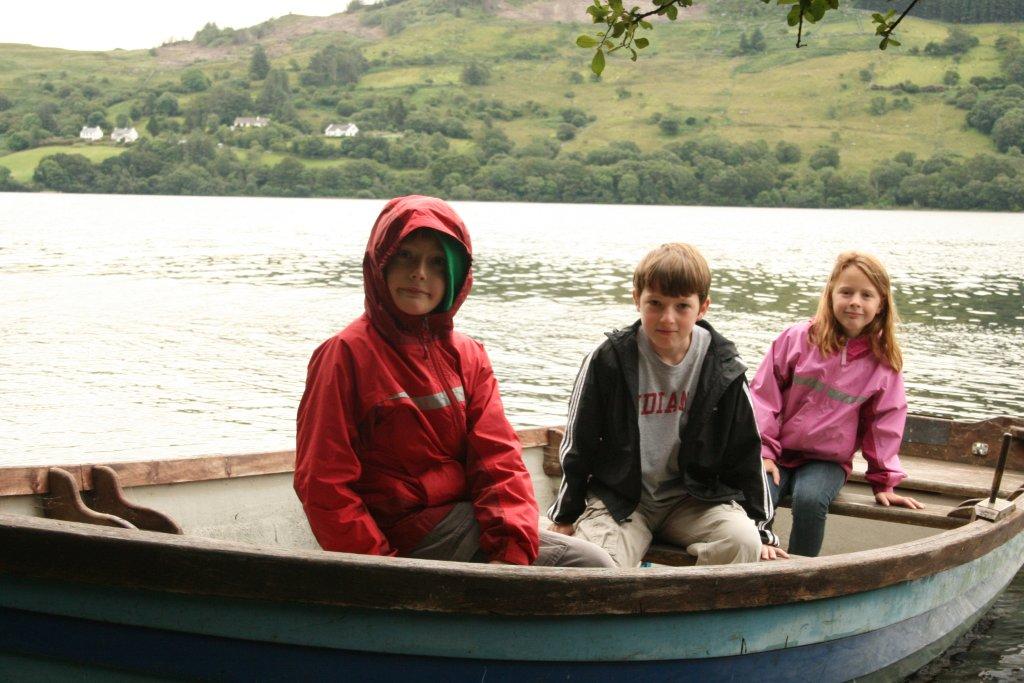
Lough Corrib on the east edge of Connemara, County Galway.
But here we were in Ireland. This, by the way, is not the “crossroads of Europe” kind of place where you would find a lot of historic sites. We saw that three years ago when we visited Norman France. But Ireland is sparsely populated. It’s poor. And whatever historic resources they had were not appreciated by the British overlords, and were not well-preserved.
Ireland lives in the American imagination as a place of great poverty and a great source of immigrants, who made it good in politics and labor organizing… not to mention pretty much everything else. Ten years ago, we talked about the Celtic Tiger and its economic transformation of Ireland, which recently had the highest per-capita income of any country in Europe.
But the tiger was a housecat. The interest rates, speculation and corporate subsidies that fueled Irish wealth were a house of cards that came crashing down. Now, Ireland is poor again. But still… you visit Ireland because it’s America’s cousin and you need to show some family respect. You also go for the scenery, the people and the music.
We stayed in County Galway, on the edge of Connemara. The mountains and lakes of Connemara are more beautiful than you can imagine. The mountains rise steeply in infinite shades of green, standing before you in arrogant splendor. This landscape is poetry, though poetry could never touch it. If the sky is thick with clouds you wait for the burst of sun rays that single out one mountain in a glowing display.
We stayed in a three-story house out in the middle of nowhere… meaning it was about five miles from a wide spot in the road called Cornemona, and about 20 miles from a little village called Cong, where John Ford filmed “The Quiet Man.” We were paid a visit from San Diego friends Mick and Kathy Ward, who were amazed we were able to find a place so isolated. The Wards are Irish, but moved to San Diego to open a bar called The Ould Sod. They were staying in Galway City, visiting friends they met in San Diego who are also Irish. Hope that all makes sense.
Galway is a center of Irish traditional music. Walk down Shop Street in Galway City and you’ll hear musicians playing for coins and sounding amazing. The Irish people love to talk. I know you know that already. But say two words to a typical Irishman and you’ve immediately got a half-hour conversation.

You also go to Ireland for the silence. Our rental house was a short walk from the shores of Lough Corrib. We had the use of a rowboat, and one night my son Nicholas and I rowed to a small island. For a while a chainsaw howled in the distance as I sat on a rock by the water, but then it stopped. There was no wind; only the gentlest sound of lapping water and the occasional “baah” of a sheep as we sat in the endless summer twilight. The sound was spectacular.
We soon left the country by flying out of Dublin, and had a chance to see a little of the city the evening. I’d been to Dublin once before and it was pretty much the same as I remembered… a gritty, crowded place without much charm. Ireland is not known for its cities.
I’ve since spoken with several people in San Diego, who inquired into our travels then said, “I’ve never been to Europe.” So why do WE keep going? It’s a long trip to a place whose claim on to American culture grows smaller with each year. But my wife likes the place. So we’ll probably see it again.

 CUL-DE-SAC