Archive for April 2012

First Communion

April 29, 2012

My second Catholic child is one week shy of a sacrament. The seven-year-old will wear her First Communion dress a week from today and receive the host for the first time. I suppose she’ll also drink the blood of Christ.

First Communion at St. Didacus. 2008.

I typically sit in the back of the church on Sundays when I attend. So by the time I get to the front, nearly all the church has taken communion and I can’t help thinking about all of the folks who have put their mouths on the communion cup. Seems unsanitary. I usually skip the wine.

I’m glad my daughter hasn’t asked me any serious questions about transubstantiation. When I became Catholic I was surprised to hear you’re supposed to actually believe the wafer becomes the body of Christ. I mean the actual body of Jesus Christ. Not just a symbol. Are they serious?

Being the father of a kid who’s going through First Communion has meant I’ve had to attend a couple of classes, in which Father Mike explains some of the meaning of the sacrament. A funny thing happened. At one point, he asked a question of me and the about 25 other parents sitting in one of the St. Didacus classrooms. I can’t remember what point he wanted to illustrate, but he said:

“How many parents here have big families?” No hands went up. “Anyone have five kids?” No hands. “Four kids?” No hands.

A couple of parents finally raised their hands when he asked if anyone had three children. But it was pretty clear the church teaching on birth control wasn’t getting through.

One other thing the Padre mentioned during his lecture was Psalm 139. When I got home I read it and I got the point, which was the completeness of God’s embrace of us. The writer of the Psalm speaks to God:

My frame was not hidden from you when I was being made in secret, intricately woven in the depths of the earth. Your eyes beheld my unformed substance. In your book were written all the days that were formed for me, when none of them as yet existed.

But the beautiful poetry of the Psalms always seems to end with a line like this one, also found in Psalm 139:

Do I not hate those that hate you, O Lord? And do I not loathe those who rise up against you? I hate them with a perfect hatred!

Typical Psalm. A beautiful adoration of God is ended by saying, “Oh… by the way, God. You know those people who live over there, who don’t believe in you? And who are real jerks? Please make sure they starve or fall off a cliff. Amen.”

Hopefully, the message next Saturday will be more positive. After First Communion comes May Crowning, that cheerfully idolatrous coronation of the Virgin. Hope you can make it.

Thinking about Steve Jobs

April 21, 2012

I always gotta have some book to read, and couple of weeks ago I picked up Walter Isaacson’s biography of Steve Jobs. I’d read Isaacson’s bio of Benjamin Franklin and knew he was a hardworking researcher and a deft storyteller. I’d also been enticed by the many articles, that followed Jobs’ death, in which the book was quoted.

I haven’t finished Steve Jobs, and I may not because I think the writer’s profile of him comes through early in the book. Jobs was a brilliant California kid who was raised in what was becoming Silicon Valley.  He turned into an extremely ambitious, successful, energetic and sometimes abusive man who could fairly be described as an arrogant jerk. He was a perfectionist, and he had an amazing knack for knowing what your average computer user needed and wanted to buy.

Some people go so far as to say he invented the personal computer, with a little help from Steve Wozniak. And don’t forget the iPhone!

Isaacson, himself, seems to think we have Jobs to thank for the connected lifestyles we now lead. In the intro he writes, “Jobs’ ferocious drive revolutionized six industries: personal computers, animated movies, music, phones, tablet computing and digital publishing.”

The Jobs biography seems to fall into a common pattern of heroic narratives. Great men (and they usually are…) are inspired geniuses whose drive and brilliance have brought us not just the personal computer (Jobs) but also the airplane (Wright Brothers), the theory of evolution (Darwin) and Beethoven’s 9th Symphony (Ludwig van).

Well, OK! I guess we never would have gotten Beethoven’s 9th without an actual Beethoven. But there would have been – and there were – other great classical composers. There also would have been personal computers without Jobs and there would have been airplanes without the Wright Brothers.

I used to wonder if Albert Einstein would have been a great physicist if he’d been born in a poor African village. Well… no. In fact, the question I once took seriously now seems absurd. Great achievers are products of their time and place. Without those two things, Einstein would have been just another really smart guy that nobody had heard of.

I began to seriously question the hero myth when I was helping my son do a school report about Charles Darwin. He checked out a kids’ history of Darwin, which I also read. Kids’ history books, by the way, are great. They are short, easy to read, and tell you pretty much all you need to know. I realized I didn’t have to read 500 pages about Charles Darwin.

The thing about Darwin’s story that fascinated me is that his theory of evolution existed far beyond the confines of his own mind. In Victorian England there were lots of naturalists exploring the same ideas. In fact, the thing that finally got Darwin off his butt to publish The Origin of Species was a letter he got from another naturalist, asking him to review a paper the man had written.

Darwin read the paper and realized hat this guy was coming to the same conclusions that he was. If Darwin didn’t publish his book soon, he’d be scooped.

We need to give credit where it’s due. Charles Darwin’s volume of research gave the theory of evolution a lot more heft than it would have had if a lesser man had popularized it. Steve Jobs pushed the personal computer industry further and faster because he was who he was. But he didn’t invent Silicon Valley, which was a big organic field of academics and engineers bunched all together. The fact that Jobs became the Steve Jobs came from the fact he was born and raised in that heady environment.

The next book I want to read is by another guy I’ve read before. Malcolm Gladwell has a book called Outliers, and it examines the societal and temporal factors that create great achievers; aka Outliers, aka people like Darwin and Jobs. I expect he’ll say that that individuals aren’t the great inventors, cultures are. Just read a kids’ history book, and you’ll know that.

One more thing about Steve Jobs

Anyone who is interested in nature v. nurture is fascinated by identical twins and by adopted children. Steve Jobs was adopted.

And one endearing thing about Jobs (there weren’t many) was his love for his adoptive parents. Paul and Clara Jobs were kind, working-class people whose intellects were clearly not on par with that of their adopted son.

Many people have theorized that Steve Jobs was angry for being abandoned by his natural parents, who were – by the way – a Wisconsin girl of German Catholic background and the son of wealthy, Muslim family from Syria. They met at the University of Wisconsin.

Steve Jobs tells Isaacson that Paul and Clara were “1,000 percent” his parents. As far as he was concerned, his natural parents were just sperm and egg donors. That may be unfair to say of the woman who bore him, and for whom giving him up was surely a great trial.

I’ve known many people who were adopted, and they have had very diverse views of what that means or whether they want to meet their birth parents. The thing they seem to share is a passion for what they believe on the subject.

Genetics are a big part of what makes us who we are. But while that may be true, families are not bound by truth. Families are bound by love, and where there is love, I don’t think genes matter very much.


Five-Year Anniversary

April 18, 2012

It was five years ago this past week – April 14th, to be exact – when I was hit by a car and ended up in the hospital. This was while I was riding my bike to work. A lot of people who know about this ask me whether I’ve fully recovered, and I’m tempted to just say, “Yes thanks, I’m fine.”

In fact, I still have trouble sleeping and I still have daily nerve pain; the result of traumatic brain injury. I take meds every day for both. Vicodin for the pain. Not long ago I was talking to a man, like the people mentioned above. I explained to him my recurring problems, and he asked me, “Did you sue?”

For the first time, I felt like I didn’t have a good answer to that question. My answer has always been, No, I didn’t. I’d then explain that a lawsuit would have been too much trouble and not worth the emotional pain and suffering. But now, I’m not so sure.

My modest settlement from two insurance companies seemed reasonable at the time. Unfortunately, at the time, I thought that I’d fully recover and all would eventually be behind me. I never imagined that the accident would continue to affect my health until today, and possibly for the rest of my life.

Had I known that, I would have told the insurance company of the woman who struck me that their settlement wasn’t enough. Would I have taken the step of going to court to force their hand? I’m not sure. The limited liability of the insurance company might have ultimately forced me to sue the driver individually. And who says she has any money.

You get into the hard question of what money can buy in a situation like this. I think the answer is “emotional compensation.” A larger sum wouldn’t have cured me or necessarily made me any happier. It wouldn’t have saved me from any pending bankruptcy, since none was pending. But it would have left me thinking I’d received a just reward.

In the meantime, I thank God because I know I was lucky. I’m lucky to have a loving family, a job and to still be alive. I wish the pain would go away. But thanks… I’m fine.

Addendum, April 21, 2012

It turns out I am very lucky. Later on the day that I posted the story above, Charles Raymond Gilbreth was riding his bike eastward in the bike lane of Montezuma Road, between Fairmount and Collwood. There, he was hit from behind by a car and killed. I was struck on the corner of Collwood and Montezuma, just 200 yards to the east.

A group called Bike Stand, based at San Diego State, painted a bike white, and locked it to a sign on Montezuma; Gilbreth’s ghost bike. Some people laid flowers near the roadside brush where his body ended up. Charles Gilbreth was 63. Rest in peace.

TV story about Gilbreth accident.

Fearsome Grand Canyon

April 15, 2012

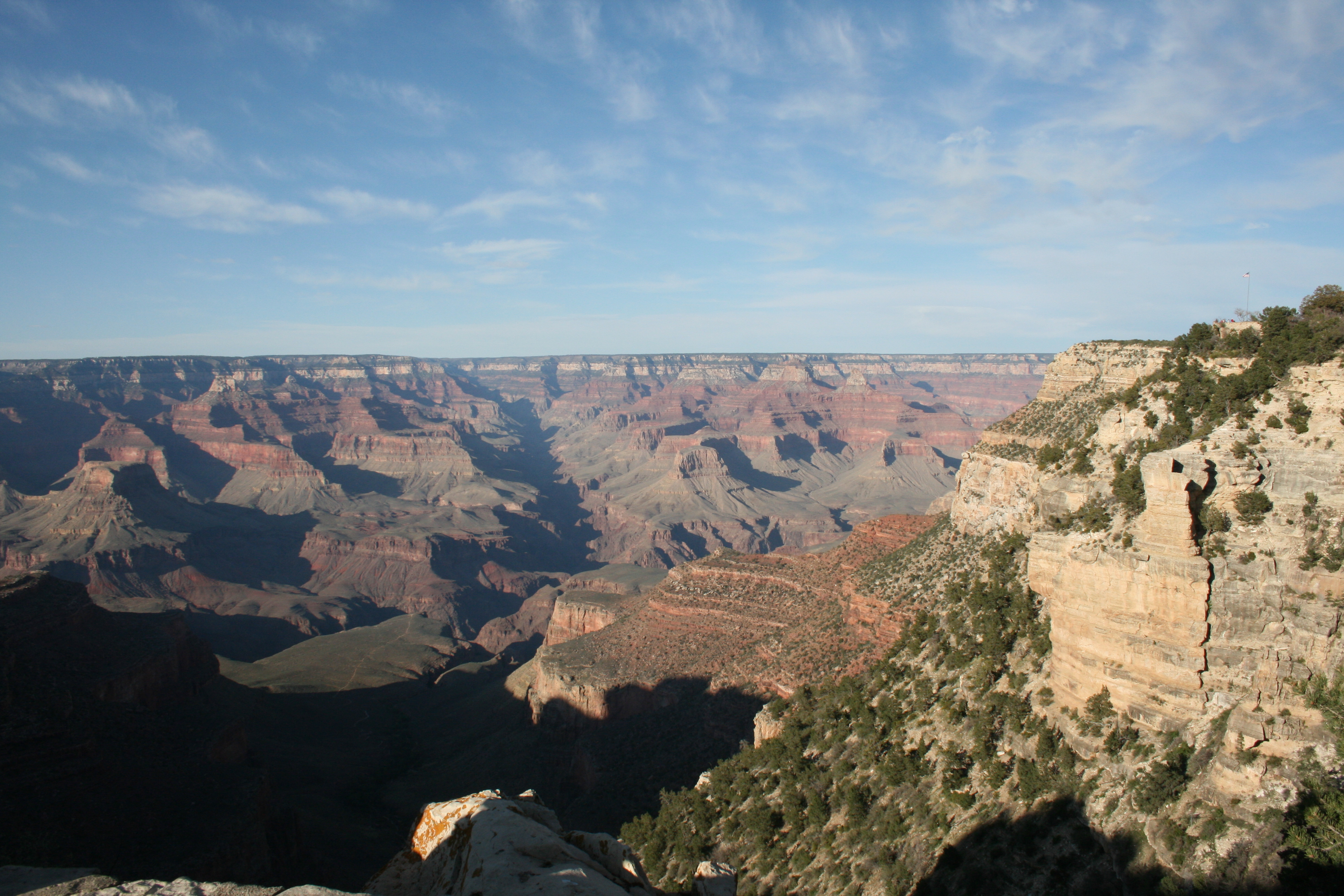
The shape of the land changes slowly as you drive from the Pacific Ocean into the American West. In coastal California you have to go east to be in the West. And I drove inland from San Diego past the snowy San Gabriel Mountains in the eastern reaches of the LA megalopolis to the Mojave Desert with its low, jagged peaks and scrub-covered mesas dotted with swirling dust devils. After that, I reached the high-country of the Colorado Plateau.

Piñon trees grew on a landscape of red soil until we entered a pine forest where coyotes, lions and elk lived at an elevation of about 7,000 feet. I’d been here before, so I knew that soon the ground would open up and become the Grand Canyon, with its shades of red and grey and its constantly changing shadows. Pictures and poetry are nice, but you have to be in the awesome presence of the thing to really understand it.

The Grand Canyon Village is on the south rim, and it’s a series of lodges and restaurants with a small power plant and a post office. There, you hear tourists speaking German, Japanese or with British accents and you see lots of people carrying heavy backpacks who are sunburned from hiking.

I’d never been here with my children before, and walking along the rim of the canyon makes you imagine them disappearing into it. I saw a man with two kids who yelled at them as they walked down the heavily used Bright Angel Path, “If you fall off this path you will die! I mean it… you WILL DIE!!”

A minute later his kids started running down the trail and the guy lost it. This was followed by an ugly scene of him dragging his son back up the trail as the boy screamed. I thought this dad was a jerk, but maybe heights and cliffs do that to you.

I thought about those Roadrunner cartoons when the Wiley Coyote would fail to catch his prey and accidentally fall over a cliff. We’d then see him get smaller and smaller as he approached the ground accompanied by a descending glissando that ended with the thud of his body finally hitting the desert floor.

When you approach the rim of the Grand Canyon and peer into the abyss your imagination overpowers you. You feel yourself falling in, and the reality that you’re not really in much danger doesn’t seem to matter. I’d rather walk into the canyon than linger at the top.

During my last trip to the Grand Canyon I heard some folklore that said the majority of people who fell to their deaths at the canyon did it while they were pissing off the edge of the rim. I doubt that’s true, but the story’s message is clear: The person who falls off the edge is typically an idiot. It’s the guy who walks up to a terrifying precipice, unzips his pants and shouts to his friends, “Hey guys… watch me piss off the edge!” It’s satisfying to think that people who died at the Grand Canyon somehow deserved it.

And then there’s the story of the incautious hiker. A sign near one of the paths tells of the woman who was a marathon runner, who decided to go all the way to the bottom of the canyon, carrying just two bottles of water and an energy bar. She died of dehydration.

The film version of the actor Spalding Gray’s one-man show has Spalding telling the story of a crusty British mariner who once said to him, “Spalding! Never play with the ocean! If you play IN the ocean, she can be a lady. But if you play WITH the ocean, she is a bitch!!”

People do play with the rugged, unforgiving landscape of the American West. They try to jog down the Grand Canyon in summer and they try to climb Half Dome at Yosemite without knowing what they’re doing, thinking somebody is bound to rescue me if I get stuck. They do perform rescues at the Grand Canyon. But if they rescue you, you get a bill for services rendered.

One of these days I will hike the bottom (with plenty of water I hope) but this time I stayed near the rim and the lodge, where my son and daughter liked the gift shop better than the view. My wife liked the rooms connected to the Bright Angel Lodge because they were historic and… well, just nice. Double-hung windows with sash cords, right on the south rim, and only $82 a night for a double bed, a sink and a toilet. The National Park Service concession held by Xanterra must force them to charge less than market rates.

See you at the Grand Canyon one of these days.

Home to Work in 18 Minutes Afoot

April 6, 2012

I live one mile from where I work. I know this because I clocked it once with my car’s odometer. I would love to walk to work every day, but I am a reporter who frequently has to cover stories all around town.

And – let’s face it – modern society expects mobility. When your bosses want you to meet clients or (in my case) news sources face to face, it’s hard to tell them you can’t do it because you walked to work and they’re too far away.

Walking up 54th Street is like climbing a very tall ladder.

And yet I do walk when I can. My path is an amalgam of terrains and rights-of-way that will sound familiar to anyone who has walked any distance in San Diego.

I begin in a neighborhood called El Cerrito and end up at KPBS Radio/TV on the campus of San Diego State. Once I turn right, off of the street where I live, I head north on 54th Street and enter a deep canyon. The street I descend as I’m bound for work is so steep that going up it, on my way home, feels like climbing a ladder.

But let’s get back on the way to work.

Once I emerge on the other side of the canyon, I have to take a right on Montezuma Road. It’s a typical San Diego four-lane throughway where cars travel up to 60 mph. During rush hour it’s stuffed with traffic and crossing it is scary. It’s one of those wide roads where you feel yourself in the gun sights of cars that may or may not actually see you.

Yet something happens on my walk to work after I cross 55th Street, headed east, and enter the part of Montezuma Road that nears SDSU. New apartment buildings rise on both sides of the street. Their front yards are landscaped with palm trees and birds of paradise.

A grass berm separates the road from me. The center of the road has a landscaped median. Suddenly, I notice the blue sky and the pretty college girls headed to their classes.

Soon, I’m at work at KPBS, feeling energized and psychologically prepared for the day.

My walk isn’t easy and it’s not uniformly pleasant. Aside from crossing Balboa Park on your way downtown, it’s hard for me to imagine a walk in San Diego that would be entirely agreeable. But my walk to work shows how small things can make a big difference when it comes to encouraging people to walk, and making them feel safe on the streets.

There was a time when I was hosting KPBS Morning Edition and had to be at work at 5 a.m. I once tried to walk to work at that hour, but it meant I had to get going very early when the streets were empty and pitch dark. Walking at that hour was creepy and I didn’t do it again.

It’s nice to imagine a world where we can get around on foot. We’d be in a lot better shape, for one thing. Talk to anyone who has lived in London or New York and they’re likely to tell you how fit they were, getting around using their feet and public transportation.

Today (April 6, 2012) is Walk to Work Day. They have a day for everything and this is that day. So do it, if you can.

NOTE: This blog post was also published by Walk San Diego and KPBS.

When Reporters Become Promoters

April 4, 2012

I was in the KPBS newsroom working on a story about the routing of rapid bus lines in San Diego. Some business folks were upset about what they saw as a pile-up of bus traffic on Broadway downtown. I called the planning agency SANDAG for comment, and my call was transferred to Bob Hawkins.

Bob Hawkins? Last I’d heard, he was working on the transportation beat for the San Diego Union Tribune. Now he was working a temporary job in PR for SANDAG, after leaving the UT in a series of layoffs and cutbacks. I was asking him for information about rapid bus lines. HE should have been writing that story, not me.

If you work in journalism for any length of time you know dozens of people who have moved from being reporters to working in public relations or marketing. Reporters joke about people going over to the dark side, but we understand why they do it. They get tired of the stress of meeting daily deadlines. Maybe they got tired of being passed over for promotions, and they opt for a job that’s more relaxing and, typically, better paid.

We reporters actually like working with former reporters who’ve moved to PR because they know how we think, and they don’t waste our time trying to sell us some story we both know is bullshit.

But the economics of modern journalism has made the exodus of reporters to PR jobs so much more dramatic lately that it should discomfort anyone who values accurate and truthful reporting. The cause of the exodus is the collapse of the economic model that fostered the daily newspaper.

Classified ads have fled the newspapers for Craigslist. Job listings have gone to Monster.com. Naturally, the Internet has provided a fine forum for distributing print journalism and, in theory, newspapers should welcome the chance to put out the paper without having to pay for presses and newsprint. But in fact, nobody quite knows how to make money over the Internet because it’s something users see as a source of information that’s free.

Last year the investigative news source ProPublica reported: “In 1980 there were about .45 PR workers per 100,000 population compared with .36 journalists.” Okay, even back then we were outnumbered. But the story goes on: “In 2008, there were .90 PR people per 100,000 compared to .25 journalists. That’s a ratio of more than three-to-one, better equipped, better financed.”

Some organizations employ virtual newsrooms of public relations people. Those who work there have subject specialties just like reporters have beats, all the time writing stories that advertise and benefit their sponsor.

This new reality affects what we know and think to be true when information gathering and distribution is so heavily weighted in favor of the promotion of governments and businesses,  rather than the investigation of them and independent reporting on them

Despite all this, I have to believe people still value a telling of facts that is devoted to being fair, true and (dare I say) objective. That’s the currency of journalism and I think people will always pay for it, and therefore continue to pay our salaries.

Hope lies in the feral expanse of the Internet. But the old institutions are done, and we don’t know where professional journalism will end up. I’m just pretty sure it won’t go away.