Archive for January 2010

My Old Hometown and the Big War

January 26, 2010

James Fudge in Southampton, UK

General George Patton once told the men serving in his 3rd Army why they should be glad they were about to fight the Germans. Patton told them that in the future, when their grandchildren sat on their knees and asked them what they did during the great World War II, they would not have to say, “I shoveled shit in Louisiana.”

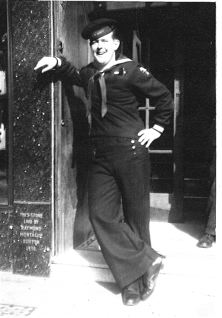
Some of Patton’s soldiers died in battle and didn’t have a chance to tell any children or grandchildren anything. But I’m sure most of those who survived came to believe they really were the happy few Shakespeare described in Henry V. I know this because my father, age 85, is among the remaining men who served in WWII.

His story is one that’s told in a book edited by George Drake, the former president of Grinnell College. It’s called Our War and it’s a collection of essays by and interviews with WWII veterans from my hometown of Grinnell, Iowa.

My father was a Navy signalman who served in the invasion of Normandy. Another man, Ken Christiansen, was a forward observer for a mortar platoon in Germany and France. Cleo Strawser was a gunner on an aircraft that took pre-invasion photos of islands in the Pacific. Another, John Pfitsch, actually did serve in Patton’s 3rd army.

They tell stories of a war machine that was huge, complex and highly technical. The enemy was often unseen because they attacked with mortars and artillery shells, not with guns or knives. My father describes a rare experience of seeing German POWs behind barbed wire on Omaha Beach and hearing one of them sing Santa Lucia in a tenor voice as the other prisoners hummed an accompaniment.

If you served in the war your best asset wasn’t courage, reason or faith. It was luck. Christiansen tells of a day when he and some other enemy spotters were spotted, themselves, by a German artillery team as they dashed across a beet field. Christiansen prepared to die as the Germans finally drew a bead on his location but he was saved by a ditch that suddenly appeared before of him. He and his partners dove into the ditch and covered their heads as the shrapnel whizzed above them.

The noise of the big guns was literally deafening. My father, who was a musician, is convinced he’s always had a hard time hearing certain pitches due to the hammering the big guns gave to his ears. Madison Tomfeld, who served with the Marines in the battle for Okinawa, said the worst thing about combat was “the noise.”

I grew up hearing my father’s stories of serving in the war. I heard about the fights that broke out during shore leave, the endless game of craps on his ship and about seeing dead bodies floating near the shore during the Normandy invasion. Meanwhile, I came of age with no military experience and no inclination to serve in a country where the men who came back from Vietnam were seen as either monsters, victims or misguided souls.

My father was a college professor who worked in a place where being anti-war was an article of faith. But I remember talking to him the year Jimmy Carter required all young men of a certain age (my age) to register for the draft after the Soviet invasion of Afghanistan. I was complaining to him bitterly about it when he shocked me by saying, “Well, I guess you’re not a team player!” It seemed like such an unlikely thing for him to say. Yet when I think about the team he played on in the European theater it makes perfect sense.

Serving in World War II was the adventure of my dad’s life, and there’s nothing I’ve done that can compare. It seems stupid to be sentimental about war and the misery it brings. But as our country’s World War II experience dies off with the people who had it we will lose something important.

I’ll end with a quote from Christiansen, one of Grinnell’s WWII vets, who gave three reasons why he fought in the war. “First, you fight for the guys on your right and your left, whose lives depend on you and vice versa. The second thing you fight for is you don’t want the people around you to think you’re yellow. And the third thing you fight for is you wanted to get it over so you could go home!”

Thinking of Malcolm X after Martin Luther King Day

January 20, 2010

Racism is the original sin of the United States and the effort to banish it is a history that’s populated by heroic figures. Martin Luther King and Abraham Lincoln may be at the top of the list. But another martyr to the cause was Malcolm X.

The powerful story of his life, with its many changes and revelations is told in his autobiography. The book ends with epilogues by journalist Alex Haley and the actor Ossie Davis. Davis’s memorial reflections are very powerful and I’ve never forgotten them. So I’ll observe MLK Day, a couple of days late, by sharing the following two excerpts of what Davis wrote about Malcolm X almost 45 years ago.

Protocol and common sense require that Negroes stand back and let the white man speak up for us, defend us, and lead us from behind the scene in our fight. This is the essence of Negro politics. But Malcolm said to hell with that! Get up off your knees and fight your own battles. That’s the way to win back your self-respect. That’s the way to make the white man respect you.

You can imagine what a howling, shocking nuisance this man was to both Negroes and whites. Once Malcolm fastened on you, you could not escape. He was one of the most fascinating and charming men I have every met, and never hesitated to take his attractiveness and beat you to death with it. Yet his irritation, though painful to us, was most salutary. He would make you angry as hell but he would also make you proud. It was impossible to remain defensive and apologetic about being a Negro in his presence. He wouldn’t let you. And you always left his presence with the sneaky suspicion that maybe, after all, you were a man!

Malcolm X was shot to death in New York City, February 21, 1965.

Collective guilt in California

January 16, 2010

They say democracy is a terrible system of government until you consider the alternative. But there’s got to be something that works better than democracy in California.

A new year brings another in a seemingly endless succession of financial crises. This year, the state has to find a way to fill a $20 billion deficit. Anywhere else you would consider raising taxes to pay for it. But you can’t raise taxes in California without a two-thirds vote of the Legislature. That’s made political stasis status quo on anything that involves money.

Here’s how it goes. The Republicans are resigned to being the minority party in Sacramento. But that’s okay with them as long as they control at least a third of the Legislature and can stop any tax increase. The Democrats don’t have enough votes to raise revenue but, deep in their hearts, they’re probably okay with that too. If they could raise taxes with just a simple majority they would actually have to do it and piss people off and end up not being the majority party anymore.

And then there are the rest of us good citizens who dislike and distrust politicians so much we don’t want to let them do anything. This is why California voters continue to segregate funding, by proposition, for this or that project so there’s less money in the general fund for politicians to get their grubby hands on. Our distrust of elected officials means any effort to raise local taxes in California requires a local vote of the people.

I hope I don’t give the impression that politicians are good people who should be allowed to do whatever they want. Politicians have been known to be corrupt and incompetent. But I thought democracy was supposed to work well in spite of that. Good systems of government should transcend the imperfections of their leaders.  

Our system is messed up but it’s not the fault of politicians. It’s our fault. Let’s talk about collective guilt.

It’s a concept that’s been applied to the people of Nazi Germany. The German people, we think, bore responsibility for the evils of the Hitler regime even though the government was a dictatorship and very few Germans were directly involved with the killing of Jews. You have to prove personal responsibility to convict people for specific crimes. But the entire German nation bore collective responsibility because their coöperation was essential in order to operate the diabolical Nazi machine. Collective guilt is a weight that Germany carries even today, when the country is populated by people who had nothing to do with Nazism.   

So if the German people could be held responsible for Nazism, can Californians be blamed for our dysfunctional government? Of course we can! We not only live in a democracy we live in a direct democracy.

Since the whole thing is our fault, let me propose a possible solution. If voters are going to continue to make policy decisions, through direct democracy, let’s give them a choice and make them accountable. Don’t just propose a tax boost and put it on the ballot for a popular vote, up or down. Let voters choose either a tax increase or a package of budget cuts. They’d have to choose one or the other, and the proposal with the most votes would win and become policy. It would be just like choosing between two candidates.

The beauty of this is people will know what services they’re getting rid of, as they keep their taxes low, and they’ll be responsible for it. The system will need close regulation so the proposals are presented simply yet truthfully.

If you think this system will be even more disastrous than what we already have, you may be right. But it will force us to acknowledge that this state really does belong to us, and with freedom comes responsibility. Collective responsibility.

Gay marriage

January 11, 2010

The latest chapter in the fight over gay marriage begins this week with the effort to get California Proposition 8 shot down in federal court. The proposition to restrict marriage to heterosexual unions in California passed in 2008 and it’s already survived a challenge in state court. The federal challenge, I assume, could go all the way to the U.S. Supreme Court and have repercussions for the many laws, banning same-sex marriages, that have been passed in states all around the country.

For the record, I agree with Barack Obama and the runner-up in the Miss USA pageant that marriage has been and should remain a union between a woman and a man.

My view on this subject has always made me a little uncomfortable because most of the people I associate with seem to disagree with me. We’ve become a nation in which people of different political persuasions have very little to do with each other. (Read Bill Bishop’s book “The Big Sort” to learn more about this) We work in different jobs. We live in different neighborhoods and run in different social circles. My tribe is liberal/academic. So my opinion on gay marriage has made me feel like an enemy sympathizer in the American culture war.

It may be cliché but it’s no exaggeration to say marriage is one of the pillars of our civilization. Yes, it has changed over the years but it has always been a joining of female to male and I have yet to hear a good enough reason to change that. There is a fundamental difference between same-sex couples and heterosexual couples (the ability to have children together, in case anyone was wondering) and I believe the law can take that into account.  

The debate over gay marriage has raised an issue of human rights and I’m glad it has. It has made me realize that everyone, gay or straight, must be able to choose a life partner… someone who supports you, loves you, and speaks for you in serious or dire situations. I think reasonable people agree that all committed partnerships should enjoy government support and recognition. But we disagree on whether partnerships among same-sex couples should be called a marriage or a civil union.

Courts have disagreed on this matter as well. I can’t know how the U.S. Supreme Court will rule on the question, though I could hazard a guess. What’s very clear is that the majority of American voters, from California to Maine, aren’t ready for gay marriage.

Will they ever be? It’s possible and it may even be likely. Polls show that young people are much more open to the idea. But to say gay marriage in America is inevitable is a bold statement to make in the face of more than 30 state votes on the question, every one of which concluded that marriage should remain a heterosexual union. Personally, I don’t think we can accept gay marriage until we conclude that having children is incidental, not fundamental, to marriage.

Some folks seem to think that all people who oppose gay marriage are homophobic. That’s like saying that anyone who criticizes the state of Israel is anti-Semitic. There are good people on both sides of this debate, and I hope we can keep the discussion civilized until all the people have voted and all the courts have ruled. I’m looking forward to some resolution of this issue, but we’ve got a ways to go.

Remembering the days when kids ran wild

January 11, 2010

As the calendar turned from ‘09 to ‘10, I spent New Year’s Eve as I usually do these days. I attended a party of families with small children. Typically, we celebrate the coming of the New Year on east-coast time. The kids blow their horns and we drink our champagne at 9 p.m., which allows us to get the kids home and in bed by ten o’clock.

That evening I had a conversation I’ve had several times before, with parents my age, in which we wonder why our parents worried about us so much less than we do about our kids. We all say the same thing. When we were young, but old enough to cross the street by ourselves, our parents would send us out the front door and say, “Go play.” We’d wander the neighborhood. We’d ride our bikes to friends’ houses that were a dozen blocks away. We’d play in fields and canyons and hang out at the park.

Today, by contrast, parents are afraid to let their kids out of their sight. Children don’t walk or ride their bikes to school. Even kids who catch the school bus are accompanied to the bus stop by a mom or dad. I had a part-time job as a school bus driver in Minneapolis twenty-five years ago. Even then, elementary school children found their own way to the bus stop.

What turned us into a nation of hovering parents? It’s tempting to look for simplistic explanations but reality is rarely simple. One contributing factor must be the sensational coverage of child abduction and child sex-abuse cases in the media.

In San Diego the trial of David Westerfield, convicted of kidnapping and murdering a seven-year-old neighbor, truly made me fear for the safety of my son. This is despite the fact that abduction of kids by strangers is so rare it’s outrageous to let it govern our parenting styles. Parents today act as if they know there’s a child molester, living on their block, who sits at his front window just waiting for the first unprotected kid to wander by so he can lure him/her into his lair.

Another factor is the modern tendency to program a kid’s day. Middle class and high-income parents seem to believe their kids just won’t turn out right unless they spend most of their time doing “constructive” activities – activities that are planned and supervised. This means lots of driving kids around town to soccer practice and music lessons. It also means a lot less time that kids spend wandering around, playing their own games and discovering their own adventures.

Was there a third factor? I’m sure there’s that and more. We have smaller families today. It was impossible to keep close track of every kid back when people had seven or eight. The point is that family life in urban/suburban America has changed dramatically, and it’s up to all of us to decide if it’s for the better or the worse.

Fearing for our kids is natural. But when does it become an obsession that robs children of the skills they need to learn independence and become adults? I wish all parents, including myself, the wisdom to figure that out.

If it takes a village, where’s the village?

January 5, 2010

I read a story on voiceofsandiego.com written by Scott Lewis about the future of San Diego, which Lewis has come to call The Dissolving City. Read the story yourself. But I’ll tell you that Lewis sees San Diego as a city that has become either unable or unwilling to pay the price to maintain services and infrastructure. He says philanthropic groups and small taxing authorities – business improvement districts and the like – are stepping in, more and more, to pick up the slack and give people what they need.

This may not be a bad thing. Some people think it’s inevitable and it may even represent progress as outdated city bureaucracies come crashing down. For me, the fundamental question is this: What is our community and who has the job of maintaining it.   

Hillary Clinton once wrote a book called It Takes a Village, which takes its title from the proverb, “It takes a village to raise a child.” This is the kind of expression that’s embraced by liberals who believe in big government and great societies. Conservatives are more likely to say it takes a family to raise a child and the rest of the village should mind its own damn business.

But let’s assume, for the sake of argument, that it does take a village. What’s the village? How big is the village, and how many children is it trying to raise? And as it’s raising children, how does it also provide things like roads, sewers and libraries for all the other villagers.

The thing that scares me about the devolution of service provision to non-profits, home owners associations and hyper-local taxing districts is the loss of civic identity and increasing inequality. When infrastructure and services are provided this way they become scattered and hard to find. That means a lot of people fall through the cracks.

Yes, La Jolla’s library isn’t suffering bad budget cuts because donors are making up the difference. (Something Lewis points out). But can libraries in the poor neighborhoods of southeast San Diego manage the same thing? Whether they can or not, they don’t. American society has become Balkanized as people have segregated themselves into neighborhoods based on economic class and political persuasion. I wonder what’s left to tie us together as “the city” dissolves. I wonder what happens to poor neighborhoods when they are left on their own to install streetlights and fill potholes.

It’s ironic that Prop 13 actually took control of property taxes away from local jurisdictions and turned it over to the state. It doesn’t seem like the kind of thing most political conservatives would favor. Clearly, I think local control is a good thing. But the more local you are the more people get left out.

If it takes a village to raise a child, I’d prefer that village not be the entire state of California whose bureaucracy is massive and headquartered hundreds of miles away. But if we lose our cities, there’s not much left we can even call a society.